
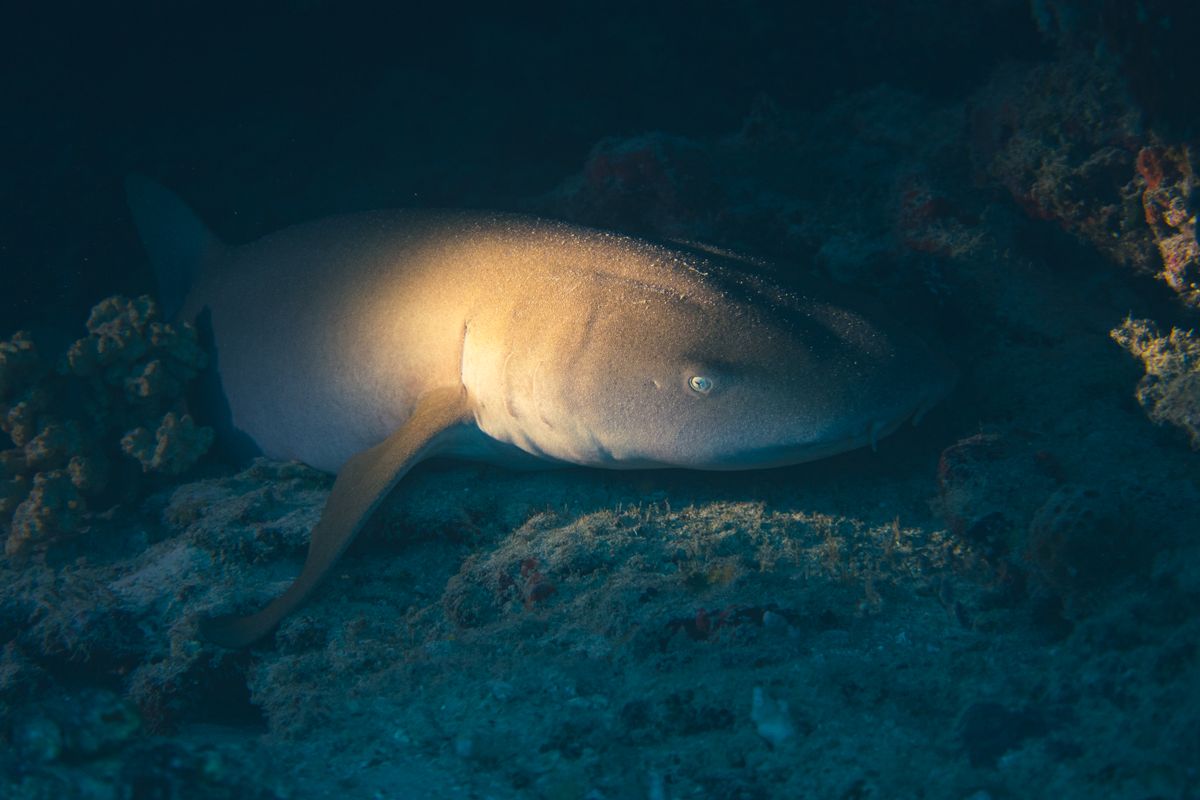
Picture a shark that, instead of gliding gracefully through the water, shuffles across the seafloor by wiggling its fins like tiny legs, sneaking between reef rocks after dark. This isn’t a cartoon gag — it’s exactly what Hemiscyllium dudgeonae does, a newly described species that scientists have nicknamed Dudgeon’s walking shark.
The discovery happened in shallow waters off southeastern Papua New Guinea, when PhD student Jess Blakeway, from the University of the Sunshine Coast in Australia, caught a specimen during a night dive. At first she assumed it was a known species from the same genus, but something felt off: the pattern of markings on its skin didn’t quite match. Back in the lab, genetic analysis confirmed her hunch — this wasn’t a familiar relative, it was a species new to science. Researchers went on to locate eleven more individuals in the same area, giving them enough specimens to formally describe it. The name honors Dr Christine Dudgeon, the project’s supervisor and one of the world’s leading experts on this shark genus, which she has studied for more than two decades.
Dudgeon’s Walking Shark Isn’t Alone in the Family
It might sound like an evolutionary oddity, but strolling across the seafloor is practically a family trait. The genus Hemiscyllium — which also includes the better-known epaulette shark — already counts at least nine species capable of this kind of locomotion, all confined to reefs around the Malay Archipelago and New Guinea. They use their pectoral and pelvic fins as front and back legs, in a gait that looks more like a salamander’s than anything you’d expect from a fish. It’s not the only recent discovery expanding the region’s tree of life, either: just months earlier, scientists described a new horned spider species, proof that plenty of surprises are still waiting to be catalogued.
So why bother walking when you’ve got fins built for swimming? The answer lies in the tide. As the water retreats, these reef flats break up into isolated pools where oxygen runs low and carbon dioxide builds up fast. Walking lets the sharks move between those pools, squeeze into narrow crevices to dodge predators, and, if needed, even drag themselves briefly out of the water altogether. It’s quite literally their survival strategy in a neighborhood that runs out of oxygen several times a day.
Holding its breath like nothing else alive
The most startling part of this shark family isn’t that it walks — it’s what its body can endure while doing so. Studies on the epaulette shark (Hemiscyllium ocellatum), a close relative of the newly described species, show it can survive up to two hours with zero oxygen and show no apparent damage, at higher temperatures than any other animal known to tolerate such extreme hypoxia. For comparison, the human brain starts suffering irreversible damage within minutes of oxygen loss. Exactly how this shark manages to “pause” its metabolism without consequences remains, by the researchers’ own admission, largely unsolved.
Despite its extreme-survivor résumé, Dudgeon’s walking shark is no sea monster: it measures a modest 60–70 centimeters, poses zero threat to humans, and spends its time sifting through sand for small crustaceans, worms and molluscs with all the unhurried curiosity of a cat sniffing out a new corner of the house. If you ever happen to be night-diving on a reef in the western Pacific and spot something “walking” under your flashlight beam, it’s probably not the stuff of nightmares — just one of these laid-back little commuters going about its business.
The catch is that its known range is tiny: a specific stretch of coast in Papua New Guinea exposed to local fishing and reef degradation. Scientists haven’t yet been able to assign it an official conservation status, but they warn that such a limited habitat makes it vulnerable almost by definition — it would take surprisingly little damage to that one patch of reef to put the entire species at risk before we’ve even finished getting to know it.
You can read more about the original discovery from the University of the Sunshine Coast, the institution that led the research.