
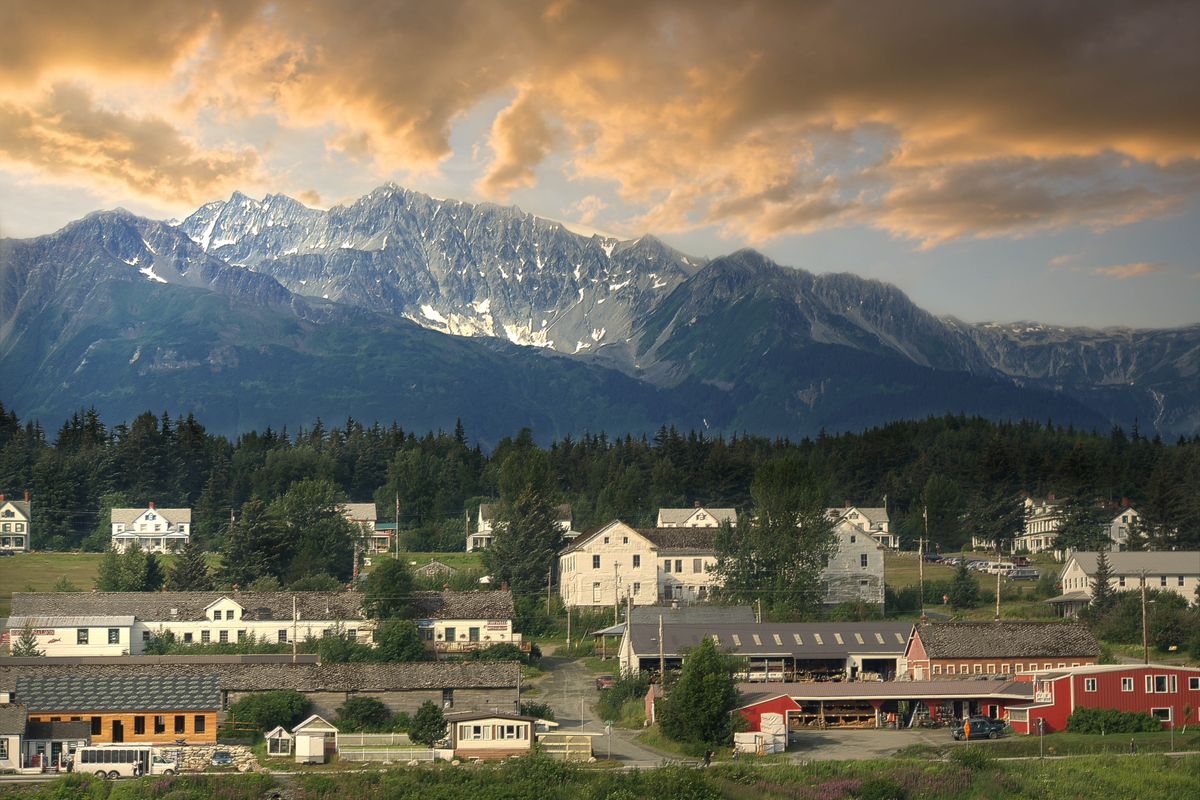
Picture a town where the grocery store, the police station, the school, and your own living room are all one elevator ride apart. It’s not the set of some dystopian TV show. It’s real, it’s called Whittier, it’s in Alaska, and for the vast majority of its residents, the entire town really does fit inside a single building: Begich Towers.
Whittier is home to just over 270 people. According to fact-checking outlet Snopes, somewhere between 80% and 90% of them live in the same block: Begich Towers, a fourteen-story building with 196 apartments that’s earned the nickname “the city under one roof.” The rest of the population lives in a second, nearby condo building — so, strictly speaking, it’s not the entire town under one roof… but close enough.
Begich Towers: one building doing the job of a whole town
According to Smithsonian Magazine, Begich Towers isn’t just apartments. Its lower floors house city hall, the police station, the post office, a grocery store, a laundromat, a medical clinic, and even a church. The school sits right next to the building, connected by an indoor tunnel, so kids can get to class without ever setting foot in the snow, all winter long.
That matters more than it sounds. Whittier gets some of the heaviest snowfall in all of Alaska — several meters a year — plus winds that routinely top 100 km/h (about 60 mph). Between October and April, when the weather turns nasty (which is most of the time), you genuinely don’t need to grab a coat just to buy bread.
From secret military base to building-town
Begich Towers wasn’t built for comfort — it was built for war. The building went up in the 1950s under the name Hodge Building, as housing for the U.S. Army Corps of Engineers, which had chosen Whittier during World War II as a strategic port. Its near-permanent cloud cover made it almost invisible to Japanese bombers. The Army kept the base active until 1960. After that, the building was gradually converted into civilian housing until it became what it is today.
For decades, the only way in or out of Whittier by land was a nearly 2.5-mile railway tunnel bored under Maynard Mountain. It wasn’t opened to car traffic until 2000, and by several accounts it’s still the longest highway tunnel in North America. You can’t just drive through whenever you like, though. Traffic alternates on a fixed one-lane schedule, and the tunnel closes every night at 10:30 p.m. Miss the last slot, and you’re sleeping in your car, or in the town’s one motel.
So why doesn’t anyone move somewhere bigger?
Here’s the thing: the setup actually works great for Whittier’s residents. The town has even grown a bit over the decades — 182 people in the 2000 census, 220 in 2010, 272 in 2020. Living right next door to the store, the doctor, the school, and the police, in a place where stepping outside in January can genuinely be dangerous, turns what sounds like a logistical nightmare into a pretty sensible arrangement.
So next time you’re annoyed about a neighbor’s bad parking or hearing every footstep through the stairwell, spare a thought for Whittier. The guy upstairs might, quite literally, be the police chief, and the one downstairs might be the only grocery store for miles around.
If this story left you wanting more, we’ve already covered what everyday life in Whittier is actually like, Alaska’s one-building town.