
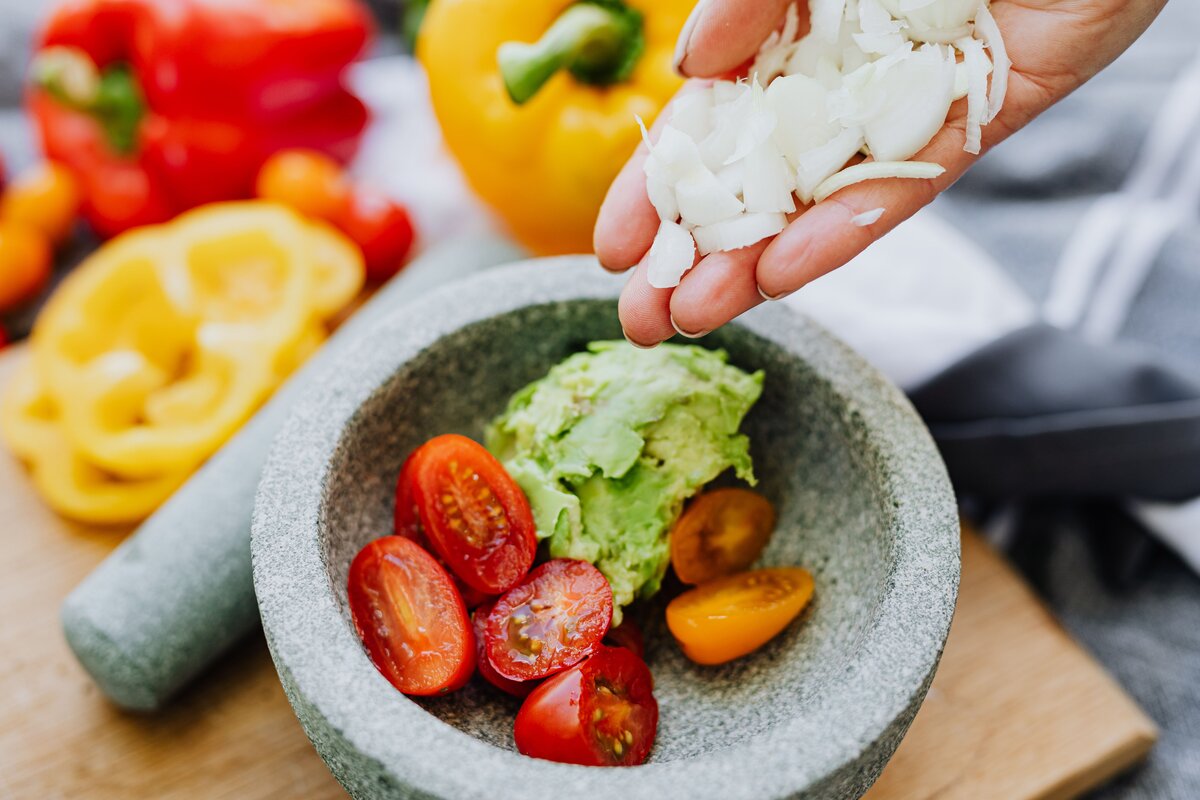
Here’s the onion trick: store half a leftover avocado in an airtight container next to a slice of onion, without letting them touch. That way, it’ll stay green a lot longer before turning brown. It sounds like a grandma myth passed around the internet. However, there’s actually a pretty elegant bit of biochemistry behind it. Let’s look at how to do it and, more importantly, whether it actually works.
How to do the onion trick
- Cut an onion (white, red, whatever you’ve got) into thick slices.
- Place the slices at the bottom of an airtight container.
- Put the avocado half on top, flesh facing up, without letting it touch the onion directly. If it does touch, it’ll pick up a bit of onion flavor — not the end of the world, but better to avoid it.
- Seal the container and pop it in the fridge. Check it the next day: it should still look pretty green.
If you want to boost the effect, squeeze a bit of lemon juice over the flesh before sealing the container. That combines two different mechanisms, as you’ll see below.
Why it works (the real science)
When you cut an avocado and leave it exposed to air, it sets off a reaction called enzymatic browning. The culprit is an enzyme with a name straight out of a B-movie: polyphenol oxidase (PPO). On contact with oxygen, this enzyme converts the avocado’s phenolic compounds into molecules called quinones. As a result, those quinones link together into that unappetizing brown pigment. In fact, it’s the exact same chemical process that darkens a bitten apple or a peeled potato.
For the reaction to happen, you need three things at once: the PPO enzyme, phenolic compounds, and oxygen. Thus, removing any one of the three slows down the browning. That’s where the onion comes in. According to the nutrition outlet Healthline, PPO needs copper at its active site to function. Moreover, the sulfur compounds onions release when cut — the same ones that make you cry — may interfere with that copper and partially block the enzyme. Basically, the onion disarms the villain a little before it can do its damage.
Lemon, meanwhile, attacks from a different angle. PPO only works well within a pH range of 6 to 7.5, and becomes practically useless below pH 3. Therefore, citric acid from the lemon acidifies the avocado’s surface and takes the enzyme out of the game. Hence, guacamole with lime holds up longer than guacamole without it.
Does the onion trick actually work, or is it a half-myth?
Here’s the honest part almost nobody mentions: the evidence for onion is solid on the mechanism but shakier on real-world results. Healthline itself notes that the effect has mostly been shown with onion extract in lab conditions. Nevertheless, it’s less clear with just a loose slice sitting in a container. Besides, when America’s Test Kitchen tested several household methods side by side — onion, lemon, water, olive oil, plastic wrap pressed right onto the flesh — only one stopped browning completely: vacuum sealing. Still, everything else, onion included, slowed the process down but didn’t fully stop it.
The practical takeaway is this: the onion trick isn’t magic, but it’s not nonsense either. It can buy you a day or two of decent avocado, especially combined with lemon and a genuinely airtight seal that keeps air out. Still, if you want a full guarantee, your best bet is a vacuum sealer. On the other hand, an easier option is the plastic wrap trick, pressed directly onto the flesh so there isn’t a single air bubble left. In the end, for everyday use, onion plus lemon in the fridge is a cheap, fast combo that actually has the chemistry on its side.