
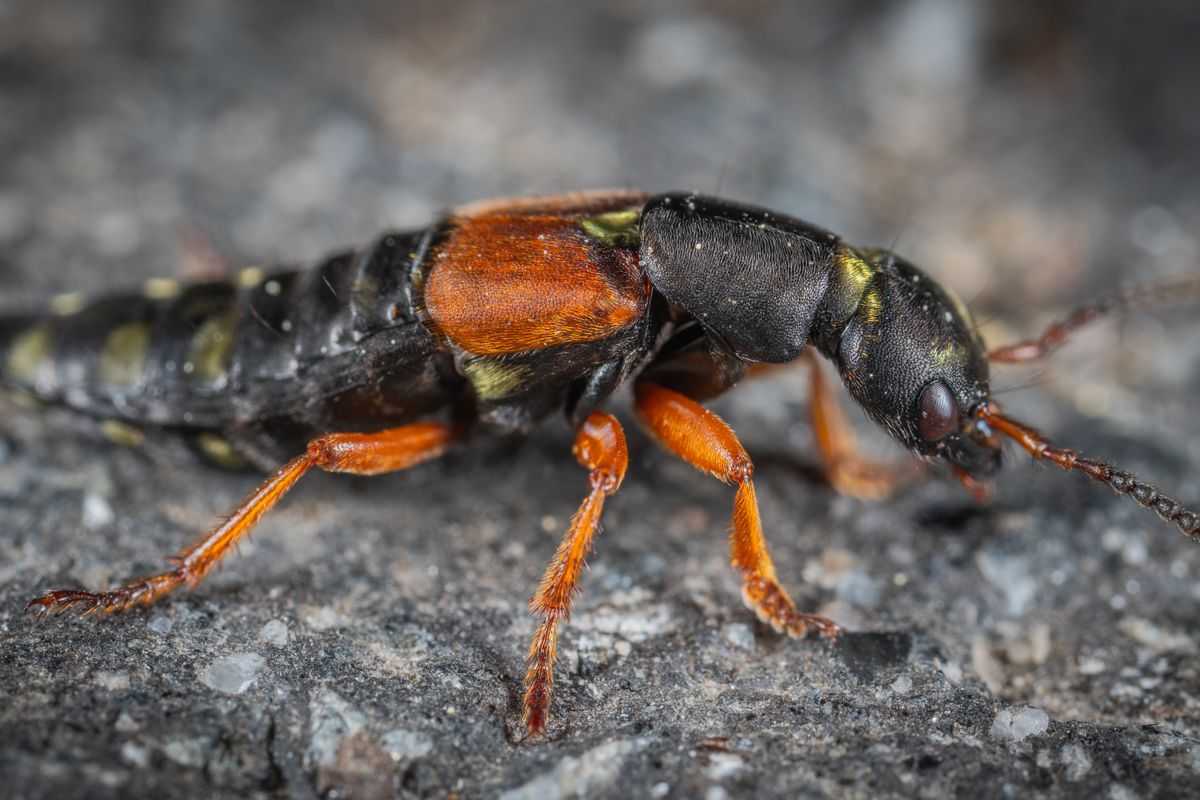
Somewhere in the forests of Yunnan, China, and northern Laos, there’s now an officially rubbery beetle. Not literally, of course — it’s built from the same chitin as every other insect on the planet. But its jaws, antennae and mouthparts are so absurdly long and slender compared to its relatives that a team of entomologists at the Natural History Museum of Denmark couldn’t help thinking of one character in particular: Luffy, the stretchy pirate from One Piece. So they named an entire new genus after him.
The study, published in the open-access journal ZooKeys by Fang-Shuo Hu and Alexey Solodovnikov, formally describes Luffy gen. nov., a genus of rove beetle — the common name for Staphylinidae, an enormous and wildly diverse beetle family known for their exposed abdomens and stubby wing covers — that until now had no formal place of its own in the classification tree.
A body built to stretch
What sets these beetles apart from their closest relatives isn’t a flashy color or an oversized body, but a silhouette that looks almost badly drawn: mandibles, antennae and maxillary palps far longer and thinner than anything else in the lineage. According to the authors, that exaggerated elongation immediately brought to mind Luffy’s rubber-body powers, gained after eating the Gomu Gomu no Mi devil fruit in the manga. This wasn’t a fandom in-joke tacked onto a press release — the researchers are explicit that the name reflects a real, diagnostic physical trait of the genus.
Two species currently sit inside Luffy. Luffy schillhammeri turned up in the broadleaf forests of China’s Yunnan province, its name honoring entomologist Harald Schillhammer of the Natural History Museum Vienna for decades of work on rove beetles. The second, Luffy nika, was found in Louang Namtha in northern Laos — and its name is an even more direct nod to the source material: “Nika” refers to the awakened form of the Gomu Gomu no Mi that Luffy unlocks during the Wano arc, the transformation fans know as Gear 5.
Why a silly name still matters scientifically
It might sound like a lab in-joke, but naming species after pop culture is a practice with real history and strict rules attached: the name still has to come bundled with a rigorous taxonomic description, comparing physical traits and pinning down exactly where the animal sits on the group’s evolutionary tree. Here, the authors argue that Luffy is genuinely useful for untangling the Eucibdelus lineage, a related group of beetles whose position within the Staphylininae subfamily had long been murky. Having a well-described “bridge” genus with such distinctive features helps reorder the family’s genealogical puzzle.
There’s also a less scientific but very real upside to giving a tiny, obscure bug a name people will actually remember: it gets noticed. The overwhelming majority of the planet’s insects — millions of species are thought to remain undescribed — never make a headline. A name that taps into something millions of people already love, in this case one of the best-selling manga of all time, turns a niche taxonomic finding into a story people actually read, share, and maybe even remember next time they spot a beetle in the garden.
A tradition that keeps growing
Naming species after pop culture is hardly new — there are spiders named after Star Wars characters, wasps named after Harry Potter villains, and snails named after video game heroes — but every fresh case reignites the same charming question: why do taxonomists love doing this so much? The answer is usually twofold. Scientists are people with their own hobbies and sense of humor, first of all. And in a field that’s constantly fighting for funding and public attention, a clever name is simply smart communication. Luffy schillhammeri and Luffy nika will keep going about their business in the forests of Yunnan and Laos, blissfully unaware of their sudden fame — but from now on, they belong to a very specific club: bugs that earned the name of a pirate who dreams of becoming King of the Pirates.