
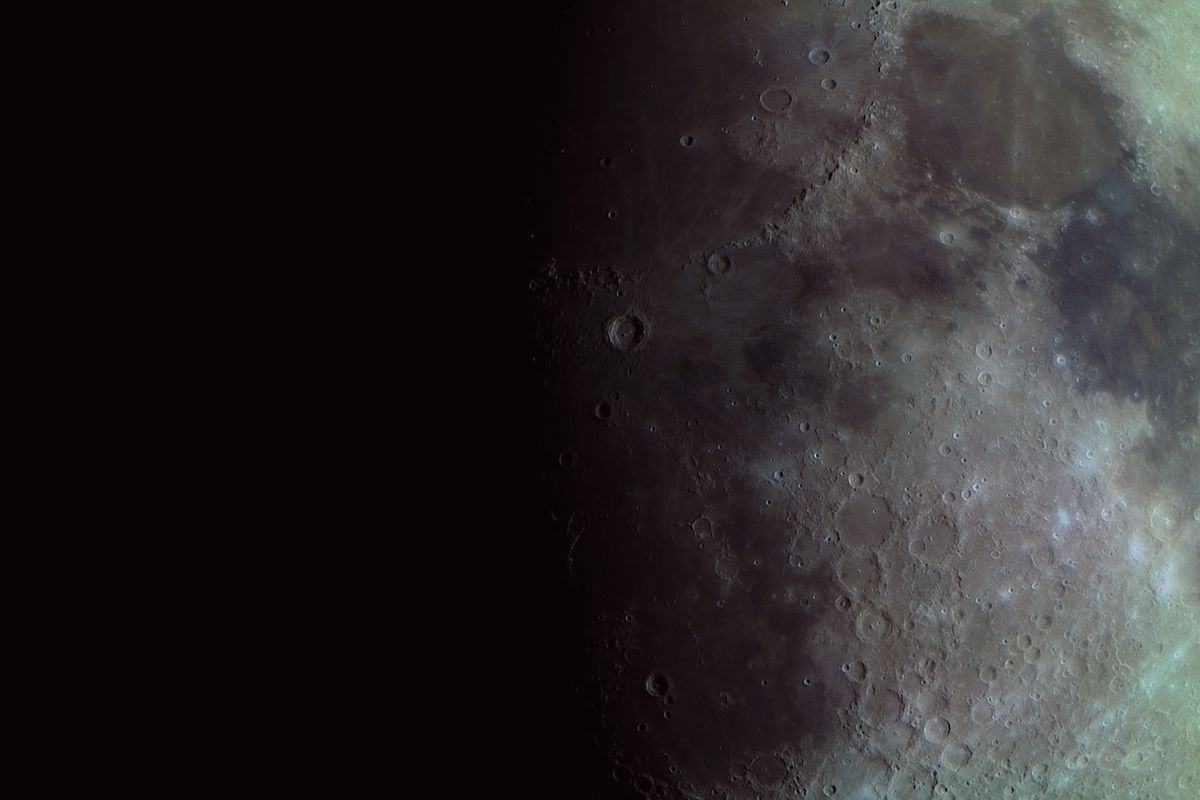
You’ve spent your entire life looking at the Moon, and yet you’ve never seen half of it. Literally: 41% of the lunar surface is a total mystery to the naked eye from Earth, and no one laid eyes on it until a Soviet probe photographed it in 1959. So why does the Moon always show us the exact same face, as if it can’t stand to let us see its dark side?
It’s not that the Moon has stopped spinning — it hasn’t, it’s rotating constantly — and it’s not that Earth is holding it in place with some magnetic trick either. The explanation is pure celestial mechanics, and it’s elegant enough that once you understand it, you’ll never look at the Moon the same way again.
A gravitational hug that’s lasted 4.5 billion years
The Moon does rotate on its own axis, but here’s the twist: it rotates at exactly the same pace it orbits us — once every 27.3 days, not a second faster or slower. This phenomenon is called tidal locking, and it’s anything but a coincidence.
Billions of years ago, when the Moon was a freshly formed ball of molten rock, Earth’s gravity pulled on it so hard that it distorted its shape, raising a small “bulge” pointed toward us — not unlike what the Moon does to our oceans today with the tides. Since the young Moon was spinning faster than it orbited, that bulge ended up slightly out of line with the direct path connecting it to Earth. That’s where the interesting physics kicks in: as NASA explains, the misaligned bulge acted like a handle that Earth’s gravity could grab onto, gradually braking the Moon’s spin until the two rhythms — rotation and orbit — locked into perfect sync forever. Ever since, the Moon has been staring at us without blinking.
Earth is falling into the same trap (just very, very slowly)
Here’s the part that rarely makes it into the story: tidal locking isn’t just something happening to the Moon — it’s happening to us too, just at an infuriatingly slow pace. The ocean tides the Moon stirs up on Earth create friction against the seafloor, and that friction is gradually braking our own rotation, millisecond by millisecond. Our days are lengthening by roughly one to two milliseconds per century — something only precision atomic clocks can detect, not your morning alarm.
That energy Earth is losing doesn’t just vanish — it gets transferred to the Moon, which drifts away from us at a measurable rate of about 3.8 centimeters a year (roughly the speed your fingernails grow). If you’re the type who likes doing the long-term math: at this rate, it would take Earth around 50 billion years to become as tidally locked to the Moon as the Moon already is to us, permanently showing it the same face in return. There’s just one catch — the Sun is expected to swell into a red giant and likely swallow the entire Earth-Moon system in “only” 7.6 billion years, so that particular future will never actually arrive. A bit of an anticlimactic ending, honestly.
We’re not the only ones caught in this
Here’s the fun part: this kind of locking isn’t some quirk unique to the Earth-Moon pair — it’s actually the default fate of any large moon that orbits close to its planet for long enough. Every large moon in the solar system, from Jupiter’s and Saturn’s giants to Pluto and its companion Charon — which are mutually locked to each other — always shows the same face to its planet. So next time you look up at a full Moon, remember: it’s not gazing back at you by choice. It simply hasn’t been able to look away for billions of years.