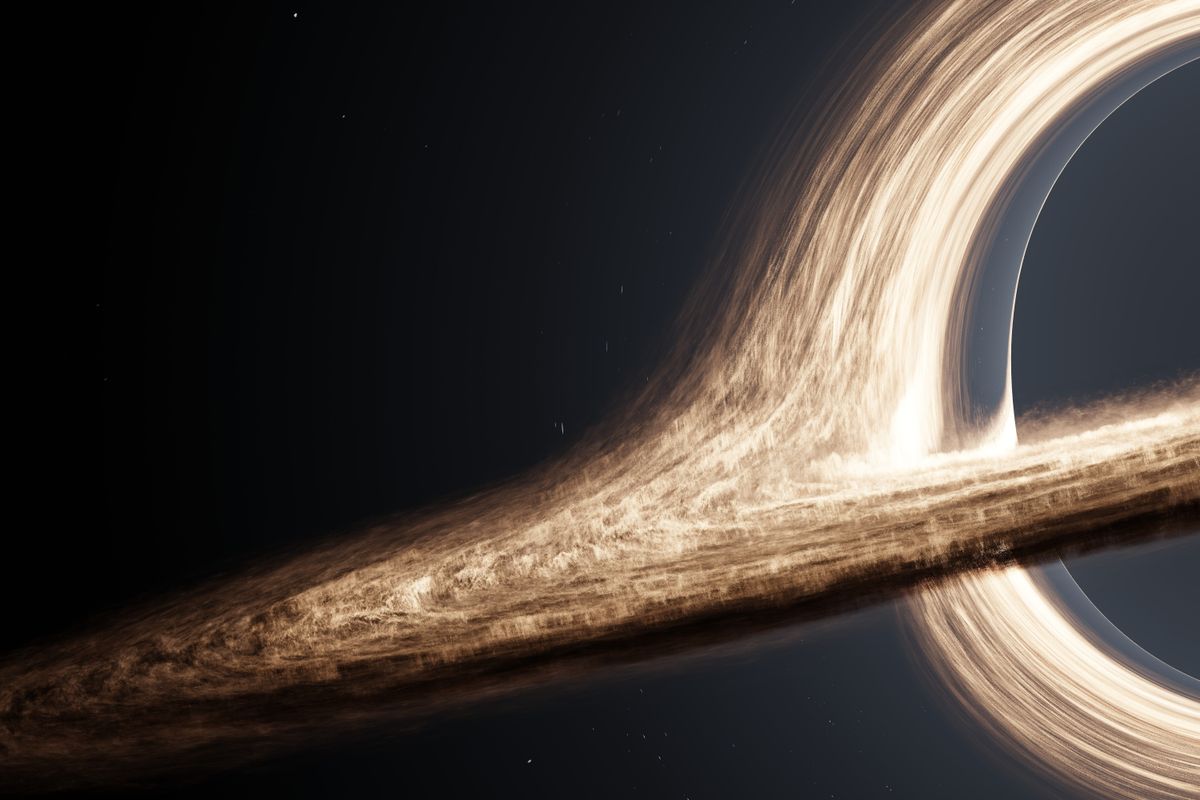
Picture this: the Big Bang wasn’t the beginning of everything, but more of a bounce. There was another universe before ours, shrinking down and down under brutal density, and instead of vanishing into nothing, that collapse slammed on the brakes and reversed into expansion. Sounds like a sci-fi pitch, but that’s exactly what a physicist at the University of Portsmouth is proposing — and the idea comes with an extra twist: some black holes from that earlier universe may have survived the bounce and are still floating around today, disguised as dark matter.
The study, authored by Enrique Gaztañaga and published in February 2026 in Physical Review D, doesn’t throw out the Big Bang altogether, but it does challenge the idea that it was an absolute starting point from nothing. In this model, the previous universe compressed to an extreme, and that compression didn’t end in total collapse — it ended in a “bounce” that kicked off the expansion we’re still living through today. The interesting question is: did anything make it through that transition?
Fossils of a universe that no longer exists
According to Gaztañaga’s calculations, yes — but only above a very specific size. Any object or density fluctuation larger than roughly 90 meters could have crossed the bounce intact. Anything smaller gets scrambled in the chaos of the transition; anything bigger has a shot at coming out the other side as a black hole, a gravitational wave, or a plain density fluctuation that would eventually collapse on its own.
These “surviving” black holes wouldn’t have formed the way the ones we know do, through the collapse of a massive star. They would have been born directly from quantum density fluctuations at the moment of maximum compression, right before the bounce. In practice, they’re primordial black holes: they already existed before the universe, as we understand it, even began expanding.
What if dark matter has been here since before the Big Bang?
This is where things get genuinely interesting. Dark matter makes up roughly 27% of the universe, gives off no light, doesn’t interact with electromagnetic radiation, and we only detect it through its gravitational pull on galaxies and clusters. We’ve spent decades hunting for exotic particles to explain it, without a conclusive answer. Gaztañaga’s proposal adds a new angle: if the bounce produced enough tiny black holes, that population could account for a significant — possibly dominant — share of all the dark matter in the universe.
And there’s a second puzzle piece this model happens to fit. The James Webb Space Telescope has spent the past couple of years turning up galaxies and supermassive black holes that look “too big, too soon” for the age the universe was when they formed — a problem that has been giving standard cosmology a headache. If seed black holes already existed before the Big Bang itself, those giant structures would have had far more time than we thought to grow, which would explain why we’re catching them so fully formed so early.
To be clear: this is still a theoretical model, not a direct detection. Nobody has “seen” one of these primordial black holes with a label reading “pre-Big Bang” attached. But the strength of the proposal is that it makes testable predictions — a specific gravitational-wave background and a particular range of black hole masses that future observatories, both gravitational-wave detectors and Webb itself, could check against reality in the coming years.
As the University of Portsmouth’s press release on the study puts it, these cosmic relics could offer a common origin for three mysteries usually investigated separately: dark matter, the gravitational-wave background, and the surprisingly early growth of the first supermassive black holes. Three questions, one answer — courtesy of a universe that, technically, doesn’t exist anymore.
So next time someone tells you “it all started with the Big Bang,” you can casually point out that it might not have been the beginning at all — more of a bounce. And that part of what’s around you right now could be older than the universe you’re living in.
1 thought on “There Are Black Holes Older Than the Big Bang, and They Might Be the Dark Matter We’ve Been Looking For”