
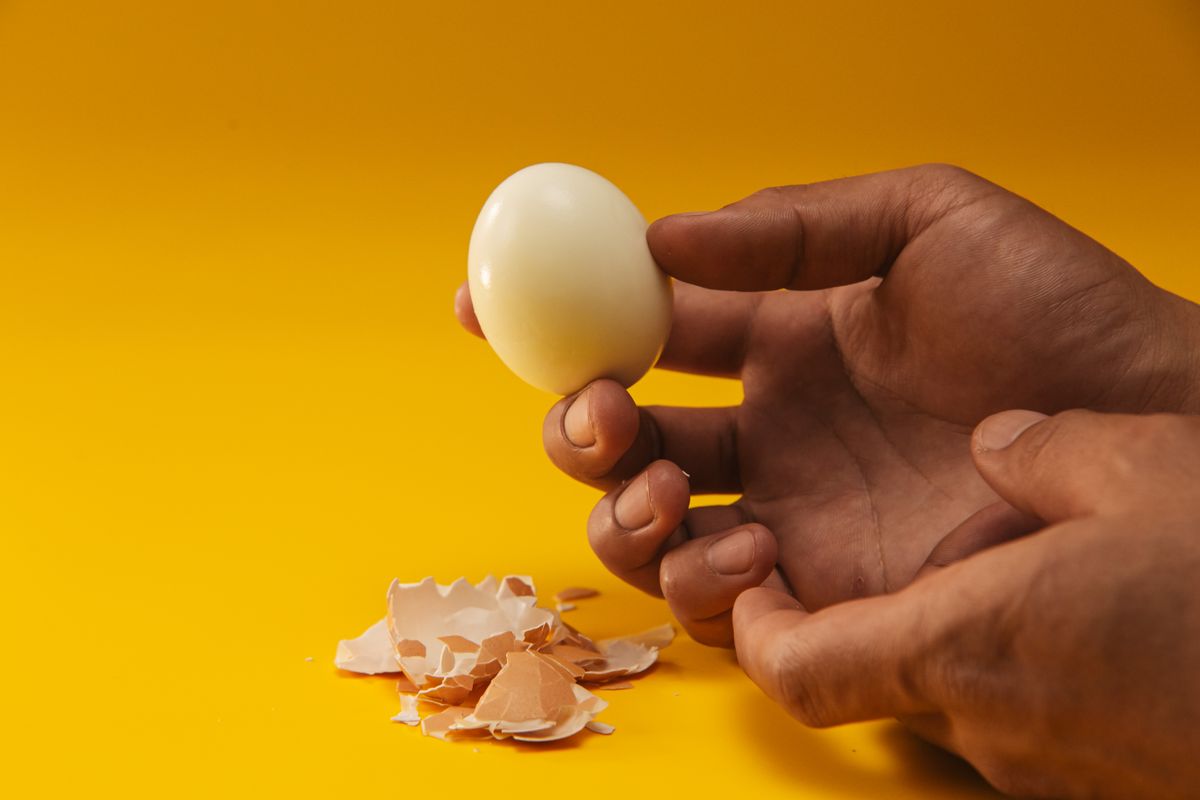
Here’s how to peel hard-boiled eggs without a fight: add half a teaspoon of baking soda to the water you boil your eggs in. When you cool them down, the shell will come off in two or three big pieces instead of shattering into twenty little shards fused to the egg white. If you’ve ever muttered curses at the sink while a hard-boiled egg turned into a lunar crater in your hands, keep reading.
How to do it
- Put the eggs in a pot and cover them with cold water, about an inch above the top.
- Add half a teaspoon of baking soda per quart of water (no need to measure to the gram).
- Bring to a boil, lower the heat, and cook for 10 to 12 minutes for classic hard-boiled.
- Transfer the eggs immediately into a bowl of ice water for at least 5 minutes.
- Gently crack the egg all over against the counter, then peel it under a thin stream of cold water. The shell should come off in large, near-complete pieces.
Nothing exotic here: same pot, same cook time, one ingredient you already have in the pantry, and it costs less than a cup of coffee.
Why baking soda helps you peel hard-boiled eggs
The reason some eggs peel like a dream while others seem to hold a personal grudge against you comes down to the pH of the egg white. A freshly laid egg has a white with a relatively low pH (around 7.6), which makes the inner shell membrane stick tightly to the egg white protein, almost as if welded together. As the egg ages in the fridge, carbon dioxide slowly escapes through the shell’s microscopic pores. That pushes the internal pH up toward roughly 9.2 after about three weeks. At that higher, more alkaline pH, the white releases from the membrane far more easily — which is exactly why experienced cooks have always sworn by “slightly old” eggs over fresh ones for boiling.
Baking soda pulls off the same trick, just in minutes instead of weeks: once it dissolves in the cooking water, it raises the pH of the water, and by diffusion, the pH inside the egg white as it cooks. In other words, it cheats the clock, turning a fresh egg into one that behaves, peeling-wise, as if it had spent three weeks in the fridge. That pH shift weakens the bonds holding the white to the inner shell membrane without changing the egg’s flavor or texture. That’s according to Science Friday’s breakdown of the chemistry behind hard-cooked eggs.
The ice bath at the end isn’t just for show, either: shocking the egg cold makes the white contract slightly and pull away a bit further from the shell. It also stops the cooking, so the yolk doesn’t develop that greenish-gray ring from overcooking (which, for the record, is harmless iron sulfide — just unappetizing to look at).
A couple of caveats so you don’t overdo it: too much baking soda can give the white a faint soapy taste, so it’s better to underdose than overdose. And if your eggs are already two or three weeks old, you probably don’t even need the trick, since nature has already done the job for you. But for those farm-fresh or just-bought eggs that still smell like the coop, learning to peel hard-boiled eggs this way is the difference between a perfect egg and a white that looks like it survived an explosion.
It’s the same logic behind the spoon-in-the-glass trick: one small physical or chemical tweak that completely changes the outcome in the kitchen.