
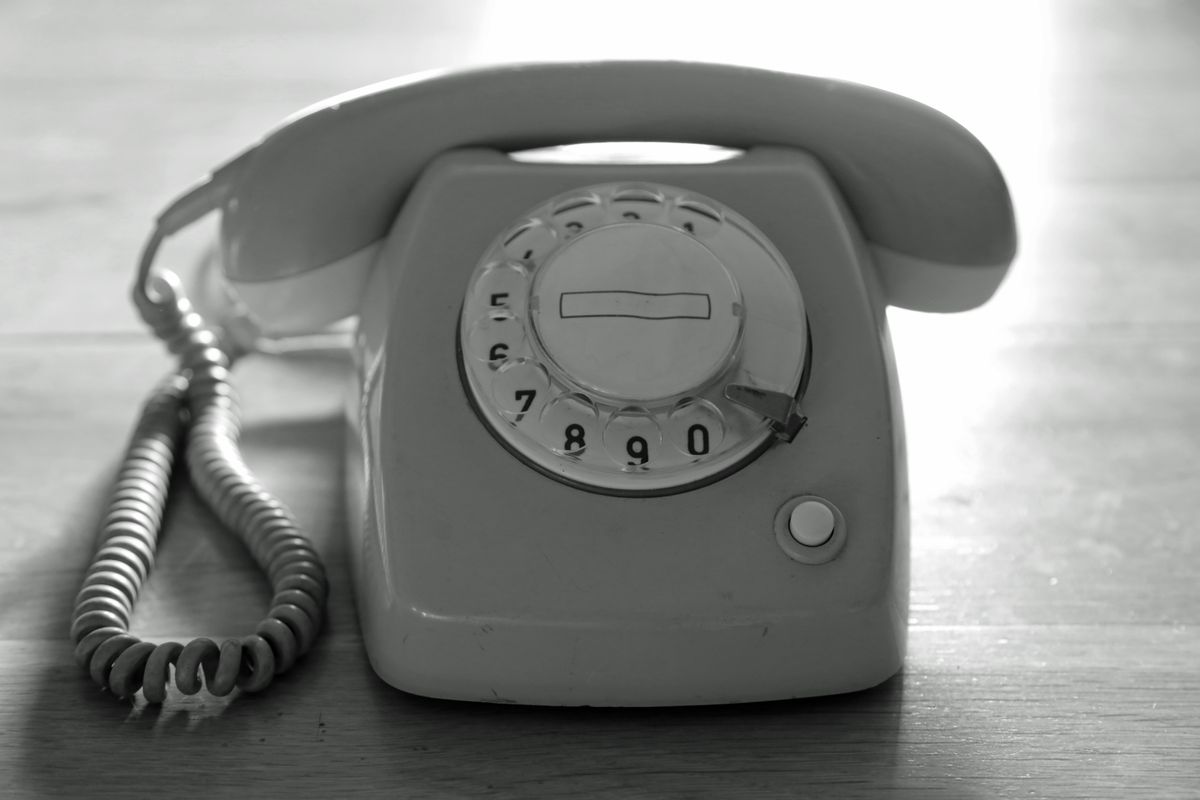
On a hill overlooking the sea, in the Japanese town of Ōtsuchi, there’s a white phone booth standing in the middle of a garden. Inside, resting on a small wooden shelf, sits a black rotary phone. It’s the kind almost nobody remembers how to dial anymore. It isn’t connected to any line. No cable runs out of the booth, and no phone company is billing anyone for the calls. And yet, for more than a decade, tens of thousands of people have lined up to step inside, pick up the receiver of the wind phone, and talk.
The phone is called Kaze no Denwa, “the wind phone.” It was installed in 2010 by a garden designer named Itaru Sasaki, shortly after his cousin was diagnosed with terminal cancer. Sasaki needed somewhere to put his grief into words. So he set up an old glass-paned booth in his private garden, which he named Bell Gardia, and placed inside it a telephone that led nowhere. As he put it himself, his thoughts “couldn’t be relayed over a regular phone line,” but they could still be carried “on the wind.”
When a private garden became a place of pilgrimage
The plan was for it to stay a quiet, personal corner of grief. But in March 2011, the Tōhoku earthquake and tsunami slammed into Japan’s eastern coast with waves reaching up to 30 feet. Ōtsuchi was one of the hardest-hit towns: roughly 10% of its population died or went missing, about 421 people, according to the radio program This American Life, which devoted an entire segment to the phenomenon.
Sasaki opened his private booth to the rest of the town. Neighbors who had lost parents, children, or partners began climbing the hill, stepping into the booth, picking up the dead receiver, and dialing a number that no longer existed anywhere. In fact, some spoke quietly for a couple of minutes. Others stayed half an hour, catching up a loved one on the day-to-day of a family that would never be quite the same again.
Word spread first by mouth, then through Japanese public broadcaster documentaries, and eventually reached a much wider audience through a 2023 NPR feature. The exact numbers shift depending on the source: some put visits at around 10,000 in the first three years after the disaster, others cite more than 30,000 cumulative visits over the years. Still, they all agree on one thing: nobody expected a disconnected phone to become one of the best-known grief rituals in the world.
Why talking to the wind phone actually works
A line doesn’t need to be connected for talking into it to help. Psychologists who’ve studied the Kaze no Denwa phenomenon point to something grief therapy has used in different forms for years: from writing letters to someone who’s gone, to talking to an empty chair. Saying things out loud, with the structure of a real conversation, helps organize emotions that would otherwise stay stuck. Meanwhile, the ritual of stepping into a booth, picking up the receiver, and dialing a number adds a symbolic weight that just thinking things through in your head doesn’t have: there’s a before and an after, a beginning and an end, exactly like any other phone call.
What’s striking is how far the idea has traveled beyond Japan. Since then, “wind phones” directly inspired by Sasaki’s have popped up across the United States — in Oakland, Provincetown, Marshall, and Olympia — as well as in Ireland. During the COVID-19 pandemic, Sasaki even received inquiries from the UK and Poland from people wanting to build their own versions, hoping to help others who’d lost someone without ever getting the chance to say goodbye.
A booth that’s still ringing in the silence
More than a decade after the tsunami, people are still climbing up to Bell Gardia. Some go just once. Others return every anniversary, the way someone might visit a grave, except here the ritual includes a call that no one ever answers and that still, somehow, seems to get through. The wind phone still has no cable, still has no line, and for thousands of people, it’s still the only number they can call.