
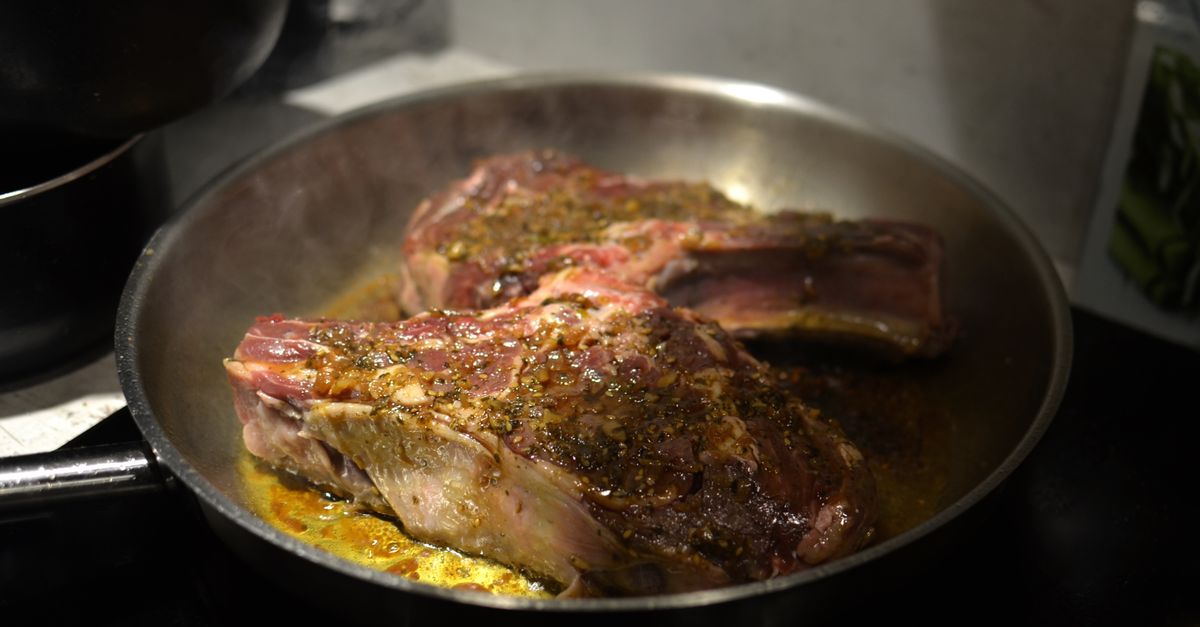
Forgot to take the meat out of the freezer and need it in an hour? You don’t have to reach for the microwave. It has a charming habit of cooking the edges into leather while the center stays rock solid. The real trick is much simpler: it’s the metal pan trick. Just set the frozen piece on a metal pan or tray, ideally sandwiched under a second one, instead of leaving it on a plate or the counter.
How to use the metal pan trick step by step
- Grab an aluminum or steel pan or sheet tray (the thicker and heavier, the better) and let it sit at room temperature.
- Place the meat, fish, or whatever you’re thawing directly on the metal, skipping any plastic wrap in between if you can.
- If you have a second metal pan, set it on top and press down slightly so it makes contact on both sides.
- Flip the food every 10-15 minutes so it gets even contact with the metal.
- Cook it as soon as it’s thawed; don’t let it sit around at room temperature “just in case.”
With this method, a steak or chop an inch or so thick can go from frozen brick to pliable in 30 to 60 minutes. Compare that to the several hours it takes on a ceramic plate.
Why it works
The key is something almost nobody thinks about while cooking: air is a fantastic insulator. That’s exactly why thawing food on the counter is so slow. The metal pan trick works because metal is the opposite — it conducts heat with far greater efficiency.
Aluminum, for instance, is over 9,000 times better at conducting heat than still air. So when frozen meat touches the metal, it “steals” heat from the room and delivers it straight to the icy surface. That way, the food doesn’t have to wait around for stray air molecules to bump into it one at a time.
Paul Adams, a science editor at America’s Test Kitchen, puts it simply: to defrost food, you need heat to get into it. Waiting for that heat to travel through air, he notes, is wildly inefficient. What actually speeds things up, instead, is putting the food in contact with something that conducts heat well, like metal or water. In fact, The Kitchn put the trick to the test. They found that a pork chop fully thawed on an aluminum sheet pan in one hour, while the same cut on a stoneware plate took 45 minutes longer. In an even more visual experiment, an ice cube on aluminum was half-melted after 4 minutes. The same cube on a ceramic plate, meanwhile, was still solid.
One important caveat: the USDA officially recognizes only three safe thawing methods — the fridge, cold water, or the microwave. The reason is that leaving food at room temperature can heat the surface into the bacterial “danger zone” (roughly 40 to 140°F) while the inside is still frozen. That doesn’t mean the metal pan trick is unsafe, just that it should be used sensibly. Stick to not-too-thick cuts, keep the time on the counter moderate, and cook the food the moment it’s ready instead of letting it linger there “just in case.”
So next time you find a rock-solid steak staring back at you at the last minute, skip the microwave and the guesswork with warm water. All you need is a couple of pans and a bit of patience backed by actual physics. For another kitchen trick that comes down to simple physics, check out the spoon-in-the-glass trick, which stops a glass from cracking when you pour in boiling water.