
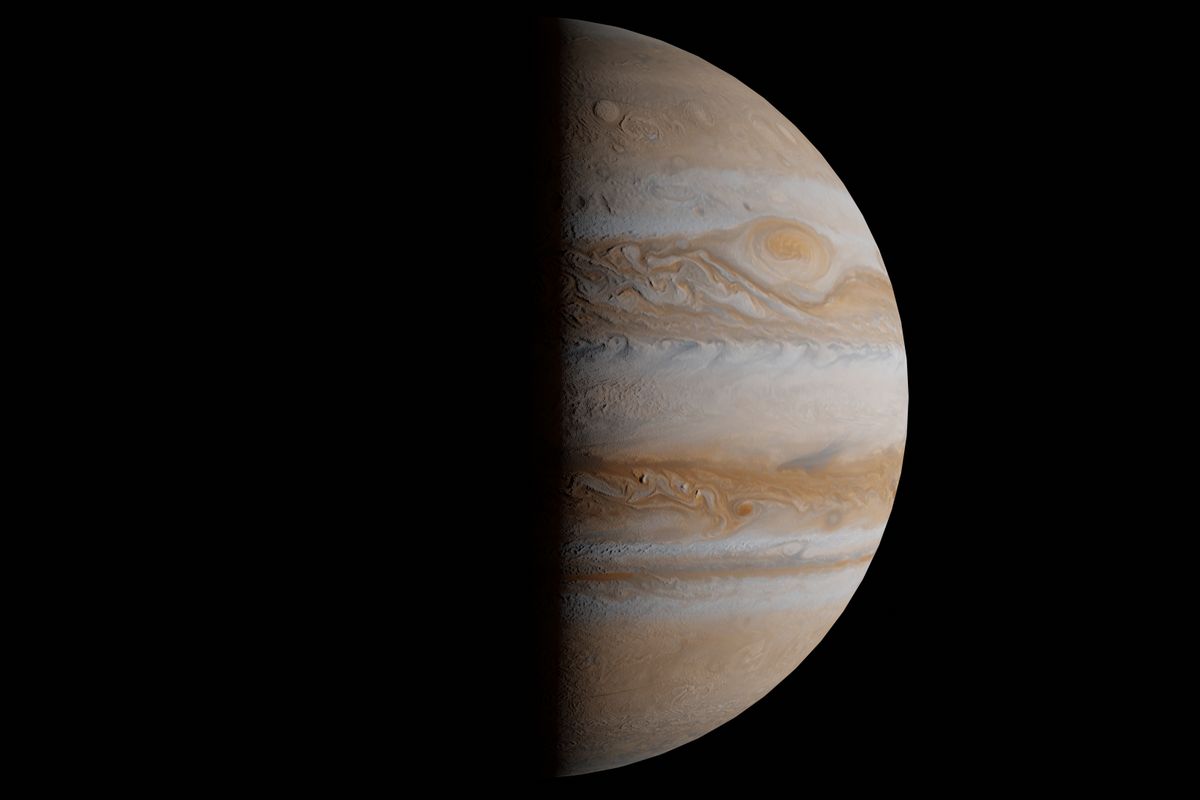
There’s cheese in your fridge older than this planet. Sitting 450 light-years from Earth, there’s a Jupiter-sized world. It’s in the Ophiuchus star-forming region. This is the youngest planet ever confirmed by science. It’s less than a million years old. In cosmic terms, that basically means it’s still crying in the delivery room.
Meet Elias 2-24 b. It orbits a star just as young, still wrapped in the disk of gas and dust it formed from. Here’s the fun part: the planet hasn’t even left the buffet table yet. It’s still actively “eating” material from that disk as it finishes forming, like catching a newborn that’s still got the umbilical cord attached.
How astronomers caught the youngest planet red-handed
The story started more than a decade ago. In the early 2010s, the ALMA radio telescope in Chile spotted a suspiciously clean gap in the gas-and-dust disk. That disk surrounds the star Elias 2-24, about 55 astronomical units out — farther than Neptune sits from our Sun, to put it in perspective. A gap like that is usually the fingerprint of a planet clearing its own lane through gravity. However, for years nobody could actually photograph the culprit.
The breakthrough came when astronomers compared archival images taken by the Keck Observatory in Hawaii. They used its NIRC2 vortex coronagraph, with snapshots from 2018 and 2020. By tracking the motion of a faint speck of light between the two images, they ruled out noise. It wasn’t a background star either — it was a real planet sitting exactly where the disk’s gap said it should be. The findings were published in The Astrophysical Journal Letters, by a NASA-backed research team. The technique echoes the one that finally photographed the secret companion of Betelgeuse, another cosmic neighbor that had been hiding in plain sight for years.
A baby that skips the growth chart
Still, what’s really rattling astronomers about this youngest planet isn’t just the age, it’s the speed. Under classic planet-formation models, a gas giant this far from its star should take a long time to form. Core accretion, specifically, should need far longer than a million years. That process involves a rocky core slowly snowballing gas around itself. Moreover, raw material is scarce that far out. That’s why the rival theory was gravitational instability, where the whole disk collapses at once. For years, it was considered the only realistic way to explain giant planets this young and this far from home.
However, Elias 2-24 b seems to be breaking that script. Everything points to it forming through good old core accretion. That said, it’s happening at a pace nobody thought was possible at that distance. It’s a bit like discovering you can assemble flat-pack furniture in five minutes without the instructions. Technically doable, but it forces you to rethink everything you assumed about how long the job takes.
For astronomers, catching a planet mid-formation is a rare treat. In fact, it’s literally siphoning gas from its birth disk in real time. Meanwhile, most exoplanets are only discovered once they’re already adults, billions of years old. Therefore, having a freshly baked specimen lets scientists test which formation theories hold up and which ones need a rewrite. Funny enough, while we’re still down here arguing about whether Pluto counts as a planet, one just got born 450 light-years away. That youngest planet has already earned itself a spot in the textbooks.