
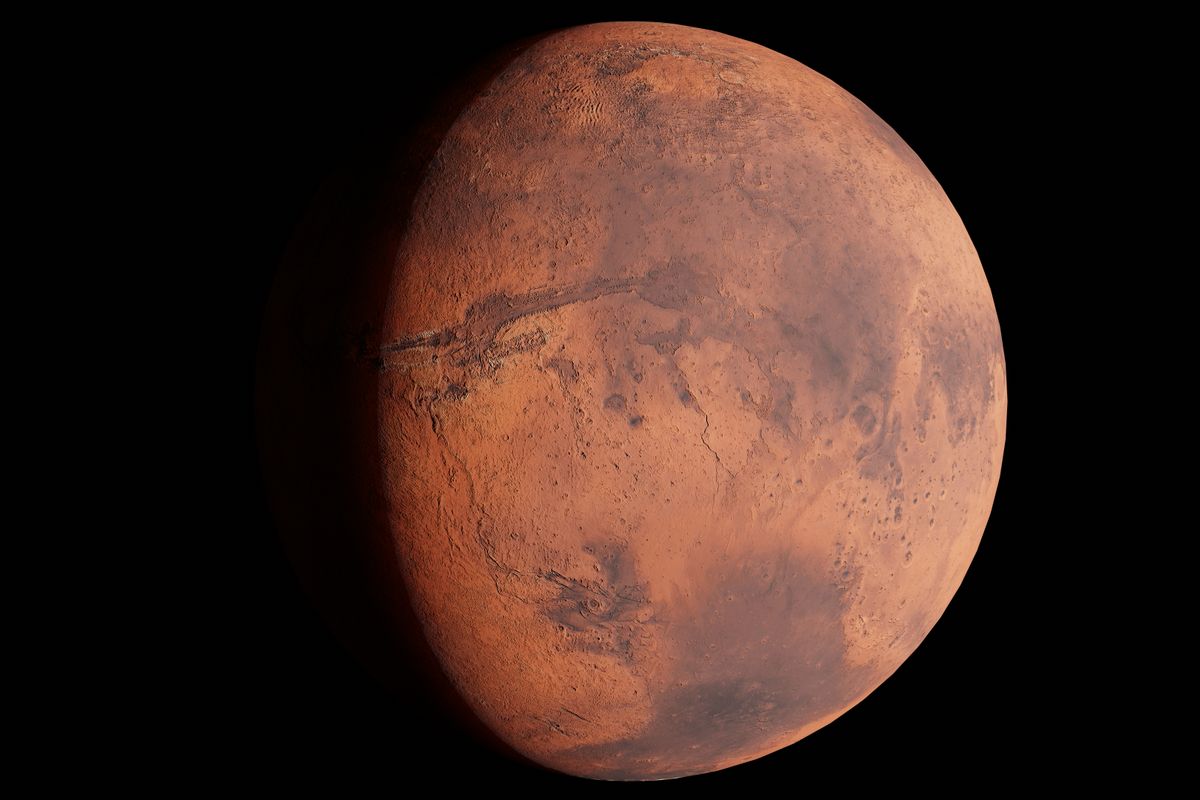
Buried inside a 3.5-billion-year-old rock in a Martian crater, something no instrument had ever picked up on the red planet just turned up: a Mars molecule related to DNA — it shares the same chemical scaffolding that DNA and RNA use. No, this isn’t proof of alien life. But it’s the closest thing to a life “ingredient” Mars has ever handed us.
Credit goes to NASA’s Curiosity rover, which has spent more than a decade digging around inside Gale Crater. The sample was drilled back in 2020, at a spot nicknamed “Mary Anning 3” — named after the 19th-century British fossil hunter who found what nobody else thought to look for — inside a clay-rich patch of terrain called Glen Torridon. That clay matters: it forms in the presence of liquid water and happens to be remarkably good at locking organic material away for billions of years.
The chemistry trick that revealed the Mars molecule related to DNA
For years, that sample sat inside Curiosity without giving up its secrets. Things changed when the science team finally ran, for the first time on Mars, one of the trickiest experiments built into the SAM instrument (Sample Analysis at Mars): a “wet chemistry” run using a reagent called TMAH (tetramethylammonium hydroxide). In plain terms, TMAH works like a solvent that breaks big, clingy organic molecules into smaller fragments small enough to actually detect and analyze.
The results, published in April 2026 in Nature Communications, turned out to be a haul: more than 20 distinct organic molecules, seven of them never seen on Mars before. Among them was a nitrogen-bearing ring compound belonging to the same chemical family as the building blocks of DNA and RNA on Earth. The team also detected benzothiophene, a carbon-and-sulfur molecule that — interestingly enough — also shows up in meteorites, including the famous Murchison meteorite. If you’re curious how these molecules keep evolving here on Earth, check out these evolutionary highways written into DNA.
So, did Mars actually have life?
Time to pump the brakes a little: finding organic molecules is not the same as finding life. These compounds can form through purely geological or chemical processes with no living organism anywhere near them — which is exactly why they also turn up in meteorites that never got close to anything alive. What this discovery does show is that if microbial life ever existed on Mars, the planet had the right chemistry to support it, and that these compounds can survive intact for billions of years underground.
What really stands out, according to the researchers themselves, is that Mars managed to preserve this “chemical archive” even after losing its global magnetic field, most of its atmosphere, and nearly all of its surface water billions of years ago. The clay acted like a vault.
Next up: hunting for more of these chemical signatures elsewhere in Gale Crater and, with any luck, in samples that the Mars Sample Return mission — if it ultimately gets funded and flown — could bring back to Earth for analysis with lab equipment far more powerful than anything that fits on a rover. Until then, Mars is still holding its best cards under a foot of red dust.
You can check out the technical details of the study in the paper published in Nature Communications.