
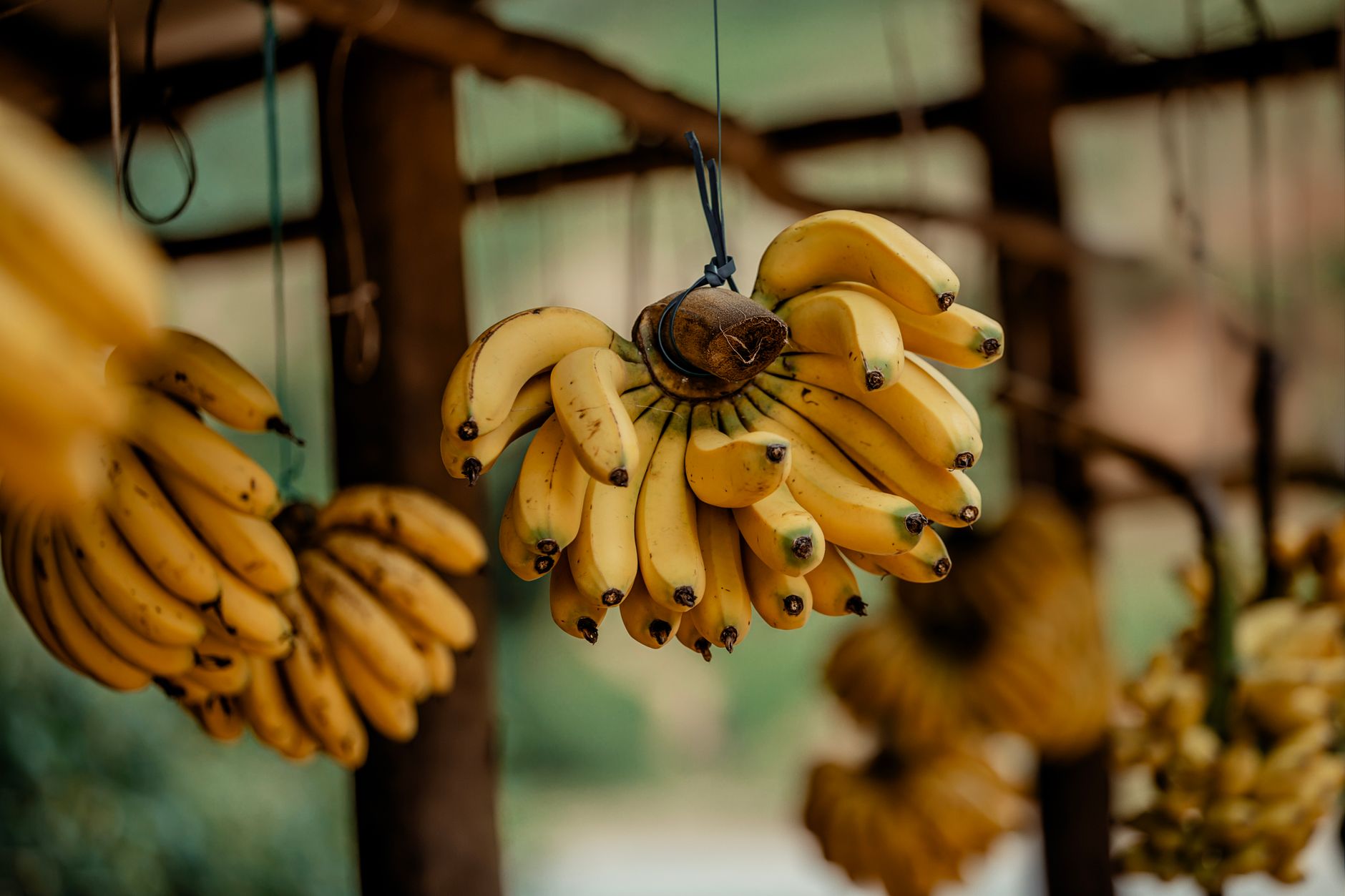
Here’s the plastic wrap trick: as soon as you get home from the store, wrap the crown of your banana bunch — the little knob where all the stems meet — in plastic wrap. Do that, and your bananas will stay green several days longer than they would otherwise. No fridge required, no fancy gadget, just a scrap of kitchen wrap and thirty seconds of your time.
How to use the plastic wrap trick
- Cut a piece of plastic wrap roughly 4×4 inches (aluminum foil works even better, since it seals the gas in more tightly).
- Wrap it snugly around the crown of the bunch — the spot where all the individual stems join together.
- For maximum effect, pull the bananas apart and wrap each stem individually. That way, if one banana starts ripening faster, it won’t drag the rest down with it.
- Store the bunch at room temperature, away from direct sunlight and, crucially, away from ripening apples, tomatoes, or avocados.
- Check in every couple of days. If one banana gets ahead of the pack, just pull it out and let the others keep their pace.
Do this and you can buy yourself three or four extra days before the first brown spots show up — even more if you wrap each banana separately.
Why the plastic wrap trick works
The culprit — or the hero, depending how you look at it — is ethylene, a gaseous plant hormone that fruit produces naturally. It’s the reason a green banana turns yellow and then freckles with brown spots. Bananas are what’s known as a climacteric fruit: they keep ripening after being picked. In fact, that sets them apart from fruits such as strawberries or grapes, which stop developing the moment they’re harvested.
That ethylene escapes mostly through the stem, right where the bunch was cut from the plant. And here’s the part that makes this genuinely clever biology: the more ethylene a banana produces, the faster it ripens, and the faster it ripens, the more ethylene it produces. It’s a self-feeding chain reaction. As a result, once it gets going, it’s hard to slow down. Moreover, ethylene switches on a set of enzymes that convert starch into sugar, which is why a ripe banana tastes sweeter. Those same enzymes soften the cell walls — hence the mushy texture — and break down chlorophyll, which is what turns that green peel yellow.
By wrapping the crown in plastic or foil, you’re essentially capping the main exit point for that gas. You’re not getting rid of the ethylene — you’re just keeping it concentrated near the stem instead of letting it drift and surround the rest of the fruit, which slows the whole process down. Food writers who’ve tested the trick report that a wrapped bunch noticeably outlasts one left bare on the counter.
As a bonus, this same mechanism explains why you should never store bananas next to apples or avocados if you want them to last. Those fruits pump out plenty of ethylene too, so all you’ll do is speed up a ripening process that was already running on its own. However, if you ever want the opposite effect — ripening a rock-hard avocado in a single day — the trick is to toss it in a paper bag with a banana. Same science, just pointed the other way depending on whether you’re racing the clock or trying to stop it.
So next time you bring home a full bunch, don’t just toss it in the fruit bowl and forget about it. Thirty seconds with the plastic wrap trick could be the difference between a perfect banana on Friday and an emergency batch of banana bread because the whole bunch went black overnight.
Still, if ripening isn’t your only banana question, you might also wonder why radioactive bananas are nothing to worry about.