
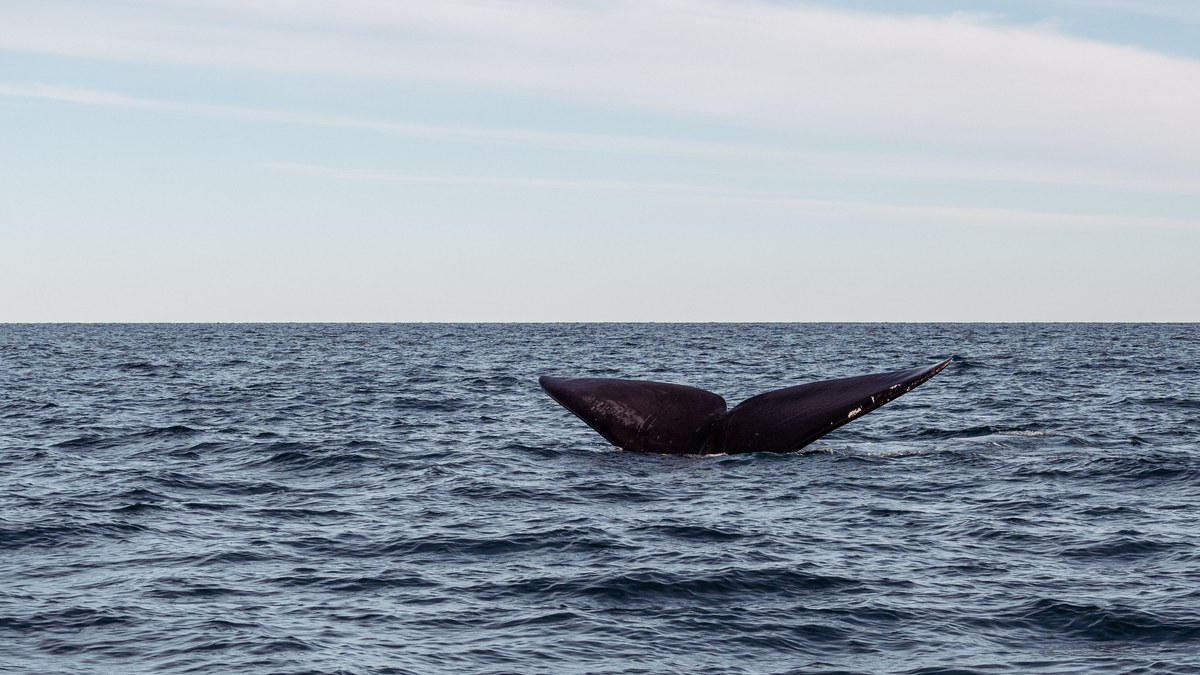
Imagine spending more than three decades singing at a party nobody else seems to have been invited to. That is, roughly, the life of the 52 Blue whale, an animal in the North Pacific that scientists nicknamed after the frequency of its call: 52 hertz.
To grasp how odd that is: blue whales typically call between 10 and 39 hertz, and fin whales around 20. The 52 Blue whale sings far higher than any of its known relatives. It’s as if a choir of basses suddenly had someone belting out falsetto, and nobody else bothered to match the pitch.
A ghost the Cold War helped uncover
The story starts, fittingly, with submarines. During the Cold War, the U.S. Navy laid a network of hydrophones across the Pacific seafloor, the SOSUS system, built to track Soviet submarines. Part of that technology was declassified for scientific use in 1992. Researchers at the Woods Hole Oceanographic Institution, led by marine biologist William Watkins, began combing through years of old recordings. Buried in tape dating back to 1989 was a voice that matched nothing else on record.
Watkins and his team tracked that same voice for more than a decade, from 1992 to 2004, across thousands of miles of ocean. Always the same frequency, always the same pattern. It shows up in the Pacific around August and stays detectable through December, before moving out of hydrophone range.
Is it really one whale — and is it actually alone?
Here’s the twist that rarely makes it into the headlines: nobody has ever seen the 52 Blue whale. No photos, no confirmed sightings, just the call — so its species isn’t even confirmed. The leading theory is that it could be a hybrid between a blue whale and a fin whale, a cross that genuinely exists and can be fertile. Another possibility is an individual with some malformation in its vocal apparatus. The catch is that a “normal” hybrid should sing at a pitch somewhere between its parents, not higher than both. So even that explanation doesn’t fully add up.
Then there’s the “nobody answers” part. The fact that no other whale calls at exactly 52 hertz doesn’t necessarily mean it’s truly alone. Researchers point out that it most likely can perceive other whales’ calls even on different frequencies. It’s a bit like how we can understand someone speaking in an unusually high voice, without needing them to match our pitch. In fact, its migration route looks a lot like a blue whale’s, while its timing lines up more with fin whales. That suggests it travels fairly close to other whales, just singing in a register nobody else shares.
From curious data point to cultural symbol
The story went viral in 2004 after a New York Times feature. Since then, the 52 Blue whale has become an accidental symbol of loneliness: it has inspired songs, a 2021 documentary (The Loneliest Whale), and countless mental-health campaigns using it as a metaphor.
What we do know for certain is that the Navy has kept picking up that same call almost every year since 1989. That rules out a one-off fluke or a single faulty hydrophone. Thirty-six years singing the same odd note, in the same corner of the Pacific. Whether it turns out to be better accompanied than we assumed, or truly is the loneliest voice in the ocean, is a question science still hasn’t closed — and maybe that’s for the best. Some mysteries are worth leaving a little unsolved.
You can read more on the scientific tracking of the case in the reference article on the 52-hertz whale.
1 thought on “The 52 Blue Whale Has Been Singing Alone Since 1989”