
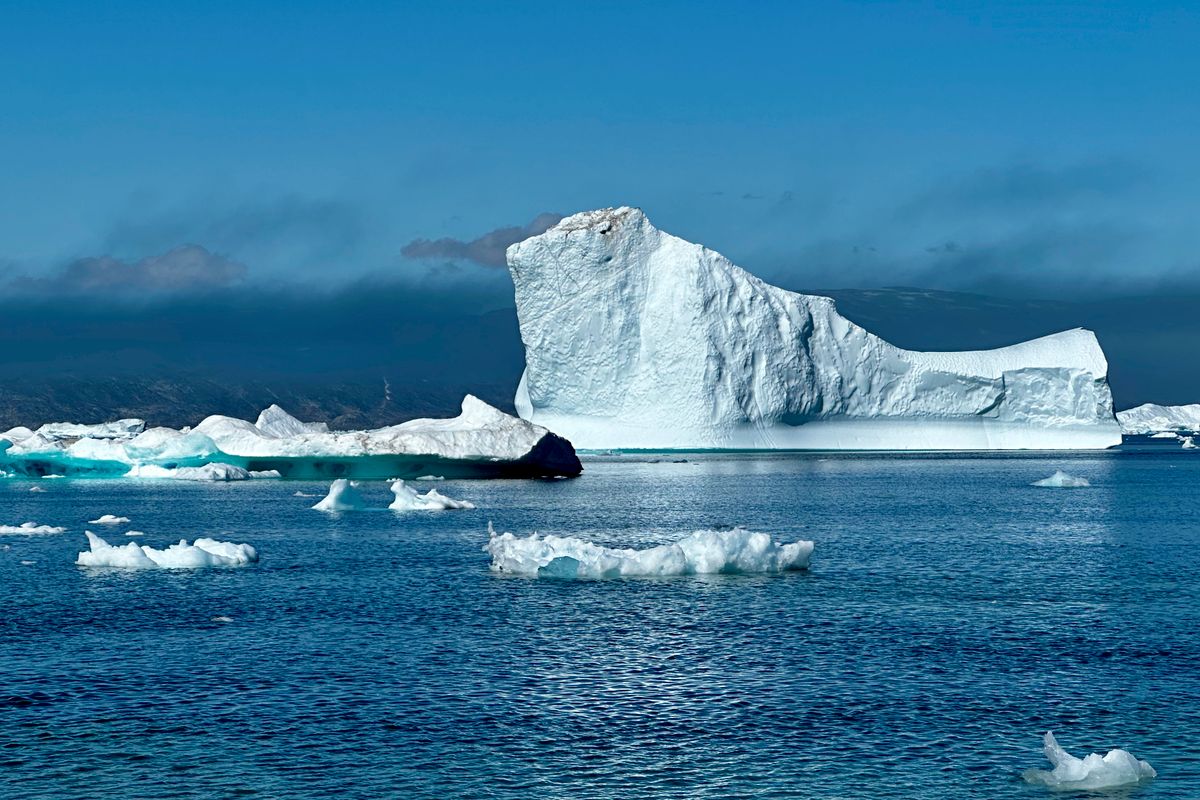
In 1942, German U-boats were picking off Allied ships like it was target practice in the middle of the Atlantic. An eccentric British inventor named Geoffrey Pyke saw this and pitched a solution that sounds like a pub joke: build a giant ice aircraft carrier. The surprising part isn’t that someone dreamed this up — it’s that Winston Churchill actually signed off on trying it for real.
The problem it was meant to fix was no joke, though. A stretch of the mid-Atlantic — grimly nicknamed the “black pit” — sat too far from any land base for fighter escorts to reach. Right there, out of range of friendly aircraft, German submarines picked apart Allied supply convoys almost unopposed. More carriers were the obvious fix, but steel and shipyards were already stretched thin by the rest of the war effort. Pyke’s answer: no steel? Fine, use ice.
The ice aircraft carrier’s secret: wood pulp
Regular ice is brittle and shatters on impact. So the real breakthrough wasn’t using ice at all — it was inventing an entirely new material: pykrete (named after Pyke himself), a mix of frozen water with roughly 14% wood pulp stirred in. The result was far tougher than plain ice and melted much more slowly. In fact, according to several wartime accounts collected in the Wikipedia entry on Project Habakkuk, it could reportedly even deflect a bullet.
The story goes that at the 1943 Quebec Conference, Lord Mountbatten — the project’s biggest champion among the Allied top brass — decided to make his case the loud way. He fired his pistol at a block of ordinary ice, which shattered on cue, then shot a block of pykrete, off which the bullet supposedly ricocheted and buzzed past the legs of the assembled generals. Different retellings disagree on the details — nobody quite agrees on whose trousers nearly caught a stray round. Still, the anecdote has probably grown taller with age, but it says a lot about how convincing the material looked in person.
A 2,000-foot ship with walls of ice
The plan, christened Project Habakkuk (after a biblical line about a work “which you would not believe, though it were told you”), called for a ship roughly 2,000 feet long — about three times the length of a modern carrier. Its ice walls would run up to 40 feet thick, threaded by a network of refrigeration pipes to keep the whole hull frozen in open ocean. Top speed: a stately 6 knots, slower than a cargo ship, but in theory nearly impossible to sink with torpedoes or bombs.
To test the ice aircraft carrier concept, engineers built a scaled-down prototype on Patricia Lake in Alberta, Canada, well away from prying eyes. That structure — about 60 by 30 feet and roughly a thousand tons — stayed frozen for months thanks to a small refrigeration unit. Moreover, it proved the concept actually held up technically.
Why it never set sail
What ultimately sank the project wasn’t physics — it was the budget. Building a single full-size Habakkuk was estimated at around $70 million in wartime dollars. Furthermore, it would have tied up thousands of workers for months just to keep it frozen. Meanwhile, the war kept moving: long-range aircraft improved enough to cover the “black pit” without any new ice aircraft carrier at all. Therefore, the United States started churning out conventional carriers at an industrial pace. By early 1944, before a single real keel was laid, the project was quietly shelved.
Today, all that’s left of the plan sits at the bottom of Patricia Lake, where the prototype’s remains — ballast, machinery, bits of structure — still rest, now a quirky spot for scuba divers. A fitting reminder that history’s most far-fetched ideas don’t always fail because they were bad — sometimes they just show up a little too late, much like another extravagant, budget-busting military project decades later.