
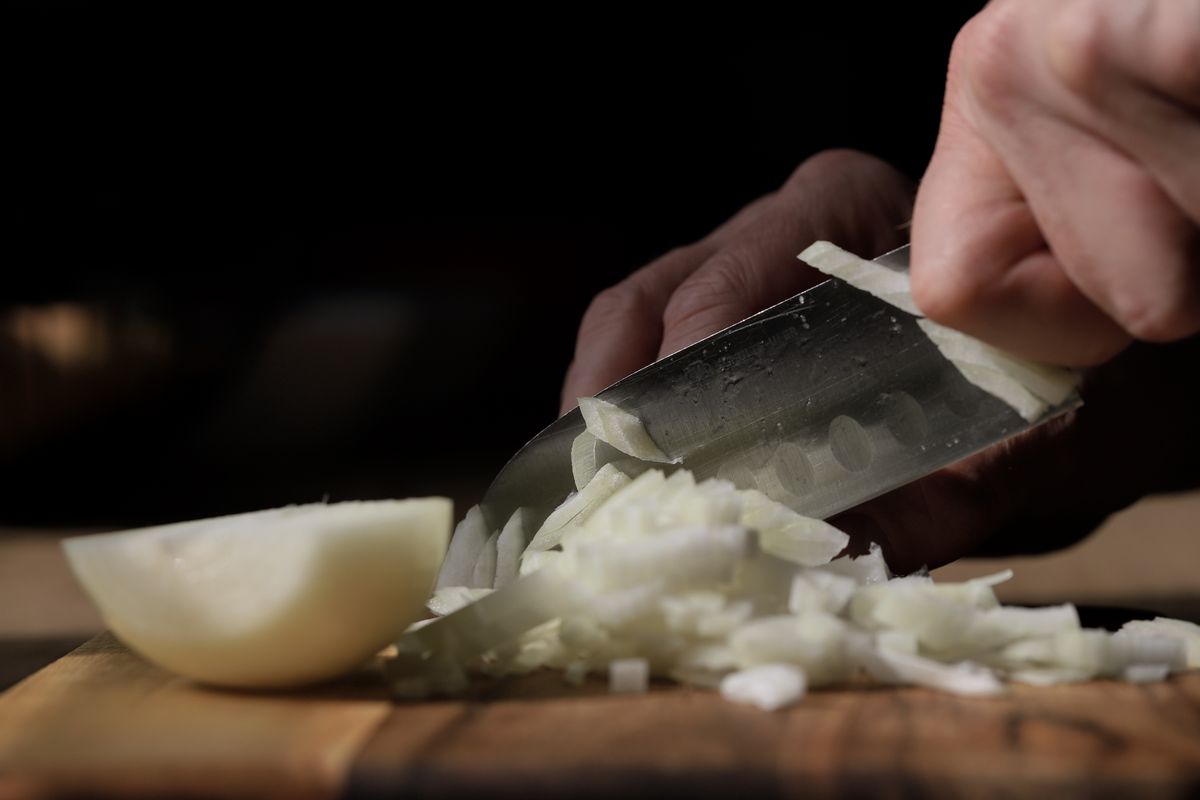
You pick up the knife with the best of intentions, and thirty seconds later you’re crying like you just watched the end of a tearjerker. It’s not you, and it’s not a lack of kitchen toughness: onions make you cry through a precision chemical trap the plant has been perfecting since long before knives even existed.
It all starts the moment you break open the bulb’s cells. While the onion is intact, it quietly stores a sulfur-rich compound inside its cells (scientists call it PRENCSO) kept neatly separate from the enzymes that could activate it. Think of it like keeping gunpowder in one drawer and the fuse in another: apart, nothing happens.
A two-step reaction built to make onions make you cry
The trouble is, your knife erases that separation. The instant the cells rupture, an enzyme called alliinase meets the PRENCSO and turns it into an unstable acid. So far, nothing worth crying over. But the onion has a second trick up its sleeve: another enzyme, lachrymatory-factor synthase (LF-synthase, for short), converts that acid into the real chemical weapon — a volatile compound called syn-propanethial-S-oxide. That gas floats straight up from the cutting board into your eyes, and that’s where the drama begins.
As biochemist Giles Johnson explains in The Conversation, this two-enzyme chain is exactly why decades of pop-science explanations oversimplified things. In fact, it’s not just that cells break — both enzymatic steps have to happen in sequence for the irritant gas to actually form.
Why your eye switches into sprinkler mode
Syn-propanethial-S-oxide doesn’t irritate you because it’s toxic — it irritates you because it’s extremely reactive. The moment it touches the moist surface of your eye, it reacts with the water in your tears and forms tiny traces of acid. Your cornea, essentially raw nerve tissue exposed to open air, reads that acidity as a genuine threat. Therefore, it fires an alarm signal straight to your brain. The response is automatic and immediate: your tear glands flood the eye to dilute and flush out the acid before it can do more damage. It is, quite literally, your body hitting the fire sprinkler.
This also explains why onions make you cry more with a dull knife than a sharp one: instead of slicing cleanly, a dull blade crushes far more cells than necessary, dumping a much bigger burst of gas all at once. So, counterintuitively, sharpening your knife beats any pair of swim goggles when it comes to fighting the tears.
Why do garlic and leeks get off scot-free?
Here’s the most curious part: garlic, leeks, chives and shallots are all close botanical relatives of the onion. They also produce sulfenic acids when you cut them. But according to the same research, most of them lack — or carry only trace amounts of — that second enzyme, LF-synthase, the one that actually manufactures the final irritant gas. Without that second step, the reaction stalls halfway and never turns into anything that will make you tear up. The entire difference between calmly mincing garlic and watching onions make you cry boils down, basically, to one single enzyme that some plants have and others don’t.
The onion that decided to stop making people cry
If this sounds like a losing battle, there’s good news: a real variety called Sunions exists, developed through more than three decades of conventional cross-breeding (no genetic engineering involved) by the agricultural company now owned by BASF. According to the manufacturer itself, breeders hand-selected the least pungent bulbs generation after generation. As a result, they produced plants with enzyme levels too low to generate the irritant gas in any bothersome amount. Even more unusual: unlike regular onions, whose volatile compounds build up over time, Sunions’ levels actually drop the longer they sit in storage, so these onions make you cry far less the longer they wait in the fruit bowl. They first went on sale in the United States in 2017 and reached UK supermarket shelves years later.
So next time you find yourself crying over the cutting board, take comfort in knowing it isn’t weakness. It’s plant defense chemistry, honed over millions of years of evolution, working exactly as designed. The onion, quite simply, plays dirty. And if your kitchen still smells like garlic afterward, you can also check whether the stainless-steel trick against garlic smell actually works.