
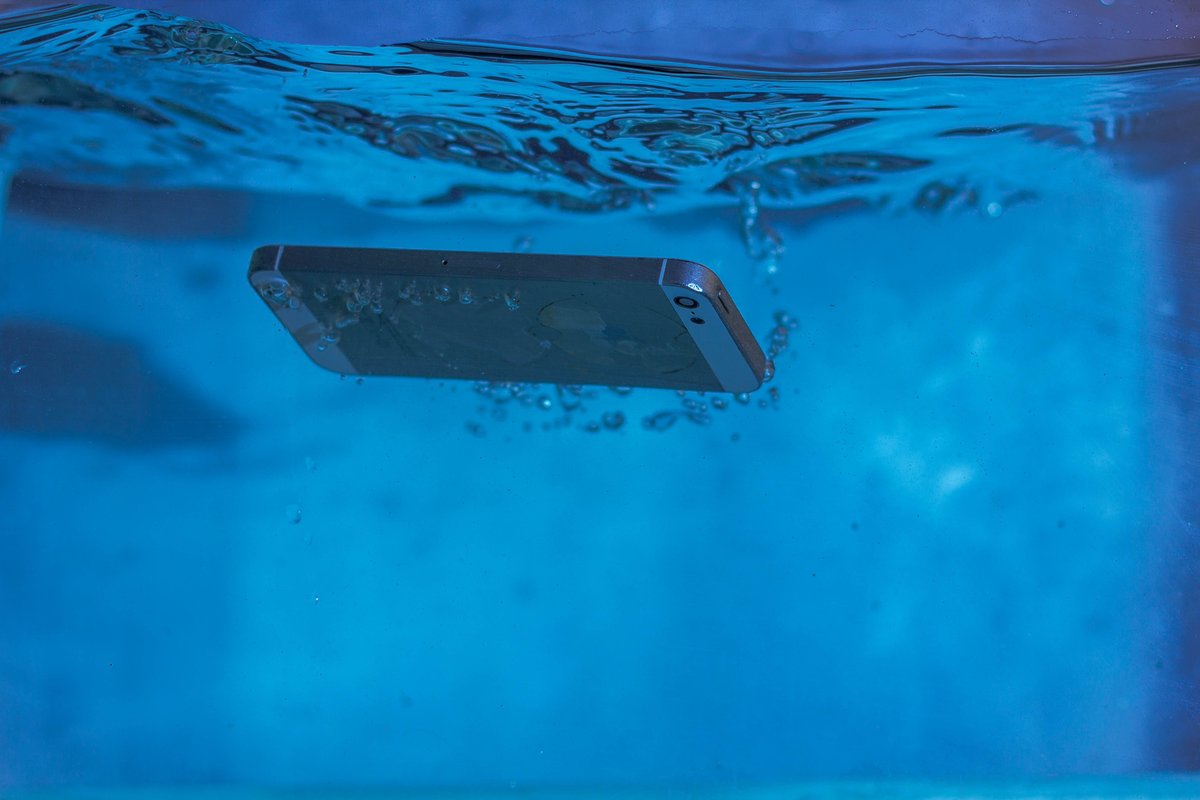
Today’s trick isn’t really a trick at all. It’s the opposite of what half of humanity has been doing for decades. If you drop your phone in water, burying it in a bowl of rice is probably the worst thing you can do about it. That’s not an opinion, it’s Apple’s own official advice.
For years, rice has been the go-to home remedy for any soaked gadget. The phone slips into the toilet, the pool or a glass of water, and someone inevitably yells “rice, quick!” Nobody really stopped to check whether it worked. Apple did it for everyone: its official support page explicitly tells you not to put a wet iPhone in a bag of rice.
The Method That Actually Works for a Phone in Water
- Get it out of the water as fast as you can and unplug any cable, case or connected accessory.
- Wipe the outside with a soft, lint-free cloth, without rubbing at the ports.
- Hold it with the connector (the charging port) facing down and gently tap it against your palm, letting gravity help pull out any water trapped inside.
- Leave it somewhere with good airflow, away from direct sunlight and any heat source, for at least 30 minutes.
- If you get a “liquid detected” warning when you plug it in, don’t push it: wait up to 24 hours before trying to charge it again.
- If it still won’t charge after that, take it to a repair shop before any trapped moisture turns into actual corrosion.
One more thing: if your phone supports wireless charging, you can use that while the connector finishes drying out. Just make sure the back of the phone is already dry first. That’s the whole advantage of charging without plugging anything into a hole.
Why it works (and why rice doesn’t)
That’s worth remembering, because once you have a phone in water, the moisture that matters isn’t just in the air. Rice is hygroscopic, meaning it pulls some moisture out of the air around it, the same principle behind those little silica packets that come in shoeboxes. But here’s the catch: it does this very slowly, and the water that actually matters isn’t the water floating around in the air. It’s the water trapped by surface tension inside the microscopic gaps of the speaker mesh, the microphone or the charging port. Rice has no way of sucking that hidden water out of such tiny spaces. At best, it slightly lowers the humidity in the air while the phone stays soaked on the inside for hours. That’s exactly enough time for the metal pins to start corroding.
On top of that, rice introduces a brand-new problem: it sheds dust and tiny grains. Those can work their way into the charging port or the speaker grille and get stuck there permanently. You’re basically trading water for ground-up rice, which doesn’t exactly improve things.
Tapping the phone with the connector facing down, on the other hand, relies on something far more reliable than cereal chemistry: good old physics. Gravity pulls liquid water back out the same way it got in, and the motion helps break the surface tension holding those droplets to the internal surfaces. After that, moving air, not heat, helps any remaining moisture evaporate without damaging the rubber seals or adhesives that keep the phone sealed shut. A hair dryer or compressed air can actually do the opposite, pushing water deeper in instead of out.
So next time someone has a phone in water —the pool, the toilet, wherever— you’ll know what to tell them: skip the emergency rice dish. Just gravity, airflow and a little patience.