
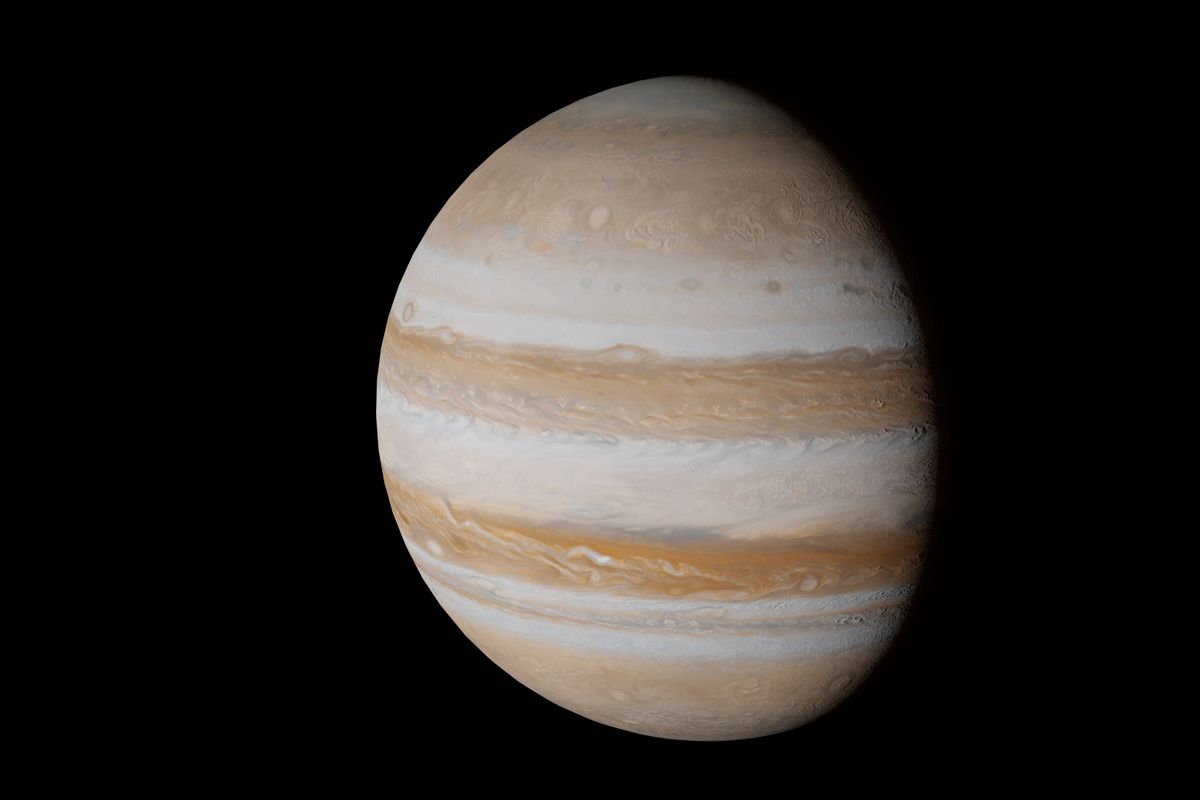
Imagine opening a weather app and checking the forecast… for a world that’s neither a planet nor a star, sitting 20 light-years from Earth. Sounds like science fiction, but that’s exactly what a team of astronomers just pulled off using the James Webb Space Telescope. And here’s the kicker: that world’s “weather report” only has three weather states, and they repeat like clockwork.
A cosmic oddball that can’t decide what it is
Our main character is called SIMP 0136, and it’s what astronomers call a free-floating planetary-mass object (or, according to other studies, a brown dwarf). It’s something too big to be a normal planet, but too small to ever ignite nuclear fusion and become a proper star. It weighs in at roughly 13 times the mass of Jupiter. And unlike Earth or any typical exoplanet, it doesn’t orbit a star at all — it just drifts through space on its own.
On top of that, it spins at a dizzying pace: its “day” lasts barely 2.4 hours. That breakneck rotation is exactly what let scientists “film” how its atmosphere changes lap after lap. It’s the same way a weather satellite watches Earth spin beneath its cameras.
How you forecast the weather without actually being there
A team at Trinity College Dublin used Webb data to measure how SIMP 0136’s infrared brightness shifted as it rotated. Those tiny flickers of light aren’t noise — they give away which parts of its atmosphere are hotter or colder, and how high and thick the clouds are in each spot.
Using a statistical method called principal component analysis, the researchers found something surprising. All that variability, which looks chaotic at first glance, boils down almost entirely to just two factors: temperature and cloud altitude. It’s the same basic logic Earth-bound meteorologists rely on. Except here there’s no dedicated weather satellite, just a telescope parked a million miles from Earth, doing double duty as humanity’s eye in the sky.
Only three weather states, and they keep coming back
By combining those two factors, the team pinned down exactly three weather states that take turns showing up on SIMP 0136’s visible face:
- A hot region with thin, sparse clouds.
- A cooler region, also with relatively thin clouds.
- A third, equally cool region, but piled with much higher, thicker clouds.
What’s striking isn’t just that there are three states — it’s that they keep reappearing in a stable pattern. The team watched them cycle back again and again over more than a dozen full rotations, spanning well over a day and a half of Earth time. No random chaos here: it’s an almost predictable pattern, as if this wandering world had its own miniature “seasons,” squeezed into hours instead of months.
Why this matters beyond the trivia value
Figuring out the weather on SIMP 0136 isn’t just a fun fact to drop at dinner. Objects like this one are, in many ways, the perfect lab for studying atmospheres similar to those of gas giants and far more distant exoplanets that are much harder to observe in detail. If astronomers can “read” the climate of a world 20 light-years away using nothing but brightness flickers, the same trick could eventually be pointed at other worlds. Among them, potentially habitable exoplanets, to figure out whether they have clouds, storms, or seasons of their own. It’s the same exploratory drive that led another team to uncover the hidden ocean beneath the ice of Uranus’s moon Ariel, another distant world that kept its secrets hidden in plain sight.
So next time you grumble about your local weather forecast, remember there’s a lonely, sunless world out there, spinning at breakneck speed 20 light-years away. It has three weather states more predictable than the climate of most capital cities. The findings, published in the journal Astronomy & Astrophysics, were covered by ScienceDaily, which breaks down how the James Webb telescope is turning astronomers into history’s first interstellar weather forecasters.