
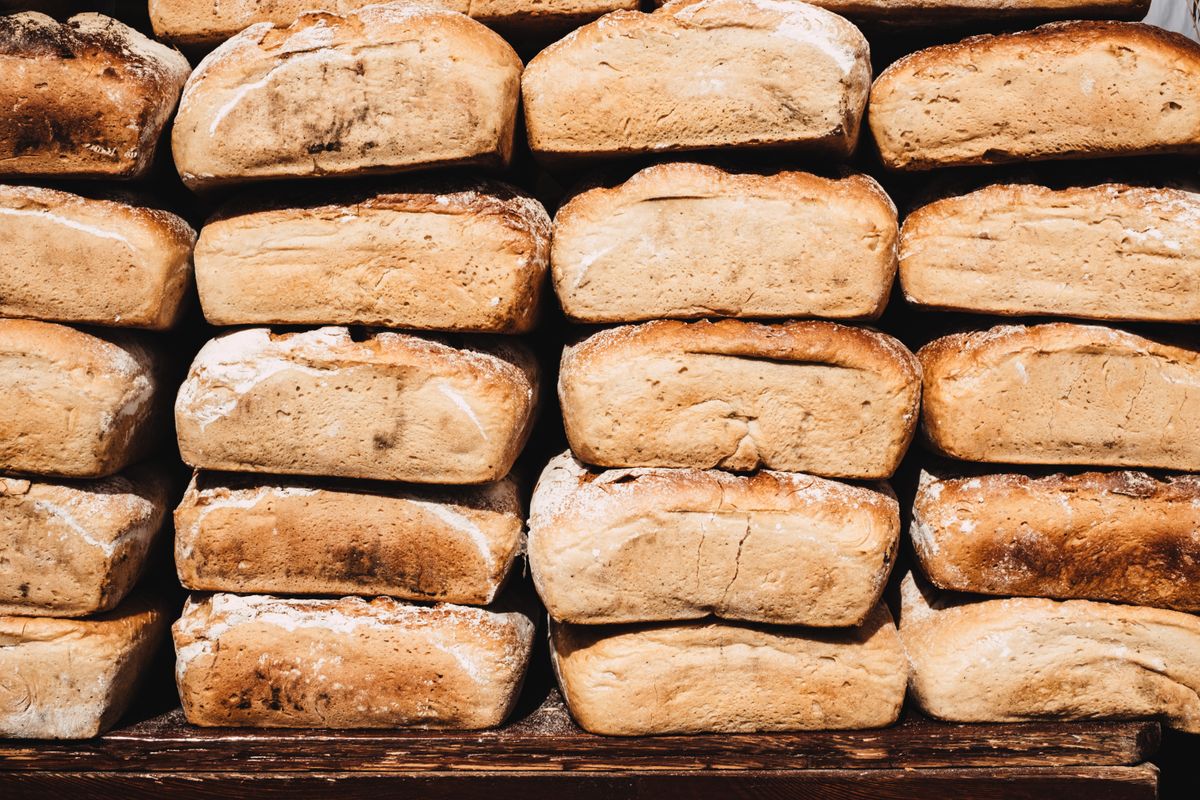
There’s a move a lot of people make without thinking twice. Half a loaf is left over. So you wrap it up and shove it in the fridge “to keep it fresh.” Seems like common sense — cold preserves things, right? With bread, keeping it in the fridge does the opposite. Today’s trick is almost an anti-recipe: never put bread in the fridge. Of every spot in your kitchen, the refrigerator is the one that turns a loaf into a brick the fastest. The culprit has a name that sounds like a spell: starch retrogradation.
How to do it
- If you’ll finish the bread within 2-3 days, keep it out of the fridge: wrapped in a cotton cloth or paper bag for crusty loaves, or in a sealed bag for soft sandwich bread.
- If you know you won’t get through it in time, slice it before it starts drying out and freeze it right away in a bag with as much air pressed out as possible.
- To thaw a slice, drop it straight into the toaster without letting it come to room temperature first — the sudden heat stops the starch from re-hardening mid-thaw.
- If you need to thaw a whole loaf, leave it at room temperature inside its own bag for a couple of hours, so the moisture it releases doesn’t escape too soon.
- Save the fridge for genuinely hot, humid climates where mold can show up in under two days — there, it’s a lesser evil than throwing the loaf away.
Why bread in the fridge turns stale faster
When bread comes out of the oven, the heat has swollen and gelatinized the starch granules. This traps water between the amylose and amylopectin chains that make them up. That loose, water-rich structure is exactly what we feel as a soft crumb. But over time, those same molecules tend to settle back into a tighter, more crystalline arrangement. That reorganization is retrogradation. As it happens, it squeezes the trapped water out toward the crust and leaves the crumb dry and tough. It’s also why stale, rubbery bread “comes back to life” a little when you heat it. The heat temporarily scrambles those crystals again, even if only for a few minutes.
The counterintuitive part is how fast this happens depending on temperature. Retrogradation isn’t simply “slower the colder it gets”. It has a sweet spot, and that sweet spot lands right in the range of a home fridge. That’s roughly 0 to 5 °C (32 to 41 °F). At that temperature, starch molecules have just enough mobility to reorganize quickly. At room temperature the process is noticeably slower, because even though there’s more molecular movement overall, there’s less thermal “incentive” to crystallize. And in the freezer, below -18 °C (0 °F), it practically stops. The molecules there are too locked in place to rearrange at all. That’s why a loaf can go rock-hard in bread-in-the-fridge storage within hours. That same loaf, however, stays soft on the counter for several days. It also keeps perfectly well for months in the freezer.
Worth clearing up: this isn’t only about moisture lost to evaporation. Even bread sealed airtight, with no way to dry out on the outside, still hardens just as fast in the cold. That’s because the process happens inside the starch’s own molecular structure, not through the surface. The one real reason to reach for the fridge is that cold does slow mold growth. So it really comes down to priorities: are you more worried about mold or about a hard crust? For most homemade or bakery bread, which tends to get eaten within a few days anyway, the case for leaving it on the counter is pretty clear-cut. Several deep dives into bread science lay this out, including Today I Found Out‘s explainer on why bread goes stale so much faster in the refrigerator.
Bread isn’t the only food that behaves the opposite of common sense in the fridge. Bananas are much the same: a simple plastic-wrap trick slows their ripening without needing to chill them at all. So next time half a loaf is staring at you from the counter, resist the urge to keep bread in the fridge “to keep it safe.” Either eat it this week straight off the counter, or slice it up and freeze it, and let your future self — toaster in hand — decide when it gets to shine again.