
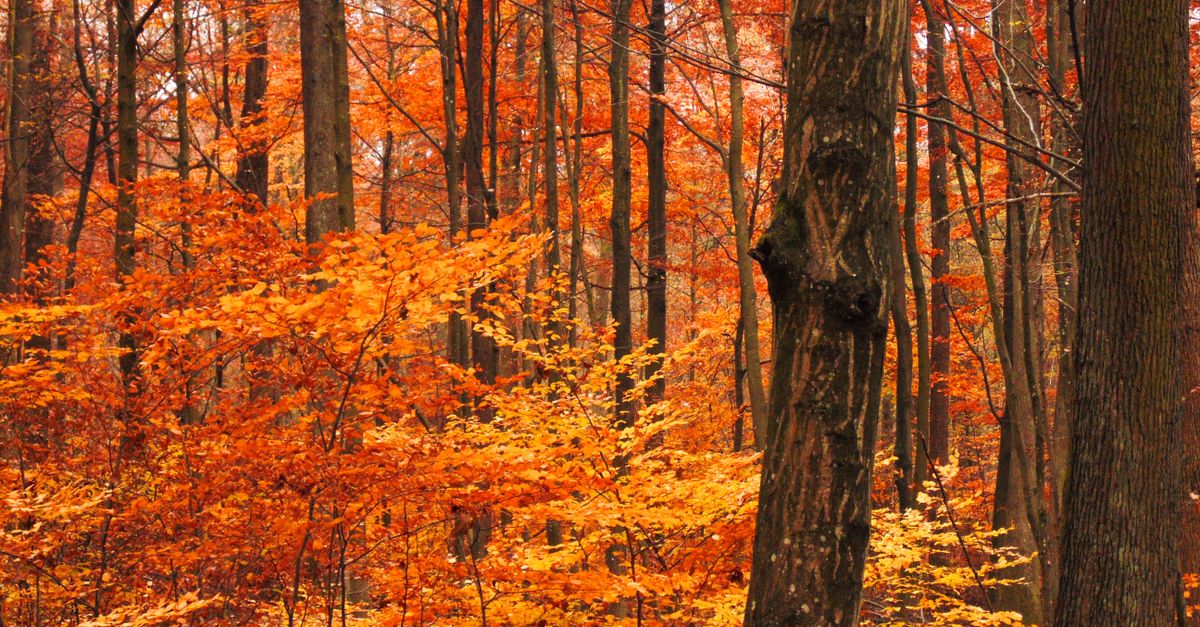
Every October, the same thing happens. Forests catch fire in orange, red and yellow as if someone flipped a switch. Saying that leaves turn red in autumn just because of the cold doesn’t really cut it. In reality, leaves don’t actually turn those colors: they were already that color. What changes is that, for the first time in months, they stop disguising themselves.
The trick is in what was already there
Through spring and summer, leaves are packed with chlorophyll, the green pigment that captures sunlight for photosynthesis. It’s so abundant and so green that it completely masks other pigments that have been sitting there the whole time. Those are the carotenoids, responsible for yellow and orange tones, the same ones that color a carrot or a banana.
As days get shorter, the tree senses that profitable photosynthesis season is winding down. So it stops producing chlorophyll. As the existing supply breaks down, green exits the stage, and underneath it, the yellows and oranges that had been waiting in the wings since April finally show up. It’s not magic — it’s just that the background set is finally visible.
Why leaves turn red: the extra-work pigment
Here’s the genuinely odd part: understanding why leaves turn red, not just yellow, in some species. The deep reds and purples in species like maples weren’t hiding, waiting their turn. The tree actively manufactures them in autumn, spending energy to produce a pigment called anthocyanin right when it’s preparing to drop the whole leaf. Why bother decorating something you’re about to throw away in two weeks?
Scientists are still debating the answer. One hypothesis, championed by researchers like William Hoch at the University of Wisconsin-Madison, proposes that anthocyanin acts as a kind of sunscreen. While the tree is busy recovering valuable nutrients (especially nitrogen) from the leaf before it falls, the red pigment filters out excess light and protects that “recycling” process from photo-oxidative damage, as described in this study reported by Live Science. A different hypothesis, based on research into Norway maple leaves, suggests anthocyanin is mostly about managing a surplus of sugars the tree can no longer transport out. This frees up the photosynthetic machinery to keep producing energy during the shutdown process.
A third data point, presented at a Geological Society of America meeting, found that trees growing in nitrogen-poor soils are precisely the ones that produce the most anthocyanin. It’s as if they were working harder to squeeze out every last gram of nutrient before letting the leaf go.
These hypotheses aren’t necessarily mutually exclusive, and autumn red might be doing several jobs at once. What does seem clear is that it’s not a freebie decorative effect: it costs energy. And in biology, nothing that costs energy survives for long unless it’s earning its keep.
The leaf isn’t giving up — it’s retiring with a plan
While all this is happening, a tiny structure called the abscission layer is forming at the base of each leaf. It’s a ring of cells that gradually cuts off the flow of water and nutrients between branch and leaf. The tree doesn’t drop the leaf all at once. Instead, it “disconnects” it over several weeks while squeezing out every last reclaimable nutrient, and only once that recovery job is finished does the layer become brittle enough for a gust of wind to finish the job.
That’s why the most spectacular autumns — the postcard-worthy ones — need a very specific combination. There have to be sunny days and cool nights, without hard frosts. Daytime sun keeps generating sugars in the leaf, and nighttime cold slows down their transport to the rest of the tree. That sugar traffic jam is exactly what triggers anthocyanin production. A cloudy, mild autumn, by contrast, produces much duller colors.
There are even exceptions that prove the rule: alder trees, for instance, barely change color in autumn. Since they live in symbiosis with nitrogen-fixing bacteria in their roots, they don’t need to be as careful about recovering that nutrient from their leaves before shedding them. So they skip the whole intense-coloring process. Leaves aren’t the only place where plant chemistry pulls off a trick like this: onions, for one, wage an entirely different chemical war the moment you cut into them, purely defensive and unrelated to autumn. So next time you walk under a tree blazing with color, you can be sure of one thing: it’s not autumn switching off summer. It’s the tree taking inventory before closing for the season.