
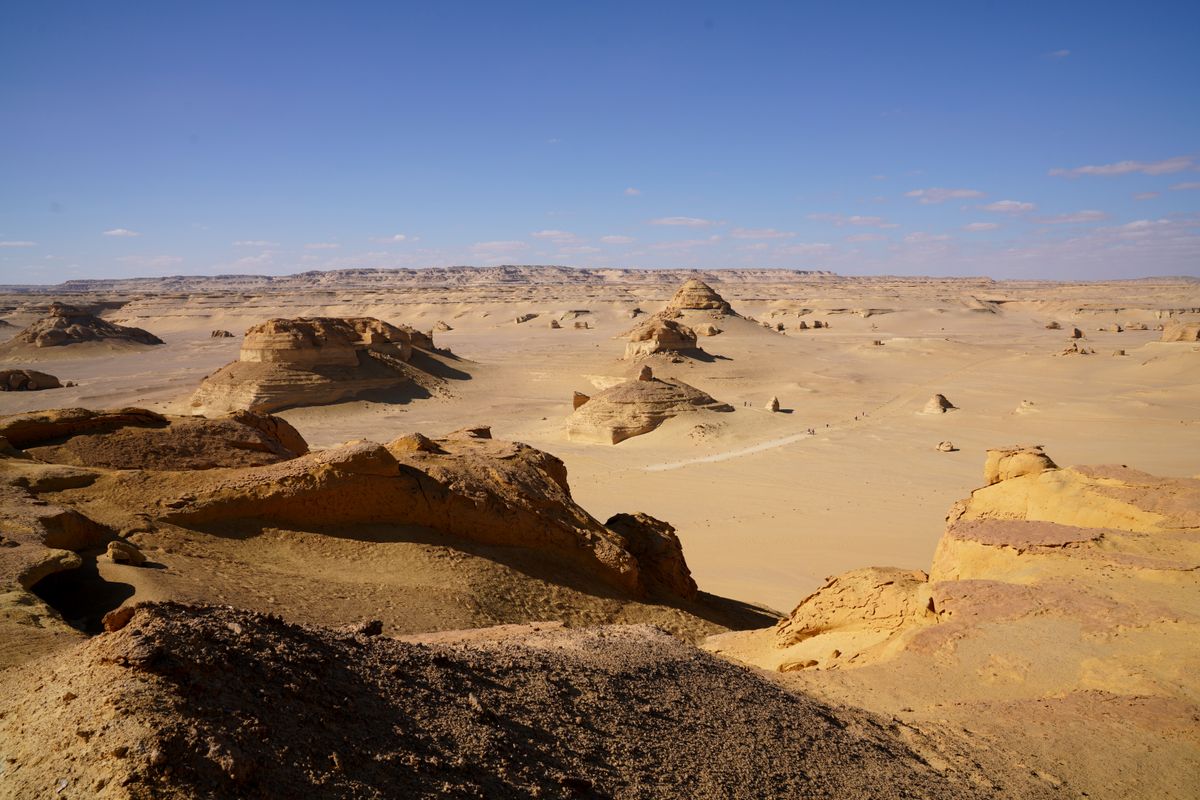
Picture a patch of desert bigger than the city of Los Angeles, with no permanent residents, no flag, no embassy… and where, in theory, anyone could try to declare their own personal kingdom just by sticking a flag in the sand. It’s real. It’s called Bir Tawil, it covers about 2,060 km² (795 square miles), and it sits wedged between Egypt and Sudan. The strange part isn’t that nobody wants it — it’s that the two countries surrounding it actively refuse to take it.
A border mess nobody there actually drew
Blame two lines drawn by the British back when they administered the region. In 1899, the UK set the border between Egypt and Sudan along the 22nd parallel — a clean, straight line on the map. Then, in 1902, they drew a second, different line meant to reflect how local tribes actually used the land, rather than pure geometry. The catch: the two lines don’t match, and the mismatch creates two disputed slivers of territory — Bir Tawil, a bare stretch of desert with no known resources, and the Hala’ib Triangle, a far juicier strip with Red Sea coastline and deposits of gold and oil. It isn’t the planet’s only quirky border: something similar happens with the Diomede Islands, just 2.4 miles apart yet nearly a day apart in time.
Why nobody wants the “free” land
Here’s the catch that explains the whole thing. Under the 1899 line, Hala’ib falls on Egypt’s side and Bir Tawil on Sudan’s. Under the 1902 line, it’s exactly the other way around: Hala’ib would belong to Sudan and Bir Tawil to Egypt. Egypt, naturally, backs the 1899 line because it hands Egypt the valuable part, Hala’ib. Sudan backs the 1902 line for the exact same reason. The result: both countries fight tooth and nail over the Hala’ib Triangle, but neither one claims Bir Tawil — accepting that patch of desert would automatically mean giving up their preferred line, and with it, the resource-rich territory. According to Wikipedia, it’s one of the only pieces of land on the planet, outside Antarctica, officially recognized as terra nullius — nobody’s land, with no state holding any legally recognized sovereignty over it.
Weekend Kings of Bir Tawil (and Their Problems)
Unsurprisingly, land with no owner tends to attract people who fancy themselves royalty. In 2014, Virginia farmer Jeremiah Heaton traveled there, planted a homemade blue flag, and proclaimed the “Kingdom of North Sudan,” crowning himself king. His motive was almost sweet: he wanted to make good on a promise to his daughter, who’d always dreamed of being a real-life princess. Years later, he even floated turning his “kingdom” into a crowdfunded nation, offering noble titles to anyone willing to chip in.
In 2017, it was Indian entrepreneur Suyash Dixit’s turn. He crossed into Bir Tawil, planted his own flag, scattered sunflower seeds — a traditional symbolic gesture of taking possession — and declared himself king of the “Kingdom of Dixit,” appointing his own father as president. He asked the United Nations for official recognition, which responded, fairly enough, that drawing borders between states isn’t part of its job. Heaton, for his part, accused Dixit of lying about whether he’d actually set foot in the territory at all.
None of these self-coronations carry any legal weight: no court and no international body recognizes personal sovereignty over a territory just because someone planted a flag there, however fun the fiction is. Meanwhile, Bir Tawil just sits there on the map, officially unowned, proof that geopolitics can look less like statecraft and more like a stubborn chess match — two players who’d rather leave a square empty than hand the other one the piece that actually matters.