
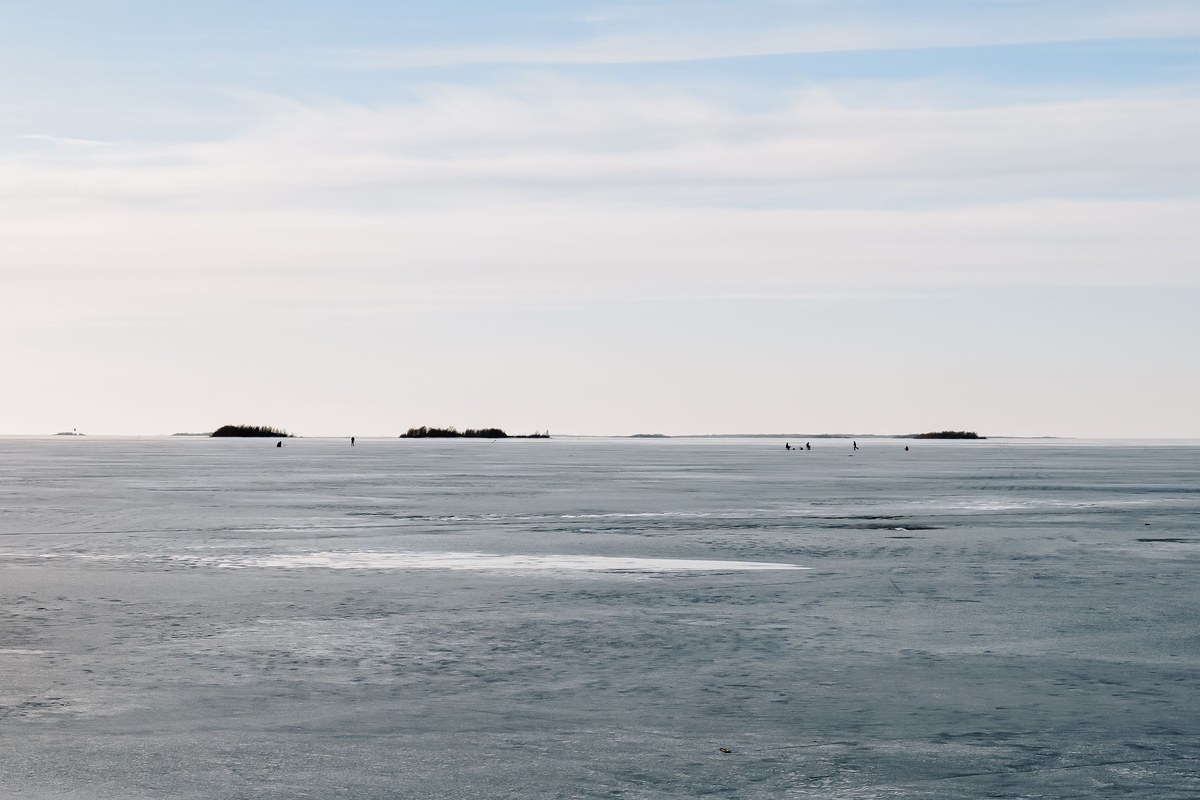
Picture shouting across to your neighbor and, technically, talking to them from yesterday. That’s the reality of the Diomede Islands, two lumps of rock sitting in the middle of the Bering Strait that are just 3.8 kilometers (2.4 miles) of icy water apart… and almost an entire day apart in time.
Big Diomede belongs to Russia. Little Diomede belongs to the United States (Alaska). The International Date Line runs right between them, so when it’s three in the afternoon on Tuesday on the American island, over on the Russian one — close enough to see with the naked eye — it’s already Wednesday morning. The time gap hits 21 hours (20 in summer), which is exactly why locals nicknamed them “Tomorrow Island” and “Yesterday Island.”
A Border That Split the Diomede Islands in Two
Before any border existed, both islands were home to the same Iñupiat community, who visited, traded, and intermarried across the water without giving much thought to which side they technically lived on. The trouble started in 1867, when Russia sold Alaska to the United States. Without anyone bothering to ask the Iñupiat themselves, the new line landed right in the middle of the strait, slicing one extended family into two countries.
For decades that wasn’t much of a problem: in winter the sea froze solid, and people kept walking across from one island to the other to visit, the way you’d pop over to grandma’s — except grandma now officially lived abroad.
When the Iron Curtain Froze Over
Then the Cold War arrived. In the late 1940s, the Soviet Union turned Big Diomede into a military base and forcibly relocated its entire native population to the mainland. Little Diomede, on the American side, became the West’s northernmost outpost: anyone who wandered too close to that invisible line on the ice risked getting picked up. In fact, according to one survivor’s account, Iñupiat who were caught near the border spent weeks in detention and interrogation before being expelled and warned never to return.
The press at the time nicknamed this frozen frontier the “Ice Curtain,” an Arctic — and quite literally frozen — cousin of the Iron Curtain. For forty years, two islands that could see each other in plain daylight ended up almost completely cut off, separated not just by water but by two superpowers glaring at each other across it.
The Swimmer Who Thawed the Border, If Only for a Day
The strangest scene in the whole story unfolded in August 1987. American swimmer Lynne Cox waded into the freezing waters of the Bering Strait, just a few degrees above freezing point, and swam roughly 2.2 miles from Little Diomede to Big Diomede — crossing from one country into the other and, along the way, officially skipping an entire day on the calendar. She was the first person to legally cross between the two islands in decades. The gesture made such an impression that both President Ronald Reagan and Soviet leader Mikhail Gorbachev publicly congratulated her, in one of those small symbolic moments that helped thaw relations between the two blocs right before the Cold War ended.
A Corner of the World That’s Emptying Out
Today, the Diomede Islands still live in two different worlds: Big Diomede remains a largely uninhabited Russian military outpost, while Little Diomede still holds a small Iñupiat village reachable only by helicopter or small plane — the sea no longer freezes as reliably as it used to. Its population has dropped from 178 residents in 1990 to just 77 in 2023, squeezed by isolation and, increasingly, by Arctic ice loss, which is literally eating away at the ground the village sits on.
So next time someone complains about jet lag from a transatlantic flight, remind them that the Diomede Islands prove you can “time travel” almost a full day just by swimming a channel shorter than plenty of weekend kayak trips. Just bring a good wetsuit — and, more importantly, a valid visa.
If quirky borders are your thing, meet Pheasant Island, a tiny islet that switches nationality every six months.
Source: Wikipedia — Diomede Islands.