
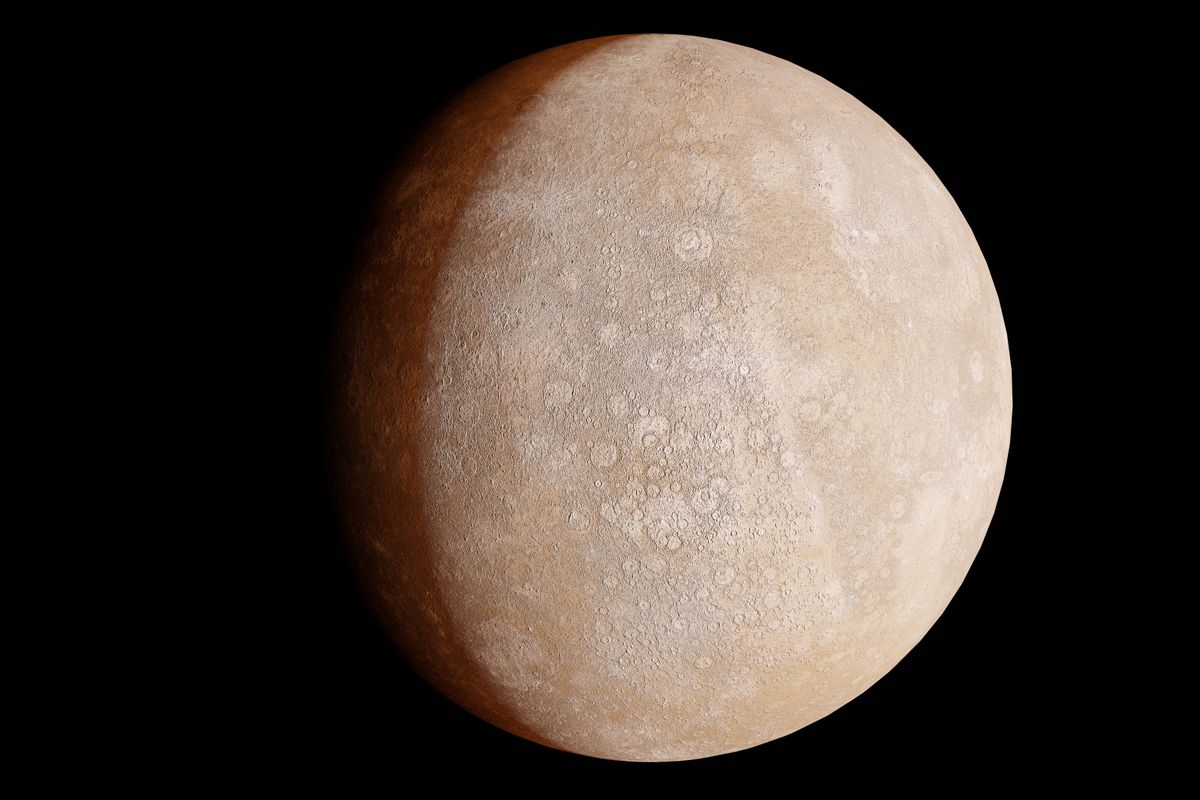
On November 21, 2026, if everything goes to plan, BepiColombo arrives at Mercury. A bus-sized spacecraft will slam on the brakes in front of the most scorched planet in the solar system and let its gravity catch it. It’s a joint mission by the European Space Agency (ESA) and Japan’s JAXA, and it’s been travelling toward the planet since October 20, 2018. Eight years to cover a distance that, in a straight line, you could clear in a matter of months. Why so long? That’s where it gets interesting.
The “nearby” planet that’s a nightmare to reach
It sounds backwards. However, Mercury is, energy-wise, harder to reach than Pluto — we cover that comparison in detail in our piece on why reaching Mercury takes almost as long as reaching Pluto. The problem isn’t getting there, it’s slowing down enough not to shoot straight back out into space. The closer you get to the Sun, the harder its gravity pulls, and an approaching spacecraft keeps picking up speed the whole way in; to settle into orbit, you have to cancel out most of that extra speed, and that eats an enormous amount of fuel.
ESA and JAXA’s workaround has been an eight-year detour using solar-electric propulsion, low-thrust but highly efficient engines that have been firing for almost the entire trip. On top of that, the route combines nine gravity assists: one flyby of Earth, two of Venus, and six of Mercury itself, the last one in January 2025. Each flyby borrows a free nudge from that planet’s gravity to bend the trajectory without burning fuel.
Why BepiColombo arrives at Mercury a year late
Arrival was originally scheduled for December 2025. Still, a fault in the spacecraft’s electric thrusters forced ESA’s flight dynamics team to redesign the route on the fly. Available thrust dropped below the minimum needed for the orbit-insertion burn, pushing the date back almost a full year, to November 21, 2026. That’s not a small detail: after eight years of travel, a last-minute glitch could have left the mission drifting near its destination, unable to settle into orbit.
Once Mercury’s gravity has it, BepiColombo still has to pull off 16 more maneuvers. Between December 9 and 10, 2026, its two twin spacecraft will separate. One is the MPO (Mercury Planetary Orbiter, ESA), which will study the surface, geology and interior. The other is Mio (Mercury Magnetospheric Orbiter, JAXA), focused on the planet’s magnetic field — one of the weakest and strangest for a rocky world anywhere in the solar system.
What scientists are hoping to find
The science phase won’t actually start until April 2027. Even so, the goals are already clear. Scientists want to figure out why Mercury has a disproportionately huge metallic core (it takes up more than 80% of the planet’s radius, compared to a bit over 50% on Earth), where its thin exosphere comes from, and what keeps its magnetic field running on such a small world. These are questions that have been open for decades, since the first photos taken by NASA’s Mariner 10 probe in the 1970s. Moreover, NASA’s MESSENGER mission could only partly answer them, between 2011 and 2015.
So while the rest of the solar system keeps grabbing headlines with new comets and telescopes, there’s a spacecraft that’s spent eight years quietly running an obstacle course of its own. In just a few weeks, BepiColombo arrives at Mercury and stakes everything on reaching orbit in the final stretch of that journey. The detailed mission timeline is available on ESA’s BepiColombo operations page.