
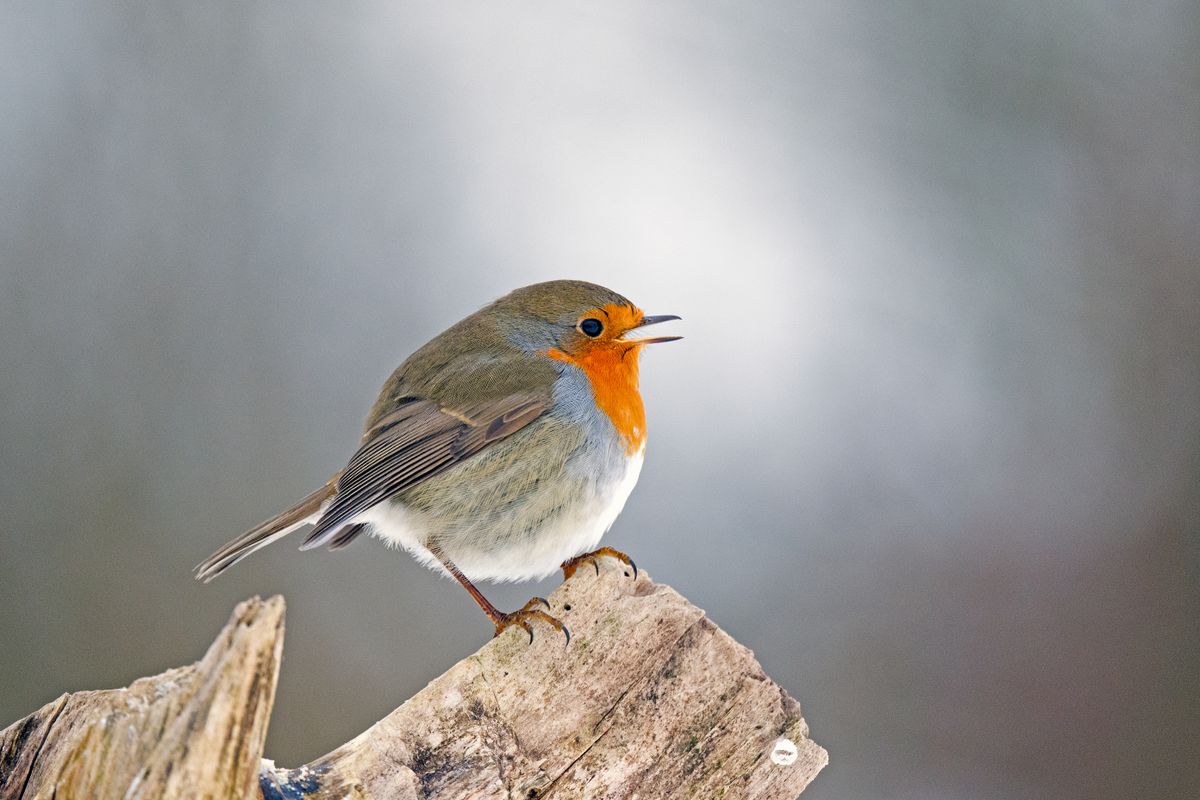
Every autumn, a European robin weighing about as much as two tablespoons of sugar takes off from Scandinavia and lands, weeks later, at a specific spot in North Africa. No map, no GPS, no asking for directions. For decades scientists suspected migratory birds carried some kind of internal compass, but the explanation that has gained the most traction in recent years sounds straight out of science fiction: these birds may actually be seeing Earth’s magnetic field, thanks to a quantum physics effect happening inside their own eyes.
A compass hiding in the retina
The prime suspect is called cryptochrome, a blue-light-sensitive protein found in the retinal cells of birds like the robin. It’s not in their skin, their beak, or some mysterious hidden organ — it’s in the very tissue they use to see. That alone is a telling clue, because it means these birds’ magnetic sense depends on light. In practice, a migratory bird only seems able to “notice” the magnetic field when certain wavelengths of light are present, something confirmed in behavioral experiments going back years.
Within that protein family, the variant getting the most attention is cryptochrome 4a (Cry4a). Researchers who compared this protein across species — including non-migratory birds that don’t need to navigate long journeys — found that the European robin’s version showed the highest magnetic sensitivity of them all. As if evolution had fine-tuned that one component for a very specific job: not getting lost.
The quantum trick: radical pairs
Here’s where the story gets genuinely strange. When blue light hits the cryptochrome, it triggers a chain of electron jumps between several tryptophan molecules inside the protein. That process can generate what physicists call a radical pair: two electrons that end up separated in different parts of the molecule but retain a quantum connection to each other, something similar (though not identical) to quantum entanglement.
Earth’s magnetic field, weak as it is, can influence how that pair of electrons behaves, slightly shifting the odds of the molecule ending up in one chemical state or another. The end result is a chemical signal that varies depending on the angle at which the bird is oriented relative to the magnetic field. In other words: the compass isn’t a needle spinning around, it’s a chemical reaction that changes intensity depending on which way you’re facing.
Do they actually “see” north?
The most striking hypothesis, backed by several research groups and covered by Scientific American, is that these chemical signals in the retina could translate into something like a visual pattern overlaid on whatever the bird is already looking at. Not a signpost with an arrow, but perhaps a smudge, shadow, or brightness gradient that shifts depending on the bird’s body orientation. The robin wouldn’t be checking a compass — it would literally see the magnetic field as part of the landscape, somewhat like how we perceive a different tint of light depending on the time of day.
An analysis published in the Journal of The Royal Society Interface reinforced this idea, confirming that migratory birds’ cryptochromes are, as far as we know, the only photoreceptors identified in any vertebrate capable of generating these magnetically sensitive radical pairs from blue light. In other words, this isn’t some generic mechanism shared across half the animal kingdom — it’s something fairly specific to these long-distance navigators.
Why this matters beyond the birds
Beyond the sheer novelty of picturing a robin with a built-in video-game HUD, this field of study — quantum biology — is forcing scientists to reconsider just how much living organisms can exploit delicate quantum processes, something that until recently was considered strictly the domain of labs operating near absolute zero. If a bean-sized bird brain can sustain a useful quantum state at room temperature, mid-flight, surrounded by biological noise, figuring out how it pulls that off could inspire everything from new magnetic sensors to more noise-resistant quantum computing.
So next time you spot a robin perched on a branch, consider that it might be seeing something you never will: Earth’s own magnetic field, sketched over the world like an invisible filter. All thanks to one protein, a bit of blue light, and a pinch of physics that even physicists haven’t fully figured out yet.