
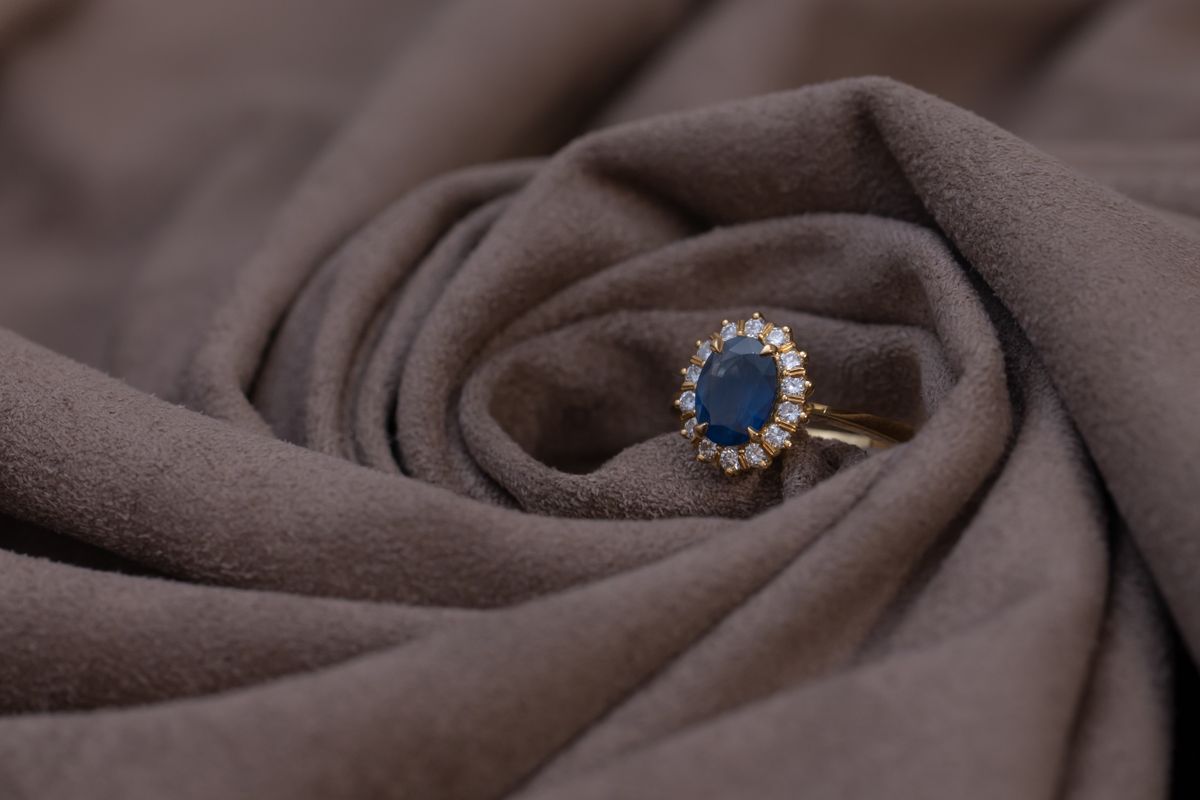
In the historic center of Tønsberg, Norway’s oldest town, a team of archaeologists was doing about as unglamorous a job as it gets: keeping an eye on a municipal drainage trench. Just seven centimeters down, archaeologist Linda Åsheim spotted something poking out of the dirt that had been waiting there for over 800 years: a gold ring set with a deep blue stone, so well preserved it looked like it had just left the goldsmith’s bench.
The find, near the intersection of Storgaten and Prestegaten, has been called by the Norwegian Institute for Cultural Heritage Research (NIKU) one of the country’s most significant medieval jewelry discoveries in years. That’s not overselling it: Norway has only 220 gold rings registered in its national artifact database (Unimus), and just 63 of those are medieval. Tønsberg itself hadn’t produced a gold ring in 15 years.
A technique that traveled from Byzantium
What makes this ring special isn’t just its rarity — it’s the craftsmanship. The stone, a deep oval-cut blue, is framed by filigree: gold wire twisted and soldered into tight spirals, finished off with tiny beads of granulation. It’s the kind of precision work that would cost a fortune to replicate by hand today, and in the Middle Ages it reached Norway via Byzantine and Carolingian goldsmithing traditions, carried along trade routes linking Scandinavia to the Mediterranean and central Europe.
The ring wasn’t just loose in some random layer of soil — it turned up directly beneath a stratum containing a spruce twig radiocarbon-dated to between 1167 and 1269. That puts the ring’s burial at that latest, though the style of the goldwork points to a tradition that may have taken shape centuries earlier, somewhere between the 9th and 11th centuries.
Whose ring was it?
Based on its size — roughly a US size 5 to 7.25 — everything points to it having belonged to a woman, likely one of high social standing: gold worked with this level of detail wasn’t something just anyone could afford in medieval Norway. How it ended up lost a few centimeters beneath what is now a city street is, as usual with these finds, a mystery that will probably never be fully solved. Did it slip off unnoticed? Fall out of a glove? Get buried on purpose?
The secret power of the blue stone
In the medieval mind, a stone like this wasn’t just decoration. Blue stones — often identified as sapphires — were believed to carry something close to magical power: they were thought to represent divine strength, to cure boils and other skin ailments, to “cool” fevers and inner passions, and even to protect the wearer’s chastity. A ring like this wasn’t just jewelry — it doubled as an amulet, a status symbol, and a kind of portable medicine cabinet for the soul.
Nearly a thousand years later, that small circle of gold and blue stone has resurfaced purely by accident, thanks to a municipal plumbing job. And instead of protecting a Norwegian noblewoman from imaginary fevers, it’s now headed for a museum display case and headlines around the world. Not bad for something that spent eight centuries under the asphalt.
1 thought on “A Medieval Gold Ring Turned Up 7 Centimeters Under a Norwegian Street (and Its Blue Stone Has a Secret)”