
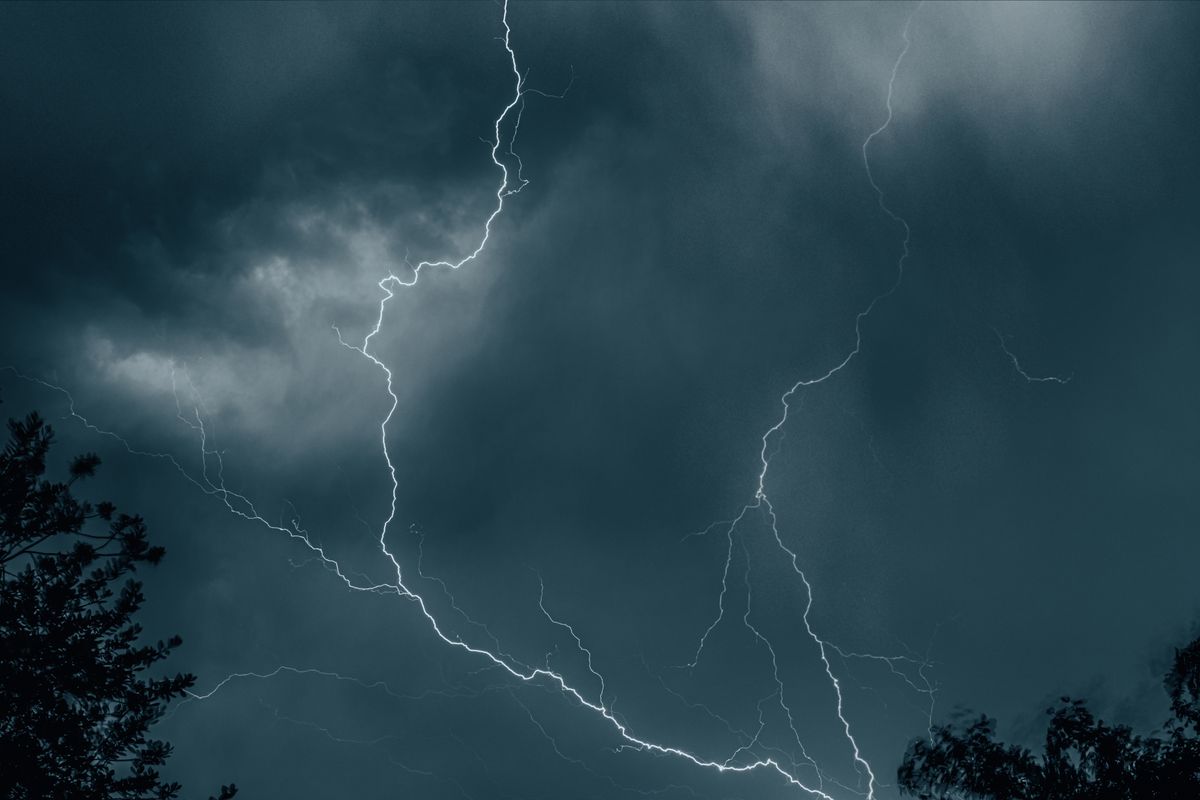
Some people have bad luck, and then there’s Roy Sullivan. This park ranger from Shenandoah National Park, Virginia, was struck by lightning seven separate times between 1942 and 1977 — and survived every single one to tell the tale. The park’s own superintendent documented each incident, and today Sullivan holds the Guinness World Record for most lightning strikes survived by a human being. To put that in perspective: the odds of being struck by lightning even once in your lifetime are roughly 1 in 15,000, so seven confirmed hits isn’t statistics anymore — it’s basically a calling.
Seven strikes, a head on fire seven times
The first hit came in April 1942, when Sullivan took shelter from a storm in a lookout tower with no lightning rod. The building caught fire, he ran outside, and the bolt tore open a gash on his leg and blew the nail clean off one toe. That wouldn’t be the last time fire followed him — in most of the seven episodes, his hair genuinely caught alight.
- 1969: driving through the mountains, a bolt bounced off nearby trees and shot through his truck’s open window, knocking him out and singeing off his eyebrows and eyelashes.
- 1970: in his own front yard, lightning hit a nearby transformer and jumped straight to his left shoulder.
- 1972: while working at a ranger station, the strike set his hair on fire again — he put it out with wet towels.
- 1973: on patrol in his car, lightning burned his legs, blew a shoe clean off, and he had to drive himself to the hospital.
- 1976: he claimed he saw a storm cloud “following him,” tried to outrun it, and got hit anyway, injuring his ankle.
- 1977: while fishing in a freshwater pool, the bolt struck the top of his head and burned down through his chest and stomach.
Bad luck, or a human lightning magnet?
Science doesn’t really do “lightning magnets” — there’s no object, metal implant, or physical trait that genuinely draws a bolt toward a person, according to meteorologists who’ve studied the case. What does matter, a lot, is repeated exposure: Sullivan spent most of the year outdoors, often on the highest ground in the park during storms — exactly the kind of exposure safety officials have spent decades warning people to avoid. In other words, the sky wasn’t holding a grudge against him; he was statistically playing the lightning lottery far more often than the rest of us, storm after storm, decade after decade, and pure accumulated bad luck did the rest seven times over.
Meteorologists also point out that lightning can strike from a seemingly clear sky several miles from the nearest visible storm — the so-called “bolt from the blue” — which is why simply moving away from dark clouds doesn’t guarantee safety either. In Sullivan’s case, nearly every strike happened in exactly the worst possible setting: outdoors, on elevated terrain, with nothing taller nearby to take the hit first. More than once, his own body ended up being the tallest point in the landscape.
The price of being one of a kind
Surviving seven lightning strikes made Sullivan world-famous, but it came with an odd side effect: several accounts from the era describe people starting to avoid him, worried the storms that seemed to follow him might follow them too, and Sullivan spent his final years more isolated than he would have liked. He died in 1983 at age 71, leaving behind a record no one has matched since — and a lesson as simple as it is memorable: next time thunder rumbles, better to find shelter than to wait around and see what happens.