
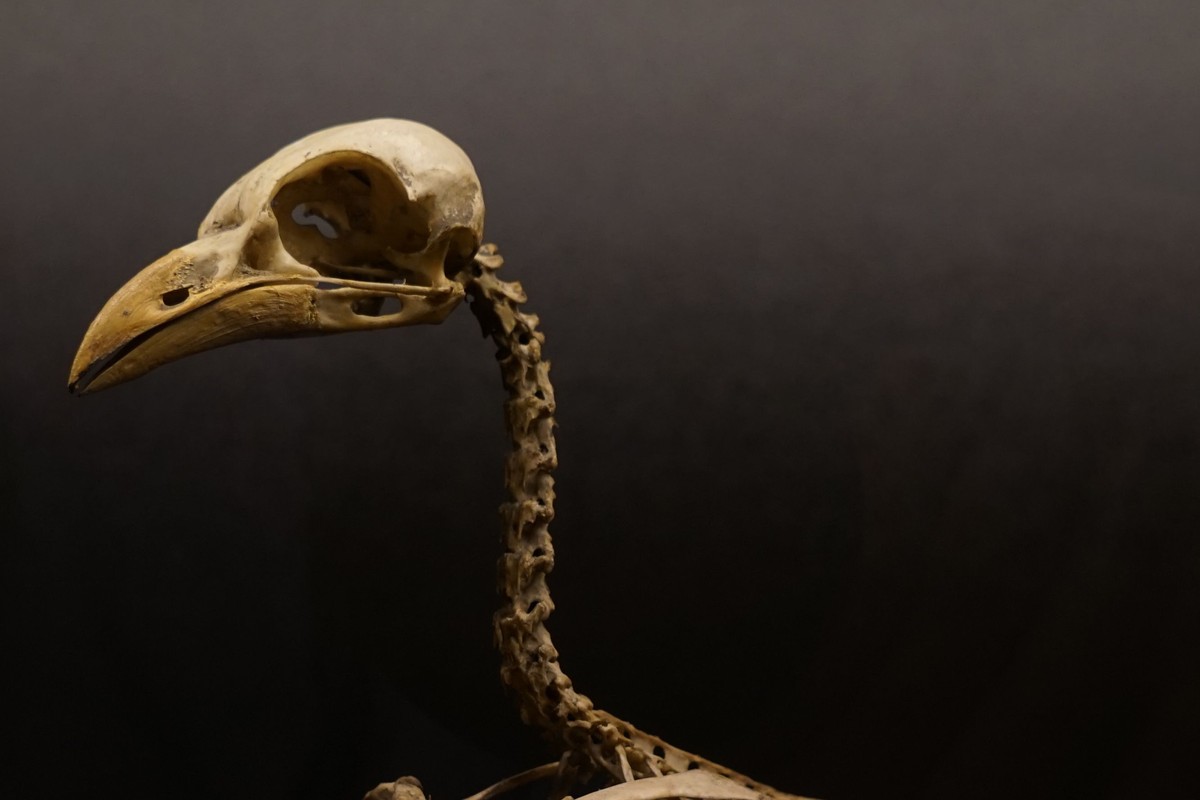
For centuries, the dodo has been the official mascot of clumsiness. Its name became shorthand for “idiot” in more than one language, and the popular image is of a fat, cross-eyed, waddling bird that couldn’t even get out of the way of the sailors who wiped it out. Well, an international team of paleontologists just scanned the only two complete dodo skulls left on Earth, and the results force a serious rewrite of that reputation: the bird had a remarkably sharp sense of smell, a beak that doubled as a full-blown touch sensor, and quite possibly the habits of a creature more comfortable at dawn and dusk than in broad daylight.
Two skulls to settle 350 years of guesswork
Raphus cucullatus went extinct on the island of Mauritius in the late 17th century, leaving behind little more than a handful of scattered bones and a few unreliable period drawings — many based on poorly stuffed, badly mounted specimens, which is where much of the “clumsy bird” myth actually comes from. That makes access to the only two complete dodo skulls known to exist — one held at the Natural History Museum of Denmark, the other at Oxford University’s Museum of Natural History — a near-archaeological luxury.
The team, led by researchers from the University of Lethbridge in Canada alongside colleagues from Denmark, the Smithsonian, and other institutions, ran high-resolution CT scans on both skulls. From that data they digitally rebuilt the space once occupied by the bird’s brain — what’s known as an “endocast” — and compared it against 36 living species of pigeons and doves, the dodo’s closest living relatives. They also brought the Rodrigues solitaire into the analysis, the dodo’s other close extinct cousin, equally flightless and wiped out just a few decades later.
A nose that punched above its weight
The first surprise: the brain regions devoted to smell were proportionally larger in the dodo than in most modern pigeons. That suggests the bird relied on scent to track down food — fallen fruit, seeds, maybe small animals — far more than you’d expect from a member of a family where smell is usually the backup sense to vision.
The beak tells its own story too. Its large size and the arrangement of its nerve openings suggest it was densely innervated, working almost like a sensory “hand” capable of picking up texture and shape by touch rather than just pecking and swallowing. In other words, the dodo probably felt its food out before deciding it was worth eating — not unlike how today’s kiwi uses its long, sensitive bill in New Zealand.
A bird that preferred sunrise and sunset?
The most striking part of the study concerns eyesight. The optic lobes — the brain region that processes visual information — were more than three times smaller, relative to overall brain size, than those of the Nicobar pigeon, the dodo’s closest living relative. In the animal kingdom, shrunken optic lobes usually go hand in hand with less reliance on vision and more activity in low light. The study’s authors propose the dodo may have been a crepuscular animal, most active around dawn and dusk, leaning on smell and beak-touch rather than eyesight to navigate the dense undergrowth of Mauritius.
None of this fits the bumbling, absent-minded creature the dodo has been reduced to since the 18th century. Quite the opposite: it describes an animal well suited to a very specific ecological niche — an island with no land predators, thick understory, and food on the ground — with a brain tuned to exactly the senses it needed to thrive there. The problem was never its intelligence or its senses; it was that this cushy niche left it completely defenseless the moment humans showed up, along with the rats and pigs they brought with them.
The study, titled “The sensory world of the Dodo and Solitaire revealed by endocast and skull anatomy,” was published in the Zoological Journal of the Linnean Society. So next time someone calls another person a “dodo” to imply they’re clumsy, it might be worth mentioning that the real animal had a better nose than a pigeon and a beak more sensitive than most metal detectors.