
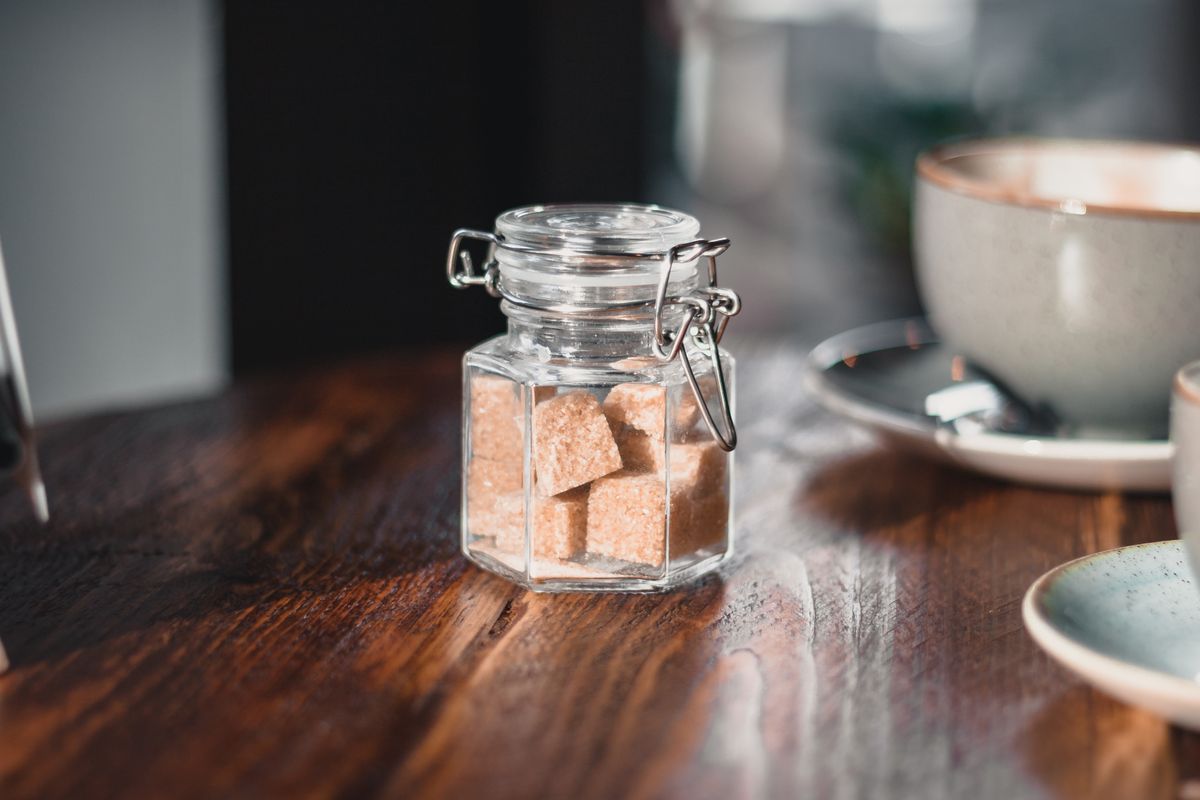
Here’s the trick: if your brown sugar has turned into a rock-hard brick you can’t even chip with a spoon, drop a slice of plain sandwich bread into the bag or container, seal it up, and walk away. By the next day, the sugar is loose and scoopable again, like you just bought it. No hammer, no grater, no giving up and buying a new bag.
It’s the kind of grandma trick that sounds like a myth… until you learn the chemistry behind it, at which point it stops sounding weird and starts sounding obvious.
How to do it
- Put the hardened brown sugar in a resealable bag or an airtight container.
- Add a slice of regular sandwich bread — a slightly stale one is fine — and seal it up.
- Let it sit at room temperature for 12 to 24 hours. The harder the brick, the longer it may take.
- Remove the bread and stir the sugar with a spoon: it should crumble apart on its own.
No bread on hand? A slice of apple or pear does the exact same job, and some professional kitchens use a small dampened terracotta disc made specifically for this.
The express version (for when you need it right now): put the sugar in a microwave-safe bowl, cover it with a damp paper towel, and microwave in short 10-20 second bursts, checking the texture between each one. The steam coming off the towel moistens the sugar’s surface and softens it almost instantly. Just don’t overdo it: more than about 15 seconds straight at full power can start caramelizing the surface, or even cause sparking if the towel has any metallic fibers in it.
Why it works
Brown sugar is basically white sugar with molasses mixed in — that dark, sticky syrup responsible for the color, the caramel-like flavor, and, crucially, the moisture. Molasses is hygroscopic, meaning it’s remarkably good at pulling water molecules out of the surrounding air and holding onto them.
As long as the container stays sealed, that moisture stays trapped between the sugar crystals and everything stays soft. The trouble starts once the bag is left open, poorly closed, or simply sits in the pantry too long: water slowly evaporates out of the molasses into the drier air around it, the molasses hardens, and it ends up acting like glue that welds the crystals together. What you’re left with looks like a rock, but chemically it’s just dehydrated sugar.
That’s where the bread comes in. The physics is simple: water always moves from where it’s more concentrated to where it’s less concentrated, chasing equilibrium. A slice of bread holds a lot more moisture than dried-out sugar does, so inside a sealed container, water slowly migrates from the bread into the sugar — a tiny, free, homemade humidifier. Within a few hours, the molasses reabsorbs enough water to soften back up and let go of the crystals it was gripping.
The microwave trick does the same thing, just sped up with heat: steam from the damp paper towel pushes into the sugar block fast and softens the molasses in seconds instead of hours. The catch is that too much heat can boil that same water back out again, and start browning the sugar on top.
The real fix, of course, is never letting it get to this point: an airtight container, or a bag with the air pressed out before sealing, keeps the molasses from losing water in the first place and keeps sugar scoopable for months. But if it’s already too late for prevention, at least now you know the brick doesn’t belong in the trash — it just needs a slice of bread and a little patience.
You can read more about the science and the different methods for softening brown sugar at King Arthur Baking.