
In 1946, a teenage girl told her school guidance counselor she wanted to be an astronomer. The reply she got was: “What lady would take mathematics instead of Latin?” Eighty years later, that same girl —Nancy Grace Roman, NASA’s first chief of astronomy— has her name on the most ambitious space telescope the United States will launch this decade. And it’s launching early: on August 30, 2026, a full eight months ahead of the date NASA itself had originally announced.
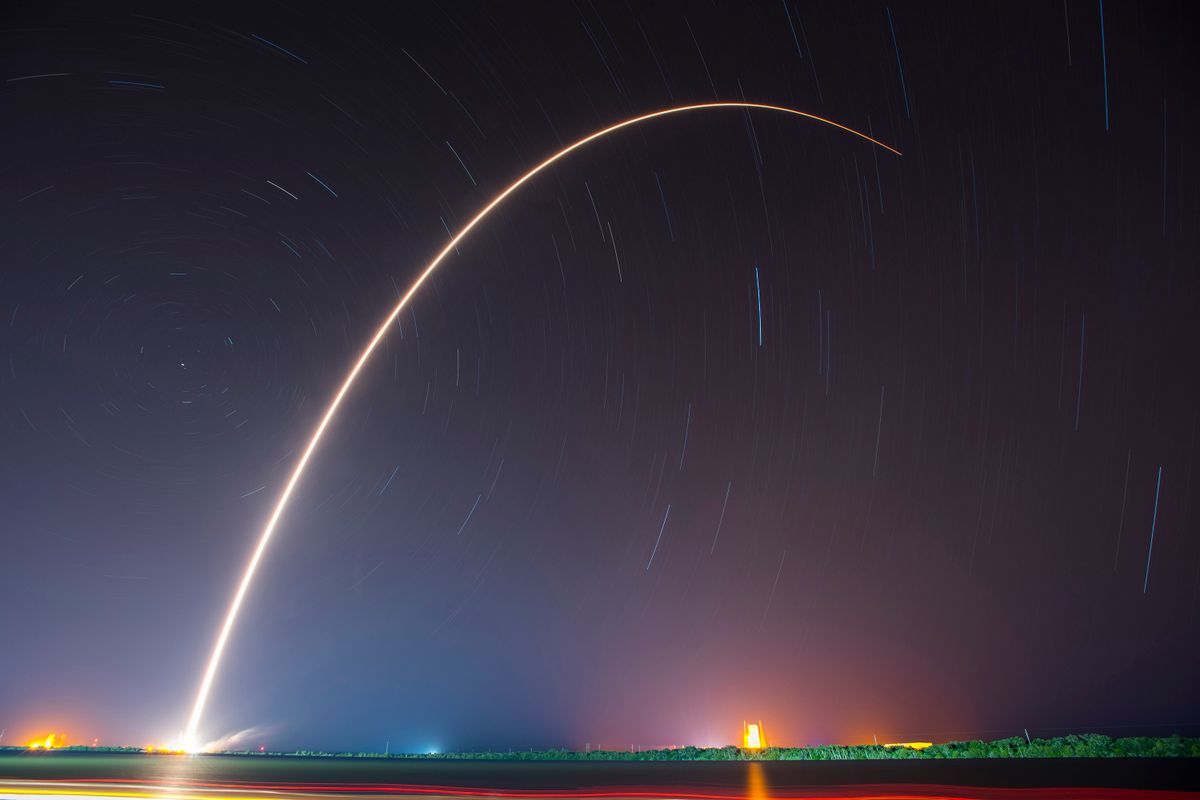
The Nancy Grace Roman Space Telescope will ride a SpaceX Falcon Heavy rocket from Launch Complex 39A at NASA’s Kennedy Space Center in Florida — the very same pad the Apollo missions used to leave for the Moon. Its mission, summed up without too much exaggeration: photograph more galaxies than any instrument in human history.
An eye with a hundred Hubbles’ worth of vision
Roman’s primary mirror measures 2.4 meters across — exactly the same size as Hubble’s. That’s where the resemblance ends, though: thanks to a camera built to capture huge swaths of sky at once, its field of view is at least a hundred times larger than its older sibling’s. Where Hubble would need hundreds of cropped exposures to cover a patch of sky, Roman gets it in a single shot.
That difference isn’t a technical flex, it’s the whole point of the mission: over its years of operation, the telescope will measure light from roughly a billion galaxies, tracking how they move and cluster to try to answer one of the most uncomfortable questions in physics today — whether dark energy, the mysterious force accelerating the universe’s expansion, has stayed constant or has been changing over time. Alongside that, Roman will also map dark matter, the other great invisible ingredient holding galaxies together.
A planet hunter using a trick Kepler couldn’t pull off
Beyond staring into deep space, Roman will also point toward the center of our own galaxy to run something no telescope has attempted at this scale: a massive exoplanet survey using gravitational microlensing, a technique that relies on how a star’s gravity briefly bends and magnifies the light of a much more distant star passing behind it. That tiny flicker of light can betray the presence of a planet — including icy worlds on wide orbits that the transit method used by the Kepler telescope could barely catch. This part of the mission alone is expected to add more than a thousand new exoplanets to the catalog.
As if that weren’t enough, Roman will also use direct imaging and transit observations, combining three planet-hunting techniques in a single mission — something no earlier telescope has done this systematically.
The woman who talked Congress into building Hubble
Nancy Grace Roman didn’t just shrug off her guidance counselor’s dismissal: she joined NASA in 1959, barely six months after the agency was founded, and became its first female executive and first chief of astronomy programs. Throughout the 1960s she led the committee of astronomers and engineers that convinced NASA and Congress it was worth investing in a giant space telescope — the one that would eventually become Hubble — which is why she’s remembered today as the “Mother of Hubble.” She retired in 1979 but kept teaching and advocating for women in science until her death in 2018, at age 93.
There’s a certain poetic justice in her name now sitting atop a telescope capable of photographing a billion galaxies with the field of view of a hundred Hubbles — quite the answer to whoever told her math wasn’t for young ladies. On August 30, if all goes to plan, that telescope will start proving it from space.
You can follow the countdown and mission details in Tech Times’ coverage of the moved-up launch date.