
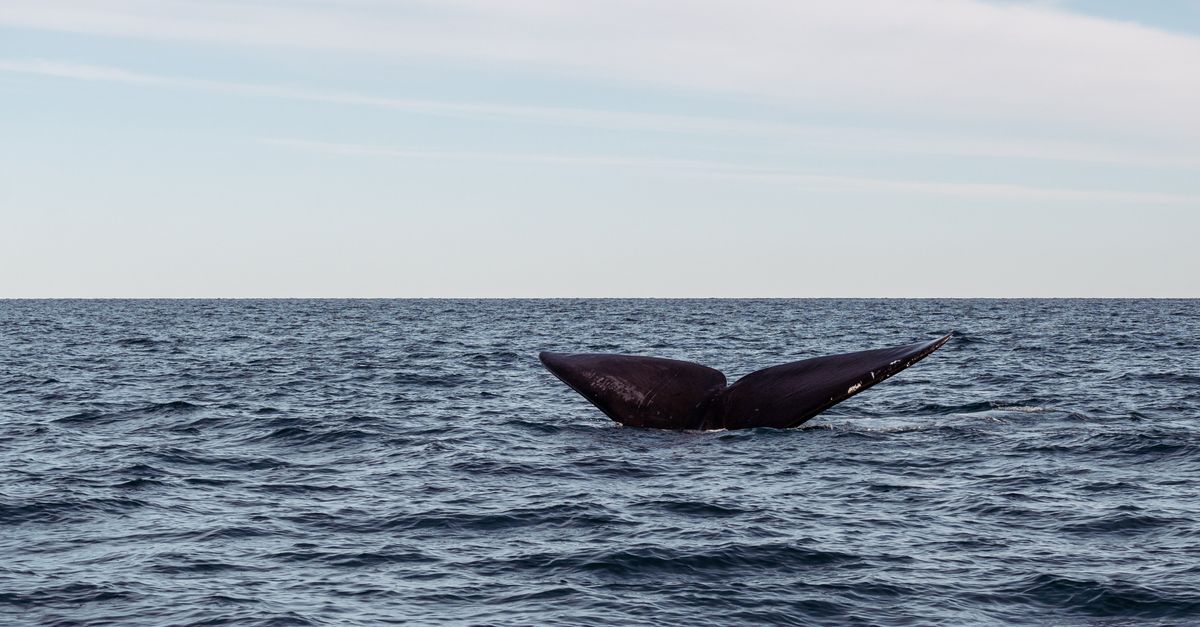
Since 1989, military hydrophones scattered across the North Pacific have been picking up the voice of a whale that sings at a frequency no other whale uses. It isn’t a glitch in the equipment: it’s real, it repeats season after season, and in more than three decades nobody has ever laid eyes on the animal making the sound. Scientists call it the 52-hertz whale, and its story just took a turn worth telling.
A voice nobody recognizes
Like a lot of Cold War stories, this one starts in secrecy. SOSUS, a network of hydrophones the US Navy laid across the Pacific seafloor to track Soviet submarines, kept picking up an odd noise in the background: whale-like moans lasting five to seven seconds, arriving in short bursts, centered on an average frequency of 51.75 hertz, according to records from NOAA’s marine acoustics lab. Once part of that data was declassified, marine biologists finally got a chance to dig in.
Bioacoustician William Watkins, of the Woods Hole Oceanographic Institution, tracked the call for twelve years, from 1992 to 2004, and published his findings in the journal Deep-Sea Research. The conclusion was as simple as it was puzzling: the whale’s migration pattern matched that of blue whales and fin whales — moving each year between the Aleutian and Kodiak Islands in Alaska and the California coast — but its song didn’t sound like either species.
Singing off in its own key
To get a sense of how far off-key it really is: blue whales typically call between 10 and 39 hertz (Atlantic blue whales hover around 19), and fin whales sit around 20. Our whale sings at more than double that pitch. Put plainly, it’s the one soprano in a choir of basses. And here’s the part that gets overlooked: even though its call is unusual, it still falls well within the hearing range of every other large whale out there. It isn’t speaking a language nobody can hear — it’s more like singing a completely different genre at the same party, and so far nobody’s picked up the beat.
Over the years, its pitch has also crept downward, drifting from the original 52 hertz to somewhere around 47 today. That kind of shift has been observed, on a smaller scale, in other whale populations too, and it’s usually tied to growth: whale calls tend to deepen as the animal matures, so the drop is one more clue — among several — that this whale is still out there, and that it likely reached full adult size a while ago.
Is it really alone?
In 2021, a team of researchers mounted an expedition — chronicled in the documentary The Loneliest Whale: The Search for 52 — to try to spot the animal with their own eyes for the first time. They didn’t manage it: tracking down a single animal across millions of square miles of ocean, guided by sound alone, is roughly the marine equivalent of finding a needle in a continent-sized haystack.
The interesting part came afterward. Re-examining footage recorded during that expedition, scientists identified a whale with an atypical call — possibly a blue whale/fin whale hybrid, a rare but documented occurrence — swimming with a group of 15 to 25 blue whales, and even closely paired with another individual. There’s no certainty it’s the same original 52-hertz whale, but the possibility has forced a rethink of the myth: this whale may never have been as alone as its legend suggests. It might simply have spent thirty years singing off-key in good company, while the rest of us got misty-eyed imagining it adrift and solitary in the vastness.
Either way, it’s still out there, singing its own version of the song every season, and NOAA’s hydrophones are still listening. Sometimes the ocean’s most moving stories aren’t about finding an answer — they’re about realizing we may have misheard the question all along.