
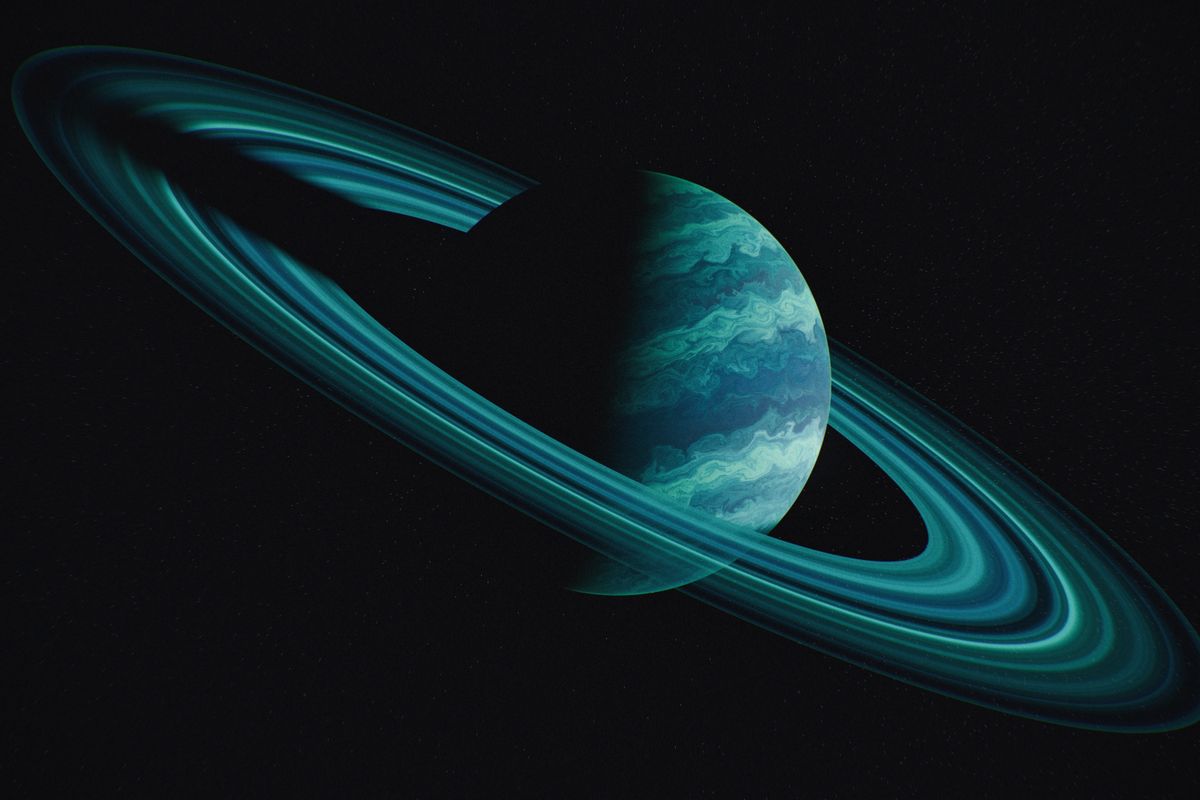
Saturn has spent 40 years showing off a giant hexagon at its north pole, a geometric shape so crisp it looks drawn with a ruler, built from wind currents that have been spinning nonstop since the Voyager probe, still alive almost 50 years later, first photographed it back in the 1980s. Well, the planet just pulled a new trick out of its sleeve: Saturn’s decagon, a ten-sided shape that has shown up at the south pole, and the strangest part isn’t that it exists, it’s that nobody had ever spotted it before.
The discovery was confirmed by NASA’s Hubble Space Telescope, which had been peering at that region of the planet since 1990 without finding anything like it. The Cassini probe, which orbited Saturn up close between 2004 and 2017, didn’t catch a trace of it either. The first hints of a wavy pattern at the south pole showed up in 2024, got stronger in 2025 images, and this summer astronomers were finally able to confirm a clean, fully formed ten-sided shape.
Saturn’s Decagon: A Giant Spanning 104,000 Miles
Saturn’s decagon isn’t some subtle detail: it measures roughly 104,250 miles (167,820 km) across, with each of its ten sides stretching about 10,425 miles (16,782 km), longer than Earth’s entire circumference. Moreover, the whole shape takes about 800 days to complete one full rotation around the pole, and Hubble’s data shows it isn’t just a surface-cloud phenomenon: it extends downward through multiple layers of the atmosphere, which points to a far more robust structure than a passing smudge.
The shape comes from the fact that this wave is riding inside one of Saturn’s powerful jet streams. When a jet stream like that gets “trapped” circling in a closed loop, it can spontaneously develop regular peaks and valleys, as if the wind itself decided to sketch a polygon instead of a plain circle. In fact, it’s the same physical mechanism that has explained the northern hexagon for decades, nobody just expected to find its ten-sided cousin on the opposite side of the planet.
What’s Puzzling Scientists the Most
Amy Simon, a NASA planetary scientist who has been tracking the phenomenon closely, sums up the surprise well: “The northern hexagon has been there every time we’ve looked for more than 40 years. This feature is different, it appears to be strengthening, giving us the rare opportunity to watch a giant atmospheric pattern develop.” She also raises the question nobody can fully answer yet: “The most intriguing part to me is that this seems to have just formed recently. The question is, why did it suddenly form now when we haven’t seen one before?”
Researchers don’t have a settled explanation yet, though they’re working with one leading hypothesis: perturbations from a nearby storm may have acted as the trigger, jostling the jet stream just enough to reorganize it into this ten-peaked shape. However, whatever the exact cause turns out to be, Saturn’s decagon is going to keep scientists busy for years, because unlike the hexagon, already a “familiar face”, this is a feature astronomers get to watch form and evolve almost in real time, something that rarely happens on a planetary scale.
So the next time someone claims there’s nothing left to discover in the solar system, feel free to remind them that a planet we’ve been watching closely since the 1980s just surprised everyone with a brand-new polygon. Between its rings and now two geometric shapes sitting at its poles, Saturn is clearly still holding out on us.