
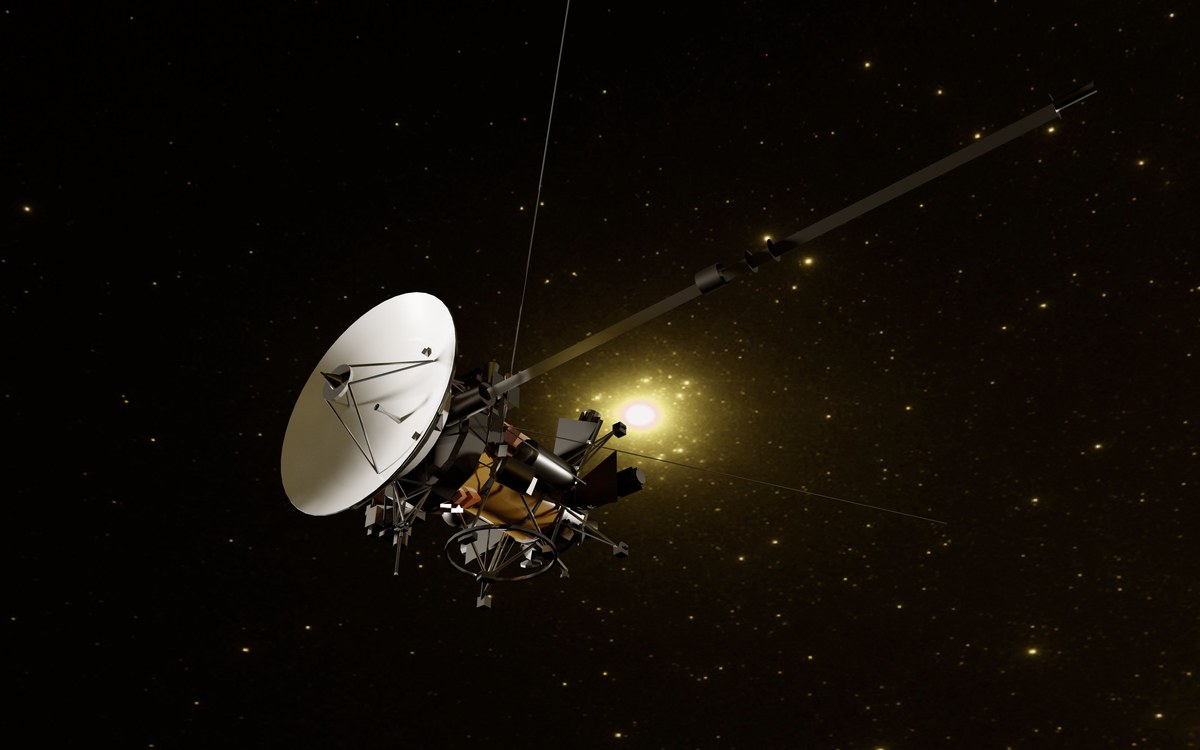
On July 9, 2026, a team of engineers at NASA’s Jet Propulsion Laboratory (JPL) sent a command to a spacecraft that has been flying since 1977. The message took about 19 hours to arrive, and another 19 for confirmation to come back that it had worked. There was no room for a dry run first: if anything went wrong, there would be no way to fix it. The operation had a name with more flair than you’d expect from a federal agency — “Big Bang” — and it just bought the Voyager 2 probe at least one more year of real science.
A spacecraft that’s literally running out of battery
Voyager 2 doesn’t run on solar panels — out where it is, the Sun is little more than a bright dot — but on a radioisotope thermoelectric generator (RTG), essentially a nuclear battery that turns the heat given off by decaying plutonium-238 into electricity. The catch is that the plutonium keeps decaying, and with it the available power: the spacecraft loses roughly 4 watts every year, permanently, with no way to top it back up.
Since launch, NASA has been switching off non-essential instruments and systems to stretch what power remains, the way you’d unplug appliances at home to avoid tripping a breaker. The trouble is that by now there’s almost nothing left to turn off without sacrificing actual science: without a fix, Voyager 2 was on track to lose another active instrument before the end of 2026.
The trick: switch things off so you can keep other things on
That’s where “Big Bang” comes in. In a maneuver choreographed down to the last detail, the team simultaneously switched off two heaters and a tape recorder that hadn’t been used to store data in decades — it had only stayed powered on for the residual heat it gave off to nearby electronics — while turning on backup components elsewhere so nothing dropped below its minimum survival temperature. The net result: nearly 10 watts freed up in one shot, enough to keep the probe’s three remaining science instruments — the magnetometer, the plasma wave subsystem and the cosmic ray subsystem — running for at least another year.
What makes this genuinely wild is that it was done blind, in the most literal sense: because Voyager 2 is so far away, there’s no way to test the operation on an identical unit on the ground beforehand. Engineers worked from blueprints of a spacecraft designed nearly five decades ago, with pre-internet-era documentation, trusting their calculations and the institutional memory of the few people who still remember how the thing was actually built.
Almost 50 years and 13 billion miles later
Voyager 2 launched on August 20, 1977, and today sits roughly 143 astronomical units from the Sun — more than 13 billion miles away — out in interstellar space, beyond the direct reach of the solar wind. Along with its twin, Voyager 1, it’s the farthest-flung object humans have ever built, and it’s still, against all odds, sending back real scientific data about what the space between the stars is actually like.
The good news doesn’t stop there: the mission team is already preparing a similar maneuver for Voyager 1, which will become the first human-made object to cross the one-light-day mark from Earth sometime this year. If the trick works a second time, it’s not far-fetched to imagine one of the two Voyagers — launched before the internet or the cell phone existed — still phoning home well into the 2030s, like your grandmother’s old fridge that, against all logic, simply refuses to die.
You can read more technical detail on the maneuver in this Popular Science report.