
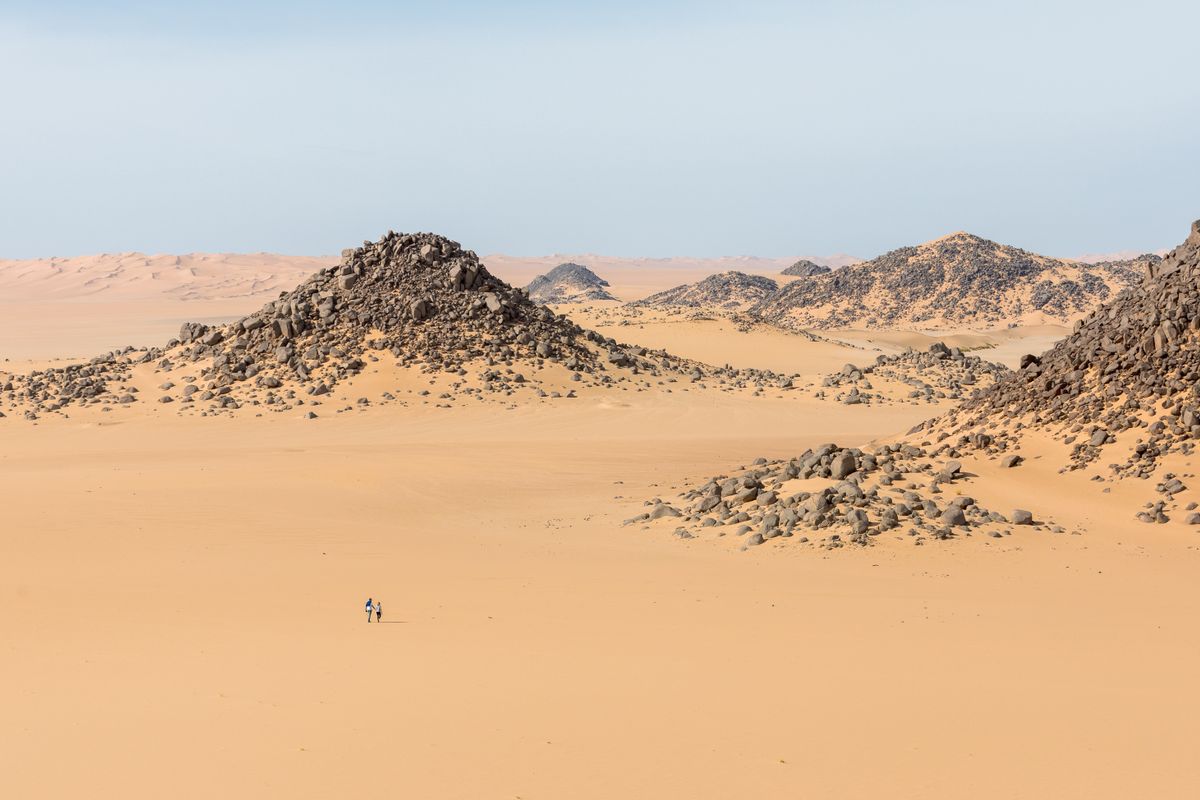
Picture a piece of land roughly the size of Rhode Island. No legal owner, no government, no taxes, no patrolled borders. Still, it’s not a lost island in the ocean or a drifting iceberg. It’s stuck in the middle of the desert, between Egypt and Sudan, and it’s called Bir Tawil. In fact, it is almost certainly the only habitable territory on the entire planet that no country claims.
Bir Tawil covers about 2,060 km² (795 square miles) of rock, sand, and brutal heat. It reaches up to 45°C for nine months of the year. Its Arabic name roughly translates to “the long water well,” a nod to an old well used by local nomads. However, the strange part isn’t the landscape — it’s the paperwork. Because of a bureaucratic mix-up over a century old, neither Egypt nor Sudan wants it.
A colonial border mess
Blame the British Empire. In 1899, while it controlled both Egypt and Sudan, Britain drew a straight border along the 22nd parallel. That line placed Bir Tawil inside Sudan. But in 1902, British administrators redrew the line to better match how local tribes actually lived. Meanwhile, the Ababda people, culturally tied to Egypt, used the Bir Tawil area. So that patch was handed over to Egyptian administration. In exchange, the much larger and far more valuable Halaib Triangle went to Sudanese administration. It has coastline on the Red Sea.
Two maps, one prize
Here’s the catch: each country ended up favoring a different map. Egypt insists on the 1899 border, which gives it the Halaib Triangle. Sudan, meanwhile, insists on the 1902 border, which also gives it the same triangle. In fact, both countries are fighting over the same prize — in other words, over the same map. As a result, neither one officially claims Bir Tawil. Doing so would mean giving up their own version of the map, and with it, the territory they actually want. Nobody wants the poor land if it means losing the rich one.
Self-declared kings of Bir Tawil
The fact that a territory belongs to no one, oddly enough, doesn’t stop people from trying to claim it. Over the past decade or so, several people have traveled to Bir Tawil to plant a flag. There, they crowned themselves rulers of their very own “country.” Some of the most famous cases:
- In 2014, American Jeremiah Heaton traveled there for his seven-year-old daughter. She had asked to become a real princess, so he proclaimed the “Kingdom of North Sudan” and named himself king.
- Russian adventurer Dmitry Zhikharev and others have made similar trips. They proclaimed republics or principalities that, unsurprisingly, no international body recognizes.
- There are even websites and flags designed for these weekend micro-states. Still, none of them has an actual government, a permanent population, or any diplomatic recognition.
The truth is less romantic. Neither Egypt nor Sudan is going to let a tourist with a flag walk off with the territory. Moreover, none of these “coronations” carry any legal weight whatsoever. Even so, Bir Tawil isn’t entirely empty. Nomads from the Ababda and Bishari tribes still cross the area with their herds. In recent years, mining companies have also shown interest in its possible gold deposits. Therefore, that could complicate its “no man’s land” status down the line.
This kind of border oddity is more common than it seems. Take the Principality of Sealand, another famous example of a self-declared micronation that no country recognizes.
Next time someone claims the whole Earth has already been discovered and divided up, you’ll know what to say. There’s a patch of desert bigger than Luxembourg, where, technically, you could camp out without paying taxes to anyone. Just bring plenty of water — and don’t expect your “kingdom” to show up on any official map. You can read more about its history at World Atlas.
1 thought on “Bir Tawil: The Land No Country in the World Wants to Claim”