
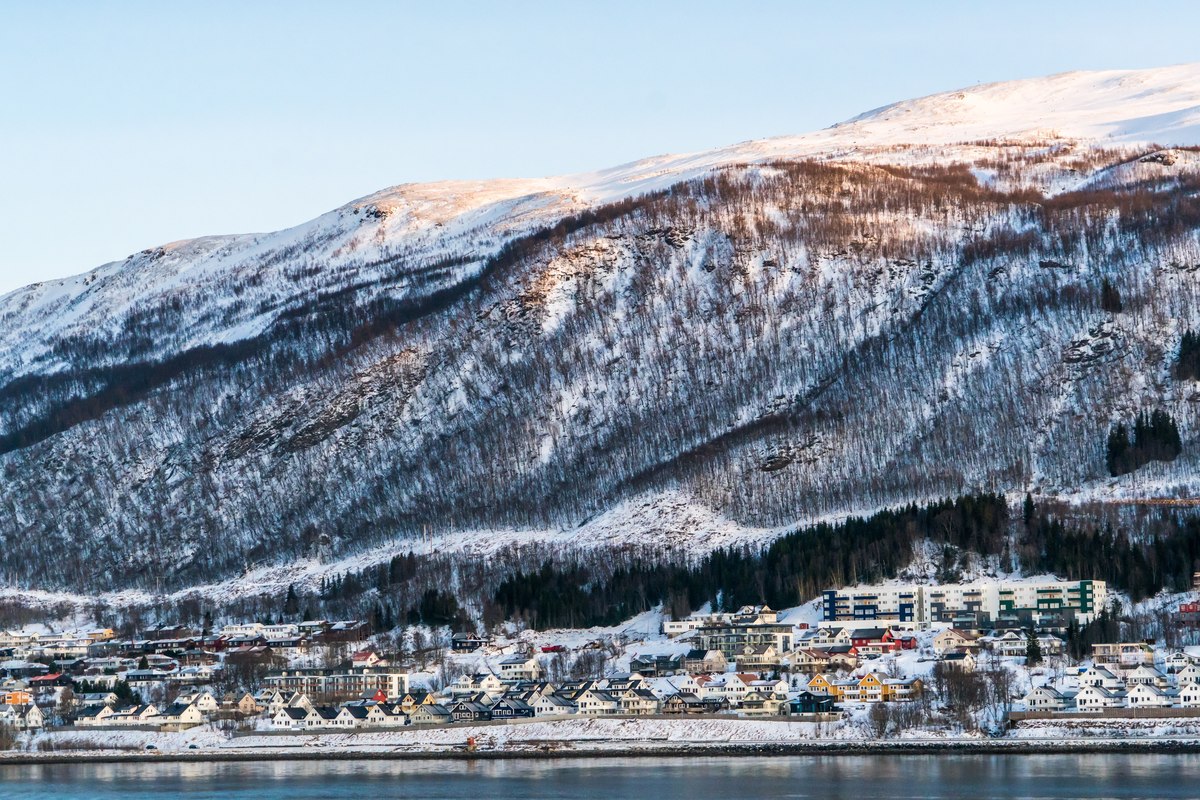
Picture a place where, if you get seriously ill, the plan isn’t to call a local ambulance but to hop on a plane to a different country. That’s how things work in the capital of Norway’s Svalbard archipelago, the world’s northernmost civilian settlement: dying in Longyearbyen is so frowned upon that, in practice, it’s basically not allowed.
The line “you can’t die in Longyearbyen” has gone viral so many times it now sounds like an exaggerated urban legend, and to some extent it is — nobody’s going to fine you for passing away. What is completely true is that the town cemetery stopped accepting new burials around 1950, and ever since, anyone who dies there is flown to mainland Norway for burial instead. The reason has nothing to do with red tape and everything to do with something far more fascinating: permafrost.
Dying in Longyearbyen: the cemetery that stopped taking bodies
Svalbard sits so far north — roughly 1,300 km from the North Pole — that the ground stays frozen year-round, aside from a thin top layer that thaws in summer. That permanent ice acts like a natural freezer: it slows decomposition down so much that buried bodies barely decompose at all instead of breaking down normally. This would just be a neat geological fact if it weren’t for what happened in 1918, when the Spanish flu reached Longyearbyen’s coal mines and killed several miners, who were buried in the local cemetery.
Almost eighty years later, an international team led by Canadian researcher Kirsty Duncan traveled there with a very specific goal: exhume the remains of seven of those miners to search their tissue for genetic material from the 1918 virus, one of the deadliest pathogens in modern history. In 1998, working under an inflatable tent pitched over the cemetery itself, the team managed to extract fragments of viral RNA from lung, liver and other tissue — samples that later helped other scientists reconstruct the pandemic’s full genome. You can read more about that expedition and its scientific context in this article published in PubMed Central, the biomedical repository run by the U.S. National Library of Medicine.
The findings confirmed what local authorities already suspected: Svalbard’s extreme cold preserves tissue — and potentially pathogens — for decades. That’s why dying in Longyearbyen today means catching a flight south while you still can: the unwritten policy has quietly gone from “advisable” to practically mandatory, and no new cemetery plots ever open.
Life (literally) goes on in the world’s northernmost town
Beyond this slightly macabre trivia, Longyearbyen feels like something out of a documentary set on another planet. It’s home to just over 2,000 people, has no traffic lights whatsoever, and enforces a rule that elsewhere would just be common sense: since polar bears roam freely outside town limits, leaving the settlement without carrying a rifle or a warning flare is frowned upon — and in practice, required.
The town also runs on an extreme light schedule: for about four months a year the sun never sets (the famous midnight sun), and for roughly another four months it never rises, plunging Longyearbyen into continuous polar night. And speaking of preserving things in ice, a few kilometers outside town sits another guardian of the cold: the Svalbard Global Seed Vault, the underground bunker that stores backup seed samples from around the world in case agriculture ever needs a fresh start. If you enjoy corners of the planet with rules this particular, you’ll also want to read about Bir Tawil, the land no country in the world wants to claim.
So next time someone tells you “dying is illegal in some town somewhere,” you now know they’re probably talking about dying in Longyearbyen — and you also know the real story, while less dramatic than the headline, is just as surprising: an entire town built around the idea that even death sometimes has to change its plans when the ground itself refuses to let anything rest.
1 thought on “Dying in Longyearbyen: The Town That Won’t Allow It”