
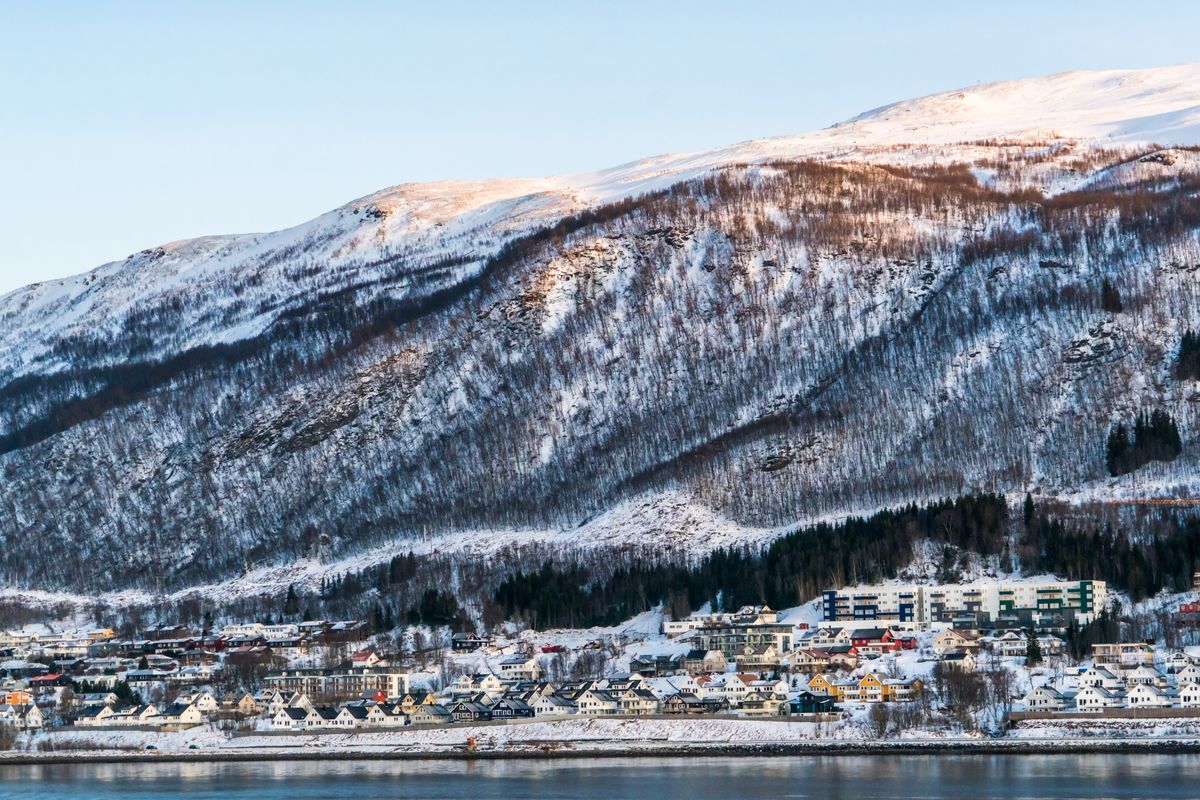
Picture living in a gorgeous little town tucked between mountains, and not seeing direct sunlight on your street for nearly half the year. That is not a poetic exaggeration: it was literally the case for the 3,400 residents of Rjukan, a Norwegian town wedged into a very narrow valley. From September to March, the surrounding peaks block the sun completely. The fix they eventually found, more than a century after someone first suggested it, sounds like science fiction: three giant mirrors on the mountainside that bounce sunlight straight back down into the town.
A town at the bottom of a cup
Rjukan was built in the early 20th century around a fertilizer factory that ran on power from a nearby waterfall. The location was great for industry, but it had one enormous downside: the valley walls are so steep and tall that, in winter, the sun never climbs high enough to clear them. The result is nearly six months of flat, indirect grey light, with not a single direct ray touching the town’s streets.
A 1913 idea that took a century to catch on
Here is the fun part: the problem bothered the town’s founders from day one. Back in 1913, engineer Sam Eyde, the man behind the factory that gave rise to Rjukan, actually floated the idea of installing mirrors on the mountain to redirect sunlight into the square. The technology of the time couldn’t pull it off, so Eyde settled for building a cable car that carried residents up to a sunny spot on the mountain instead. And the mirror idea sat on a shelf for almost a hundred years.
It got revived in 2005, thanks to local artist Martin Andersen, who picked the project back up almost as a personal obsession and eventually convinced the town council and several companies to take it seriously. Eight years later, the century-old dream finally became reality.
How Rjukan’s Giant Mirrors Actually Work
On October 30, 2013, the town switched on its three giant mirrors: computer-controlled heliostats, 17 square metres each, mounted 450 metres above the town’s main square, at 742 metres above sea level. Each mirror is driven by a motor that continuously tilts it to track the sun’s path across the sky, so it keeps reflecting the light onto exactly the same spot: the square below.
The result is a genuine patch of warm, direct sunlight — roughly 600 square metres of it — that slowly drifts across the square throughout the day, as if someone had switched on a giant spotlight from the sky. On opening day, dozens of residents rushed out to sunbathe in the middle of November, some in swimsuits and sunglasses, just for the novelty of feeling real sunlight on their skin after years without it.
Is a beam of reflected sunlight really worth all that fuss?
To anyone who has never gone a whole winter without seeing the sun, this might sound like overkill. But the lack of direct daylight genuinely affects mood and the body’s internal clock, something Nordic countries know all too well. Residents themselves said the project was never really about warmth — the actual temperature boost is negligible — but about something more symbolic. It was the feeling that the sun still belongs to them in winter too, even if it has to arrive secondhand, bounced off a mountainside.
These days, the giant mirrors have also turned the square into a small tourist draw, and the town tells the story with a wink. It took them a hundred years to act on one good idea, but in the end they literally built themselves their own patch of sun. You might also like the story of Longyearbyen, the Norwegian town where dying is not allowed. You can see the Rjukan project documented with photos in this National Geographic feature.