
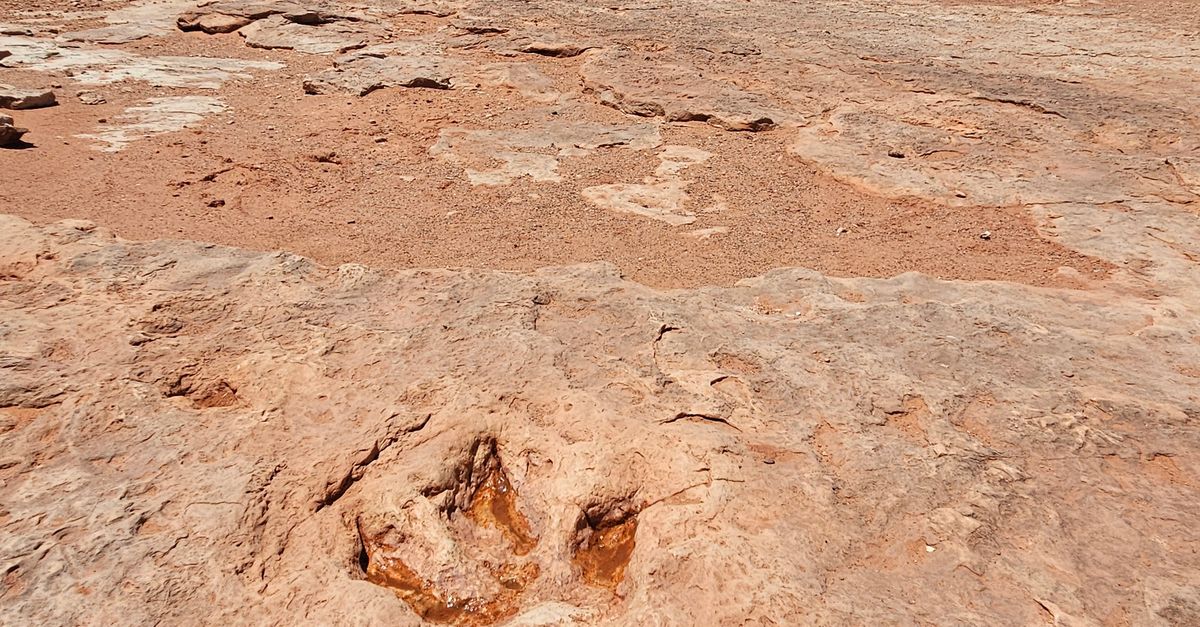
Some dinosaurs have dozens of catalogued skeletons scattered across the globe and still, not a single footprint to their name. Tyrannosaurus rex was one of them. Despite being the most famous prehistoric animal on the planet, scientists had only ever confirmed two isolated T. rex footprints from an adult. One was in New Mexico, the other in Montana. Never a string of consecutive steps. Never a fossil “video” of how it actually moved.
That has just changed. A team from the Denver Museum of Nature & Science has confirmed the first-ever T. rex footprints from a walking adult. The find is described in the Journal of Vertebrate Paleontology. Moreover, the project also involved Liverpool John Moores University in England. It’s four consecutive three-toed footprints, preserved in the Hell Creek Formation. Together, they stretch across roughly 7 meters (23 feet) of ground in the badlands of southwestern North Dakota, near the town of Marmarth.
The discovery also has an unusual hero for a headline-grabbing find in paleontology. It wasn’t a PhD holding a rock hammer who spotted it first, but Kent Hups, a high school teacher and amateur fossil hunter. Hups was volunteering on one of the museum team’s digs, on land managed by the U.S. Forest Service. In fact, it’s good news for anyone who’s ever daydreamed about stumbling onto something like this on a hike.
What T. rex footprints can tell you
Each footprint measures close to a meter (about 3 feet) long, consistent with a fully grown T. rex weighing several tons. In fact, size estimates for an animal this large run well past 7 tons. However, the size of the print isn’t actually the most interesting part. It’s the spacing between them. By measuring the distance between consecutive steps, researchers could calculate exactly how fast the animal was walking at that specific moment. It’s something no bone, however complete, can ever tell you.
The result: somewhere between 3.5 and 4.5 miles per hour, a relaxed stroll, not a chase. That’s roughly the pace of an adult human out for a casual walk. Still, every one of its strides covered the ground of several of yours, and it weighed about as much as a school bus.
These T. rex footprints, unlike skeletons, are what paleontologists call a record of frozen behavior. They don’t tell you what the animal looked like. Instead, they tell you what it was doing at that exact instant, some 66 million years ago, not long before an asteroid rewrote the planet’s rules.
Why there are so many bones and so few T. rex footprints
It might seem strange that, with hundreds of cataloged T. rex fossils, footprints remain this rare. The explanation lies in the chemistry of fossilization itself: a skeleton needs to be buried quickly to avoid decomposing. A footprint, however, needs precisely the opposite — soft ground that holds the shape without smudging it, followed by just the right layer of sediment on top to “seal” it. Otherwise, rain, erosion, or simply another animal wandering by will erase it. That’s a far narrower preservation window than bone fossilization gets. Therefore, finding a complete run of several consecutive steps is so much rarer than finding a femur.
That’s what turns this North Dakota find into something more than a museum curiosity. It’s one of the very few pieces of direct evidence available for reconstructing the real biomechanics of the largest land predator of the late Cretaceous. Moreover, it goes beyond what computer models can infer from a skeleton alone. According to Sci.News, the team hopes the discovery encourages other fossil hunters, professional and amateur alike. The idea is to start looking down at the ground as much as they look at what’s sticking out of it. After all, the next trackway could, quite literally, be waiting for someone to glance at their feet.
If you enjoy these unexpected paleontology finds, don’t miss the megalodon vertebra that sat on the wrong shelf for 35 years.
So next time you picture a T. rex, think twice. Maybe skip the movie image of a beast sprinting full tilt after a speeding jeep. Picture instead a massive, heavy, unhurried animal, out for a calm walk through the mud of what is now North Dakota. That T. rex had no idea that, 66 million years later, four holes in the rock would end up telling its story.
1 thought on “T. Rex Footprints Found 66 Million Years Later”