
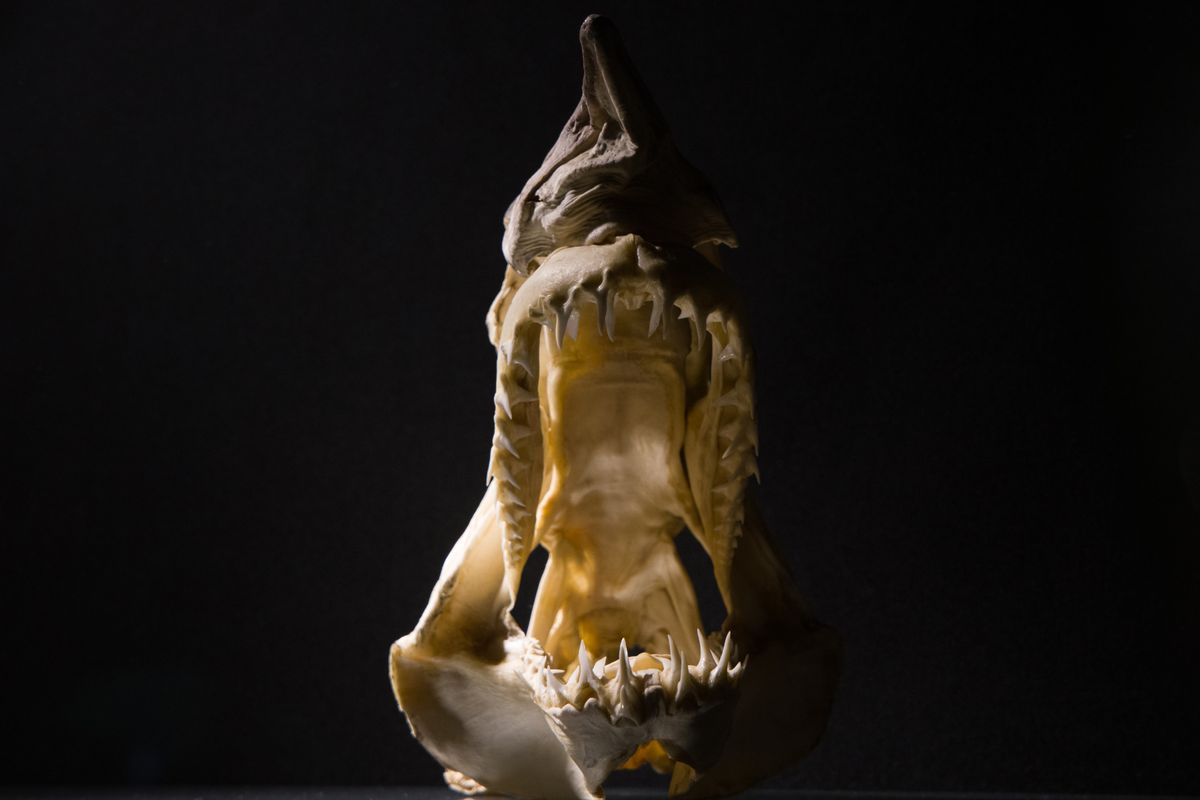
Imagine losing track of the largest predator that ever lived for 35 years… because someone put it back on the wrong museum shelf. That is, quite literally, what happened in Denmark with a set of giant vertebrae from Otodus megalodon, the colossal shark that ruled the oceans more than ten million years ago — and whose rediscovery has just settled one of the most stubborn questions about how big it really was.
The story starts in the late 1970s, when workers digging a commercial clay pit in Gram, southern Denmark, stumbled on several fossilized vertebrae from a single animal. The largest measured 23 centimeters (9 inches) in diameter — roughly the size of a big dinner plate — and was around 10.8 million years old. Scientists described and photographed them in the early 1980s, and for decades that one number, 23 cm, became the linchpin of practically every serious estimate of how large megalodon could grow. There was just one problem: in 1989, during a move from the Geological Museum of Copenhagen to the Museum of Southern Jutland, the vertebrae were declared lost, quite possibly destroyed in transit. All that remained were a handful of grainy black-and-white photos and a paper description.
A second life on a shelf
For more than three decades, any size estimate that leaned on those vertebrae carried the same awkward footnote: “based on historical, unverifiable sources.” That changed when Bent Lindow, a paleontologist at the Natural History Museum of Denmark, was going through the collections and realized that a couple of large, poorly catalogued fossils sitting quietly among thousands of other specimens were, in fact, the very vertebrae everyone assumed were gone for good. They had simply gone unnoticed for years, indistinguishable from the surrounding shelves of mineralized bone until someone finally connected them to the famous Gram specimen.
The rediscovery meant researchers could finally re-measure and scan the fossils with modern equipment instead of trusting 1970s photographs. Mette Elstrup, a paleontologist at the Museum of Southern Jutland, put it simply: the vertebrae’s reappearance “removes any doubt about the maximum diameter of 23 centimeters” that had quietly underpinned the most widely cited megalodon size estimates for decades, without ever being independently confirmed.
What the growth rings reveal
The team, led by Kenshu Shimada, a paleobiology professor at DePaul University in Chicago, didn’t stop at confirming the diameter. Like tree trunks, shark vertebrae lay down growth rings year after year, and CT-scanning them lets scientists reconstruct an animal’s entire life story. The results, published in the journal Palaeo Electronica, are genuinely striking:
- The Gram individual measured about 3.6 meters (12 feet) at birth — already bigger than a fully grown great white shark.
- It was at least 64 years old when it died, and the growth model suggests these sharks could theoretically live to around 96.
- The species’ theoretical maximum length, based on the new data, comes out at roughly 24.3 meters — with an upper ceiling as high as 28 meters, or about 79-80 feet: roughly two articulated buses parked end to end.
The authors themselves are careful to note that these figures remain estimates built on incomplete remains and several mathematical assumptions, so they deserve the usual dose of paleontological caution. But the foundational number — that 23 cm diameter which for 35 years existed only as a grainy photograph — no longer depends on trust. It’s back on the table, quite literally.
There’s something almost poetic about the whole episode: history’s most feared marine predator, capable of biting a whale clean in half, very nearly vanished from the scientific record forever — not because of some dramatic catastrophe, but for the most mundane, human reason imaginable: a poorly documented museum move. Sometimes science doesn’t advance by discovering something new. Sometimes it just finds the right box.
1 thought on “The Megalodon Vertebra Thought Destroyed Was Sitting on the Wrong Shelf for 35 Years”