
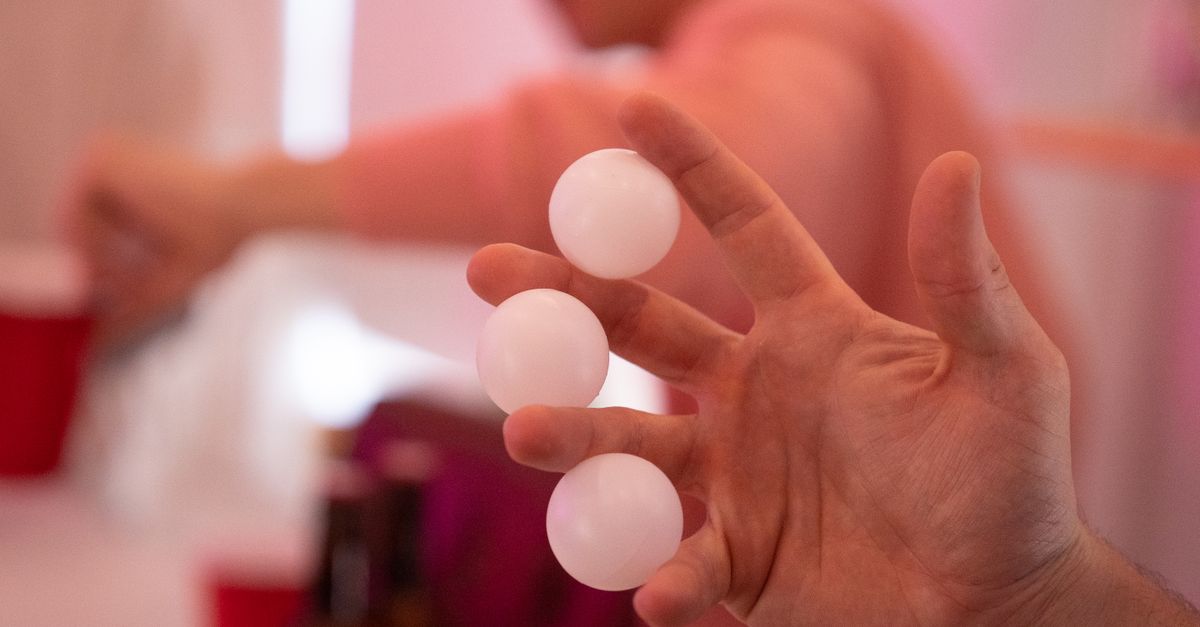
Your dented ping-pong ball is no fun, the table is ready, and there’s no spare in sight. Before you resign yourself to a ball that bounces in zigzags, try this. Dunk it in very hot water, just short of boiling, for a few seconds. Watch the dent pop back out almost like magic. However, it isn’t magic — it’s high-school physics doing its thing.
How to fix a dented ping-pong ball step by step
- Fill a cup or bowl with hot water, close to boiling but not quite bubbling (around 175-195°F does the job). Moreover, water straight from a kettle you’ve just switched off works fine too.
- Drop the dented ball in. If it floats and resists sinking, nudge it under with a spoon. Moreover, make sure the dented spot stays fully submerged.
- Wait 10 to 30 seconds, watching the ball closely. In most cases you’ll see the dent slowly “inflate” back into place on its own.
- Fish the ball out with the spoon — it’ll be hot. Let it cool for a moment before putting it back in play.
- If the dent doesn’t fully disappear the first time, give it one more round before writing the ball off.
One important catch: this trick only works on a dented ping-pong ball, not a cracked or punctured one. If there’s a crack, the air will simply escape through it instead of pushing the plastic back out. Therefore, the trick won’t do anything.
Why it works
Understanding why a dented ping-pong ball pops back into shape takes a bit of basic physics. A ping-pong ball is basically a hollow plastic sphere: celluloid in older ones, ABS plastic in most modern ones. Moreover, it holds a fixed amount of trapped air inside. However, when the ball takes a hit and dents, that air doesn’t go anywhere. It just gets compressed into the sunken spot. Meanwhile, the rest of the sphere keeps its shape.
This is where one of the most quoted gas laws from any physics class comes in. It’s called Gay-Lussac’s law, a close cousin of Charles’s law. This law describes how a gas behaves when its temperature changes at roughly constant volume. Heat the air up, and its molecules move faster and slam into the walls containing them with more force. Therefore, the pressure inside climbs.
Once the ball hits the hot water, the air inside heats up within seconds. In fact, the plastic shell is thin and conducts heat easily. That extra pressure pushes the dented plastic from the inside back out until the ball regains its original round shape. In fact, the water doesn’t even need to be truly boiling. It just needs to be hot enough to noticeably raise the temperature of the air trapped inside.
There’s a catch to the trick, though. The more a given ball gets dented and reheated, the more its plastic loses a bit of its original elasticity. Still, don’t expect it to survive the same abuse forever. And if you’re playing with modern ABS balls, mandatory in competitive table tennis for years now, the method works just as well. Still, this material is somewhat more resistant to denting in the first place than old-school celluloid.
Next time you end up with a dented ping-pong ball, you’ll know exactly what to do. Put the kettle on before you start hunting for a replacement. And if the problem isn’t the ball but a glass that cracks when you pour something cold into it, try a similar trick: a metal spoon to stop a glass from cracking. It’s based on the same thermal-shock principle. You can find more step-by-step detail in this complete guide on how to fix a table tennis ball.