
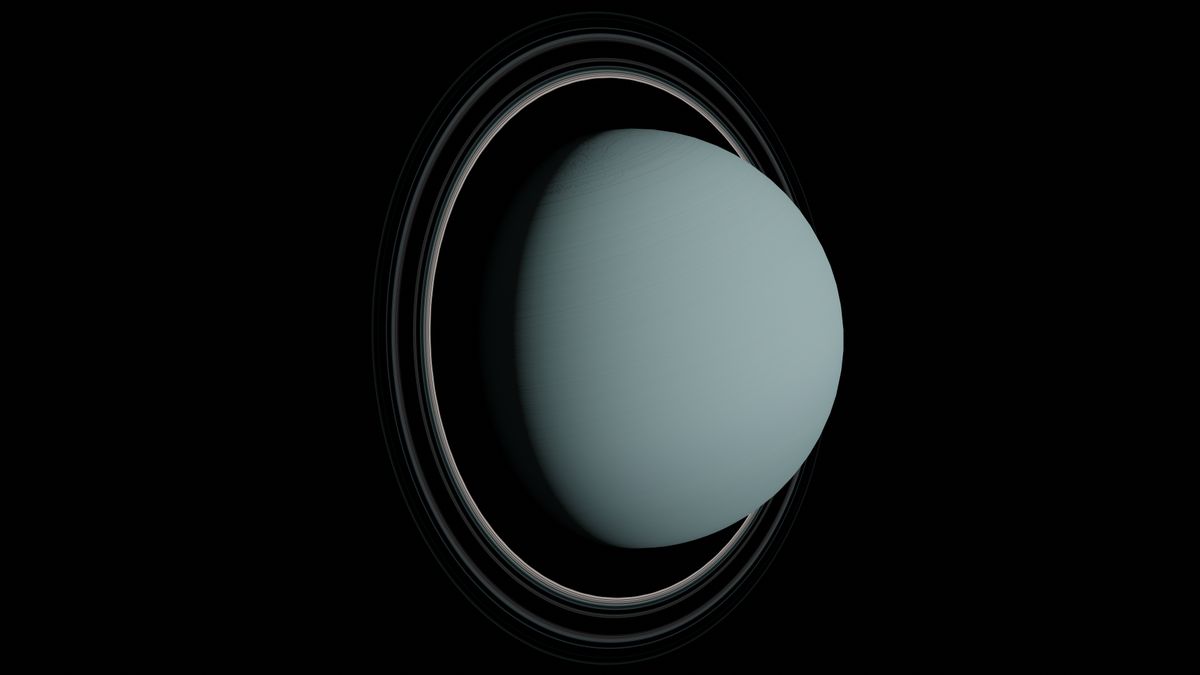
Beneath its icy crust, the small moon Ariel, one of Uranus’s satellites, may once have had a hidden ocean up to 170 kilometers (about 105 miles) deep. For scale, that’s nearly twenty times deeper than the Mariana Trench, the lowest point in all of Earth’s oceans. And the strangest part is that nobody suspected it for almost forty years. That changed when a team of scientists sat down to squint at some grainy photos snapped in passing back in 1986.
A moon we’ve only seen once, and barely at that
Ariel is one of Uranus’s five major moons, and its résumé as a visited world is pretty thin. The only spacecraft ever to fly anywhere near it was Voyager 2, and it didn’t even stick around to get a good look. During its 1986 flyby of Uranus, the probe photographed less than half of Ariel’s surface before speeding off toward Neptune. Those grainy, partial, black-and-white images are, to this day, literally all humanity has ever seen of this moon.
A team led by Caleb Strom, a recent graduate of the University of North Dakota, worked together with researchers from the Planetary Science Institute. Johns Hopkins’ Applied Physics Laboratory also took part. Therefore, they decided that was enough to try to reconstruct Ariel’s geological past from the cracks and ridges visible on its surface. In addition, the findings were published in the journal Icarus.
What the cracks reveal about Ariel’s hidden ocean
Ariel’s surface is scored with enormous canyons and fractures. According to the team, these don’t just form on their own — they require serious tidal forces pushing and stretching the ice from within. The researchers used a computer model of tidal stress. With it, they calculated that to produce that pattern of cracks, Ariel’s orbit must once have been far more eccentric — more oval-shaped — than it is today. In fact, it was roughly 40 times more eccentric than it is now.
An orbit that lopsided means Uranus would have squeezed and stretched the moon on every pass, generating internal friction and heat. In fact, that’s the same mechanism that keeps Jupiter’s moon Europa’s ocean liquid today. That tidal heating, according to the model, would have been enough to melt a layer of ice and sustain a liquid ocean beneath the surface. This hidden ocean at its peak made up roughly 55% of the moon’s total volume. It may have persisted until as recently as a billion years ago — a blink of an eye in geological terms.
Not the only suspect: the case of Miranda
Ariel isn’t alone in this. Another Uranian moon, Miranda, shows a similarly twisted, deformed terrain. Meanwhile, other studies chalk this up to a past of intense tidal heating too, possibly with a hidden ocean of its own. If two of Uranus’s five major moons carry that kind of history, that raises an obvious question: how many others in the system might once have had a hidden ocean too?
The trouble is that, with just one fleeting visit four decades ago to go on, there’s no way to fully confirm it. As one of the researchers on the team put it: “ultimately, we just need to go back to the Uranus system and see for ourselves.” Therefore, scientists have been pushing for a dedicated mission to Uranus and its moons for years. Studies like this one — which squeeze every last drop of information out of photographs taken in 1986 — are, for now, our best clue. Out there, in the frozen far edge of the solar system, there may be (or may once have been) a lot more liquid water than we ever imagined.
You can read more about the study on the Planetary Science Institute’s blog. If outer planets fascinate you, we also covered the giant decagon that appeared at Saturn’s south pole.