
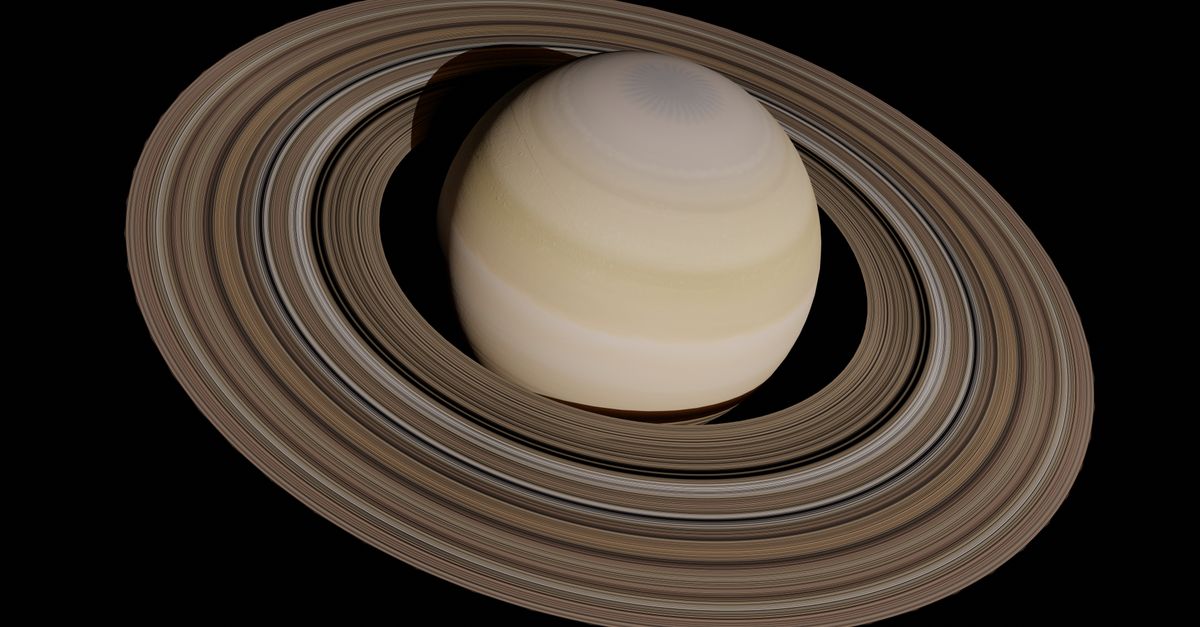
For almost forty years, Saturn’s hexagon has been one of the weirdest postcards in the solar system: a giant geometric shape, perfectly traced by clouds at the planet’s north pole, that no other world seemed to share. Well, it turns out Saturn was holding out on us. A little sibling has just shown up at the south pole, with ten sides instead of six: Saturn’s giant decagon had arrived.
The discovery, published on September 2, 2026 in the journal Science Advances, comes from an international team led by physicist Agustín Sánchez-Lavega (University of the Basque Country), together with researchers from UC Berkeley’s Space Sciences Laboratory and NASA’s Goddard Space Flight Center. And, as often happens in astronomy, the first tip-off didn’t come from a supercomputer but from two sharp-eyed amateurs: Trevor Barry and Jean-Paul Oger spotted a faint, wavy band near the south pole in 2024 while combing through older Hubble Space Telescope images dating back to 2023 — in fact, we covered the first hints of this shape here back when it was still just a blurry pattern in the images.
From hunch to confirmation
Spotting a weird shape in a blurry pixel patch is one thing; proving it’s real is another. With additional ground-based observations collected in 2025, the team confirmed that faint band had solidified into a sharp, stable decagon, trapped inside one of the jet streams that race through Saturn’s atmosphere. This isn’t an optical trick or a passing cloud: the analysis shows the structure extends downward through multiple atmospheric layers, meaning it’s a genuine physical feature, not just a pattern painted on the cloud tops.
And here’s the detail that upends nearly forty years of wonder: Saturn’s giant decagon turns out to be even more unstable than the famous hexagon, on top of being bigger. It measures about 104,250 miles (167,820 km) across, with each of its ten sides running roughly 10,425 miles (16,780 km), compared to the hexagon’s approximately 20,000 miles (32,000 km). For scale, the decagon is wide enough to fit thirteen Earths side by side.
Saturn’s Giant Decagon vs. the Hexagon
Both shapes are born from the same kind of process: a wave that gets “trapped” inside a curving jet stream, something scientists have been able to reproduce in the lab using shallow-water simulations flowing through curved channels — not unlike the eddies that form in a river as it bends around a rock. Still, the two don’t behave the same way. The north pole’s hexagon is essentially fixed relative to the planet, as if bolted to the rotation axis. The decagon, on the other hand, drifts eastward at a leisurely 6 mph (10 km/h), pushed along by winds that reach 250 mph (400 km/h) in that region.
Sánchez-Lavega summed it up with a line that probably stings a little for hexagon fans: “the ‘unique’ hexagon is not as extraordinary as we thought.” In other words, Saturn didn’t have a one-off geometric quirk up north — it has a tendency. When wind speed, temperature and rotation line up just right, the planet seems perfectly capable of sketching near-perfect polygons at either pole.
Why it matters beyond the pretty pictures
Beyond the eye-catching headline, this discovery forces a rethink of atmospheric models for gas giants. If these geometric shapes aren’t a one-polar-region fluke but a natural outcome of how jet streams interact with a planet’s rotation, similar patterns should be expected on other worlds with comparable atmospheres — Jupiter, Uranus, Neptune, or even gassy exoplanets far beyond our solar system. So the team plans to keep watching Saturn’s giant decagon with Hubble in the coming years to see whether it stays stable, changes shape, or — like the hexagon — turns out to be a permanent fixture of Saturn’s landscape.
For now, what we’re left with is an image straight out of a sci-fi video game: a gas giant with giant geometric shapes spinning at both poles, sketched by winds moving at hundreds of kilometers an hour. You can read the original technical details in NASA’s official Hubble page on the discovery.