
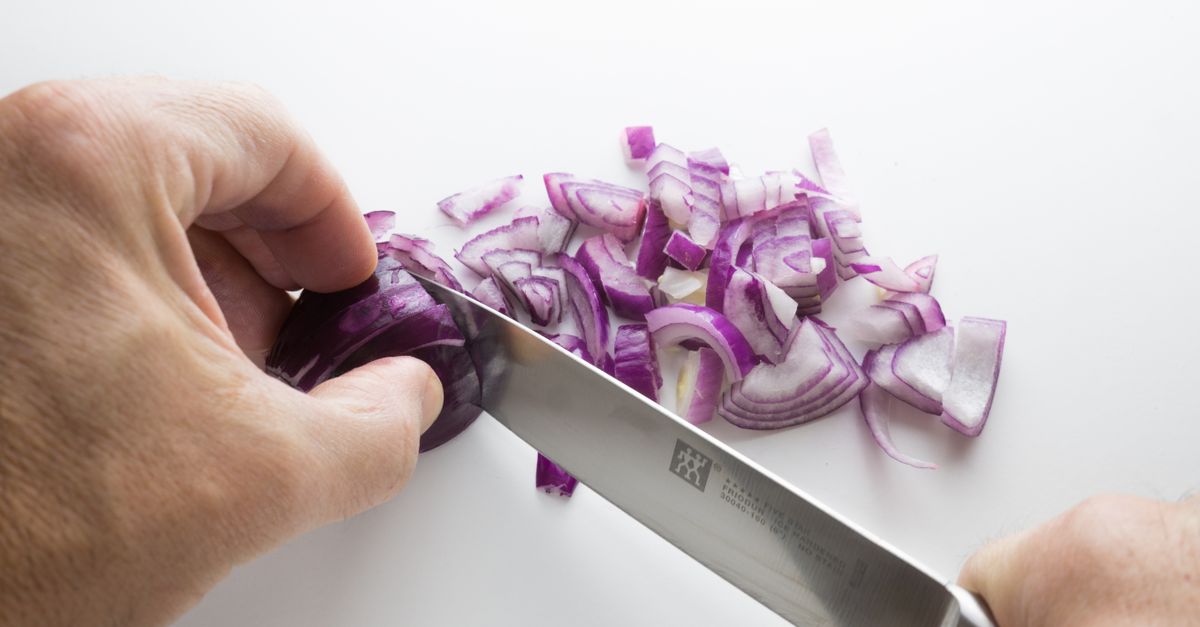
The trick is simple: chill your onion in the fridge (or 10 minutes in the freezer) before cutting it, and you’ll cry a lot less. It’s not an old wives’ tale or kitchen magic — there’s an enzyme involved, and cold knocks it out of the game.
How to do it
- Put the whole, unpeeled onion in the fridge for at least 30 minutes before cooking (in a hurry? 10-15 minutes in the freezer works too).
- Peel and cut it as usual, but with a sharp knife — the cleaner the cut, the fewer cells you rupture at once.
- Save the root end for last. That’s where most of the tear-inducing enzymes are concentrated.
- If you’re chopping a big batch, work near a running extractor fan or an open window — it helps disperse the gas before it reaches your eyes.
This won’t eliminate the tears one hundred percent — science is clear that no home trick does — but you’ll notice a real difference, especially if you usually end up looking like you just lost a boxing match.
Why it works
When you cut an onion, you rupture its cells and release an enzyme with a name straight out of a supervillain script: lachrymatory-factor synthase. This enzyme converts sulfur compounds in the onion into a volatile gas, syn-propanethial-S-oxide, which drifts up toward your eyes and, on contact with the moisture on your cornea, forms a tiny cloud of sulfuric acid. Your eyes, understandably, respond by producing tears to dilute and flush it out. The onion isn’t “trying” to make you cry — it’s pure chemical defense the plant evolved against insects and animals that would otherwise eat it.
This specific enzyme wasn’t even known to science until just over two decades ago: a team of Japanese researchers identified and described it in a study published in the journal Nature, solving a biochemical mystery that had puzzled scientists for decades (you can read the original study in Nature).
This is where the cold comes in. Like almost all enzymes, lachrymatory-factor synthase works best at moderate temperatures and gets sluggish as the temperature drops. By chilling the onion, you slow down the rate at which this enzyme converts sulfur compounds, so less irritating gas is released in the same amount of cutting time. It’s the same reason we refrigerate food in general: cold doesn’t stop chemical reactions, it just slows them down.
To be fair and not oversell it: some experimental cooking studies — including one from Cornell University — have found that the effect varies quite a bit depending on the onion variety, how thick you cut, and each person’s individual sensitivity. It’s a trick backed by real chemistry, not a vaccine against tears. But for a chore as routine as chopping onions for dinner, every bit of an edge helps.
And if anyone ever tells you that chewing gum or holding a toothpick between your teeth while cutting works for the same reason, feel free to correct them: those tricks have no chemical mechanism behind them at all. Cold, on the other hand, actually has science on its side.