
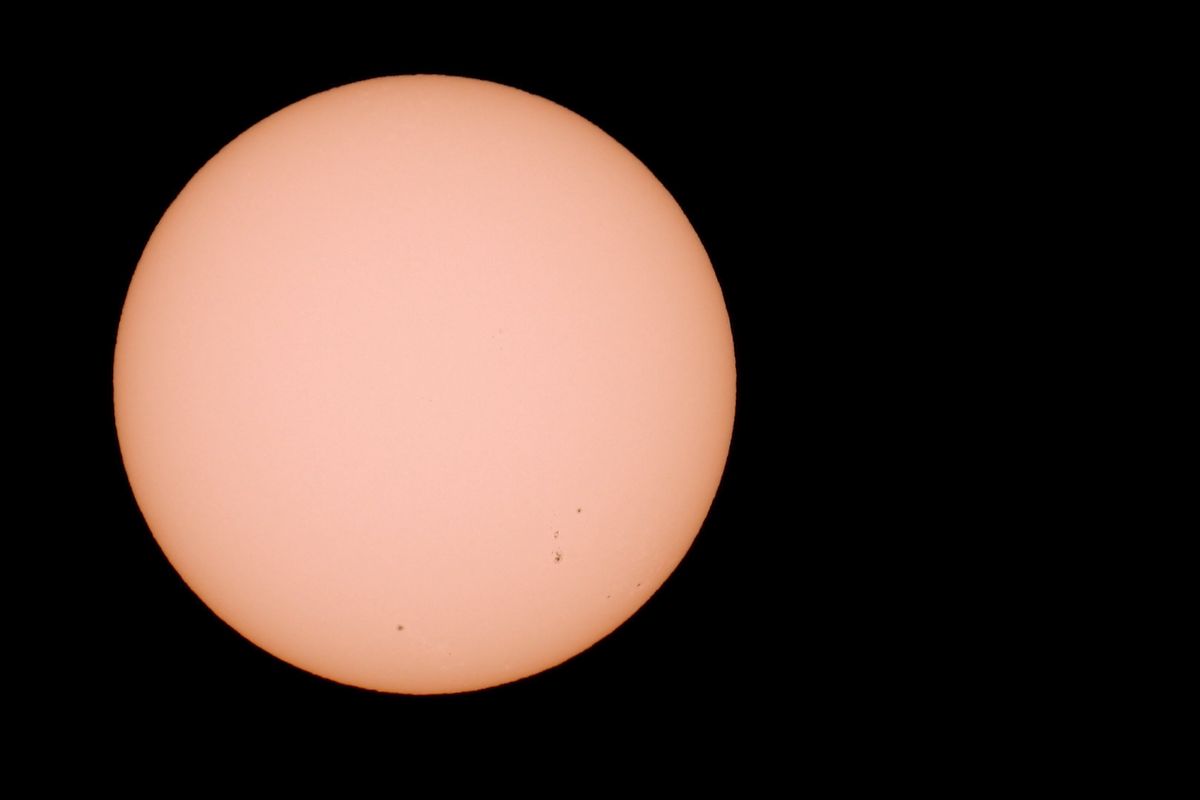
The Sun has been up there for 4.6 billion years, and it’s still full of surprises. The latest one: its surface is dotted with tiny plasma whirlpools, not unlike the curl of a wave breaking on shore, except made of gas at 5,500 degrees and scaled up to the size of an entire star. Nobody had spotted them before simply because we never had a telescope sharp enough to zoom in that close.
A Hawaiian telescope with the finest vision ever achieved
The discovery comes courtesy of the Daniel K. Inouye Solar Telescope, the largest solar telescope in the world, perched on the volcano Haleakalā on the Hawaiian island of Maui. With a 4-meter mirror, it can resolve details as small as 20 kilometers on the Sun’s surface — roughly like picking out a football field from Earth, if that football field happened to be 93 million miles away.
With that level of detail, a team of astronomers from the US National Solar Observatory, the Max Planck Institute for Solar System Research, and the High Altitude Observatory turned their attention to the edges of solar granules: the convective cells, roughly 500 to 2,000 kilometers wide, that tile the Sun’s surface like a pot of water gently simmering, each one pushing hot plasma up and letting it sink back down, cooled, around the edges.
Textbook physics, never seen on the Sun before
Right there, at the boundary between two granules, is where the phenomenon shows up: layers of plasma sliding past each other at different speeds curl into vortices, the exact same way wind blowing across the ocean ripples the surface into little waves, or the way two cloud layers sliding past each other sketch those spiral, wave-like patterns you sometimes see in the sky. It’s called the Kelvin-Helmholtz instability, a fluid-dynamics principle known since the 19th century, but one nobody had ever directly photographed on the Sun until now. The vortices sit roughly 50 to 65 kilometers apart, and they’re everywhere — the researchers found them constantly forming and dissolving across the surface.
“It is very exciting to see that the highest-resolution observations of the solar photosphere revealed a new dynamical regime in the form of Kelvin-Helmholtz vortices at the edges of magnetic field concentrations,” said astronomer Matthias Rempel of the High Altitude Observatory, a co-author of the study.
Why this is more than a pretty picture
These whirlpools aren’t just eye candy: by twisting the Sun’s magnetic field lines, they may act as a kind of energy reservoir. That’s the same energy later released as nanoflares (miniature solar eruptions) and, on a bigger scale, as full flares, plasma jets, and coronal mass ejections — the same phenomena that sometimes light up spectacular auroras on Earth and, in their strongest form, can mess with satellites and power grids.
The finding could also help crack a decades-old headache in astrophysics: why the Sun’s corona, its outer atmosphere, runs hundreds of times hotter than the surface below it. If these vortices help the magnetic field spread faster than current models predict, they could be a missing piece of that thermal puzzle.
The study was published on August 5, 2026 in the journal Nature. So next time you’re catching some rays, remember that up there, 93 million miles away, thousands of tiny plasma tornadoes are constantly twisting away. Your tan, for now, still just comes from the regular old radiation.