
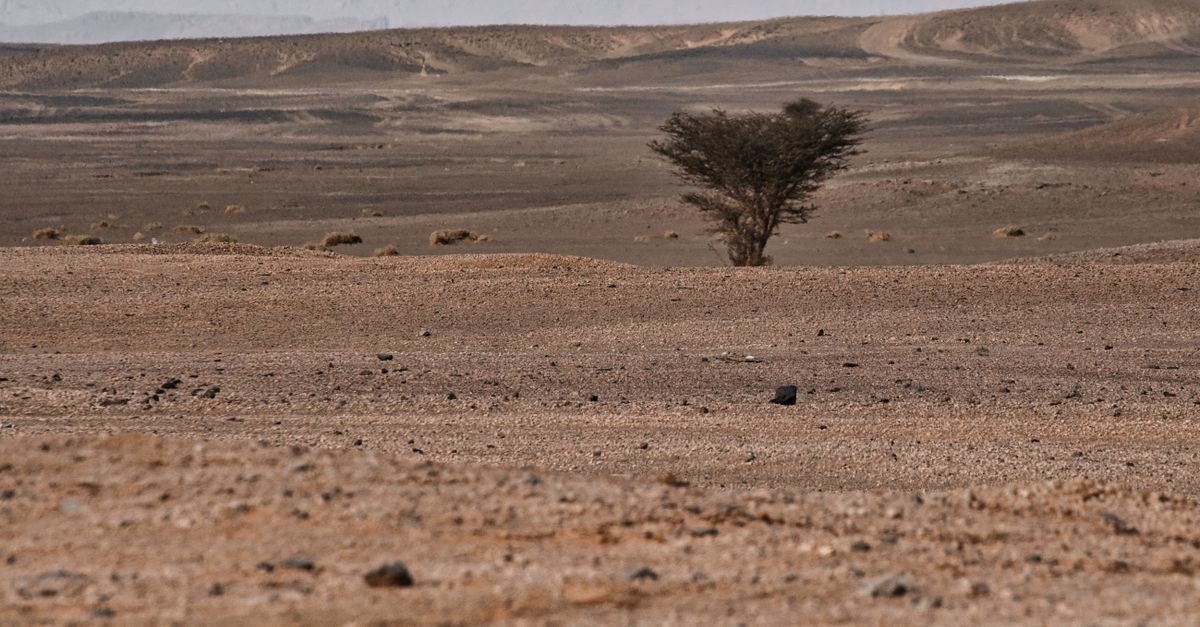
Picture a tree so alone it was, quite literally, the only one of its kind for 400 kilometers in every direction. Not just the nearest big shrub or a distant cousin — nothing. Just sand, rock, and horizon as far as the eye could see. That tree really existed, deep in the Sahara Desert, and for decades it was the most reliable landmark for caravans crossing one of the emptiest stretches of the planet. It was called the Tree of Ténéré, and its ending is as absurd as its life was extraordinary.
A green dot in the middle of nowhere
The Ténéré is a region of the Sahara in northeastern Niger, a sea of dunes where rain is almost a rumor and where, for centuries, trade routes connected far-flung oases. Right in the middle of that emptiness grew a single acacia, barely three meters tall, that served as a natural beacon for caravan drivers: spot the tree, and you knew exactly where you were. It was so singular that it was actually marked on maps at a scale of 1:4,000,000 — an almost unheard-of honor for one lone plant. Cartographers, essentially, decided a tree deserved the same billing as a city.
It’s believed to have been the last survivor of a small grove of acacias that grew in the area thousands of years ago, back when the climate was far less brutal. As the Sahara dried out, its neighbors disappeared one by one, until only this one was left, clinging to life in the middle of the desert.
Roots forty meters deep
How does a tree survive with essentially no rain for generations? The answer turned up by accident. In the winter of 1938-1939, workers dug a well near the tree to supply travelers with water, and discovered that its roots plunged nearly 40 meters (about 130 feet) underground to reach the water table. That’s roughly the height of a thirteen-story building, only vertical and buried. The discovery turned the tree into a small legend of botanical stubbornness: while the surface was pure desert, its roots had spent centuries quietly drinking from an invisible aquifer.
The first warning, and the final blow
The tree originally had two trunks, growing in a “Y” shape. In the 1950s, a truck heading toward the town of Bilma crashed into it and tore off one of the two trunks, leaving it wounded but still standing. Nobody took it as a serious warning, because really — what are the odds that anyone would hit the only tree within 400 kilometers a second time?
And yet it happened. In 1973, a Libyan truck driver, reportedly drunk, drove out into the vastness of the Ténéré and pulled off something that should have been statistically almost impossible: he plowed straight into the tree and knocked it down completely. In a desert with no curves, no intersections, nothing to run into for days of travel, he still managed to find the one natural obstacle that existed. If you ever need a textbook example of catastrophically bad luck — or catastrophically bad driving — this is it.
What’s left of the Sahara’s most famous tree
The acacia’s remains were moved to the National Museum of Niger in the capital, Niamey, where they’re preserved as a historical artifact. On the exact spot where it grew for centuries, a metal sculpture now stands in its honor, still visible today to anyone who ventures along that Saharan route. It’s not quite the same as a living tree, but at least the dot on the map still has something to point to.
The story of the Tree of Ténéré, documented in detail on Wikipedia, has become one of those anecdotes that sound made up but aren’t: a living thing that survived thousands of years of drought, isolation, and sandstorms, only to be taken down not by nature, but by a truck lost in the middle of nowhere. Sometimes the least likely threat is exactly the one that finds you.