
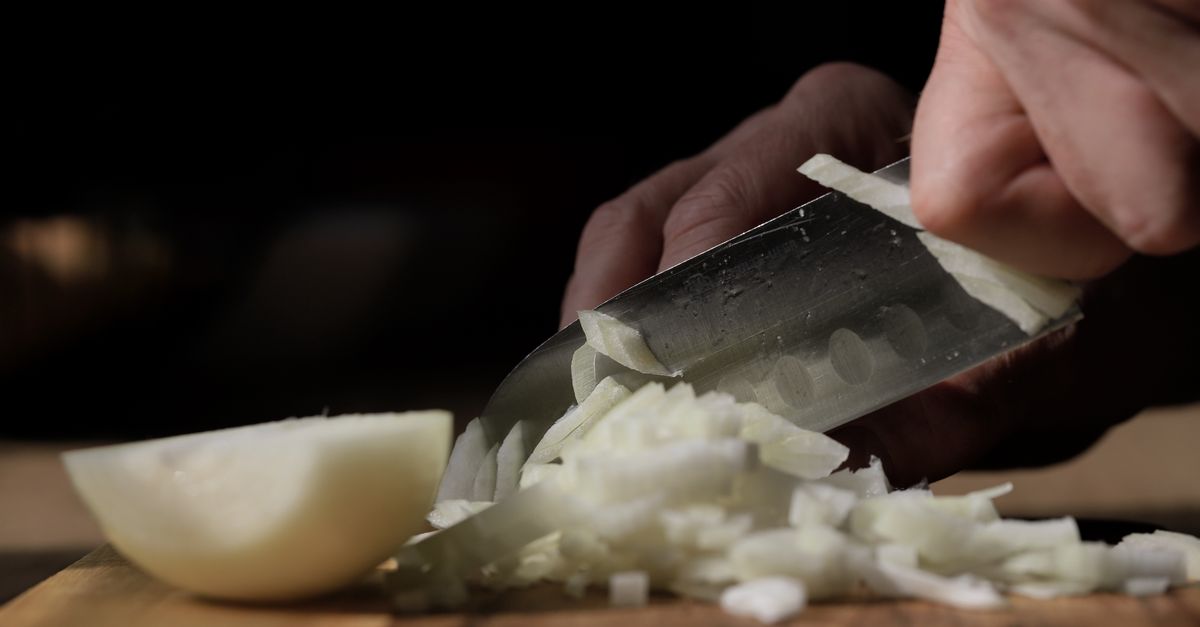
You slice into an onion, you’re not thinking about anything sad, and within thirty seconds you’re blinking like you just watched the end of a dog movie. It’s not you — it’s straight chemistry, and the onion has spent millions of years perfecting the trick.
A biological weapon in every layer
Onions don’t produce tear gas for fun. It’s a defense mechanism against animals and insects trying to eat them, as the Library of Congress explains. While the onion is intact, that weapon stays switched off, kept in separate compartments inside its cells: on one side there’s an enzyme called alliinase, and on the other, sulfur compounds the plant has pulled up from the soil.
The trouble for the onion — and for you — starts the moment a knife bursts those cells open. Suddenly, the alliinase and the sulfur compounds that used to live apart get mixed together, and a tiny chain reaction kicks off almost instantly.
From the cutting board to your eye in seconds
That first mix produces unstable compounds that a second enzyme, lachrymatory-factor synthase, converts almost immediately into the molecule behind the whole ordeal: syn-propanethial S-oxide. This compound is so light it evaporates the instant it forms and drifts straight up, right toward your eyes.
When that invisible cloud touches the moist surface of your eye, it reacts with the water there and forms a tiny amount of diluted sulfuric acid. Your eye, understandably, doesn’t take that well: it fires up the trigeminal nerve, which sends an alarm signal to the tear glands, and they respond by pumping out tears to dilute and flush the irritant out. It’s the same reflex that kicks in if shampoo gets in your eyes — except this time the culprit is a vegetable.
So do the old kitchen tricks actually work?
Some of them do have a real basis, though none is magic. Chilling the onion in the fridge before cutting it slows down the enzyme reactions, so less gas gets released. Cutting it under a range hood or near an open window helps disperse the compound before it reaches your eyes. And using a very sharp knife helps too, since it ruptures fewer cells per cut than a dull blade, which tends to crush them instead of slicing cleanly.
What has no real backing is chewing gum or clenching a wooden spoon between your teeth while you cut — entertaining, sure, but the syn-propanethial S-oxide chemistry doesn’t care either way. If you want to kill the problem at the source, the one foolproof trick is cutting the onion under running tap water, where the gas dissolves before it ever gets the chance to evaporate toward your face.
So next time someone catches you crying over the cutting board, you can tell them it’s not a bad day — it’s a plant successfully waging a chemical war that started millions of years ago.