
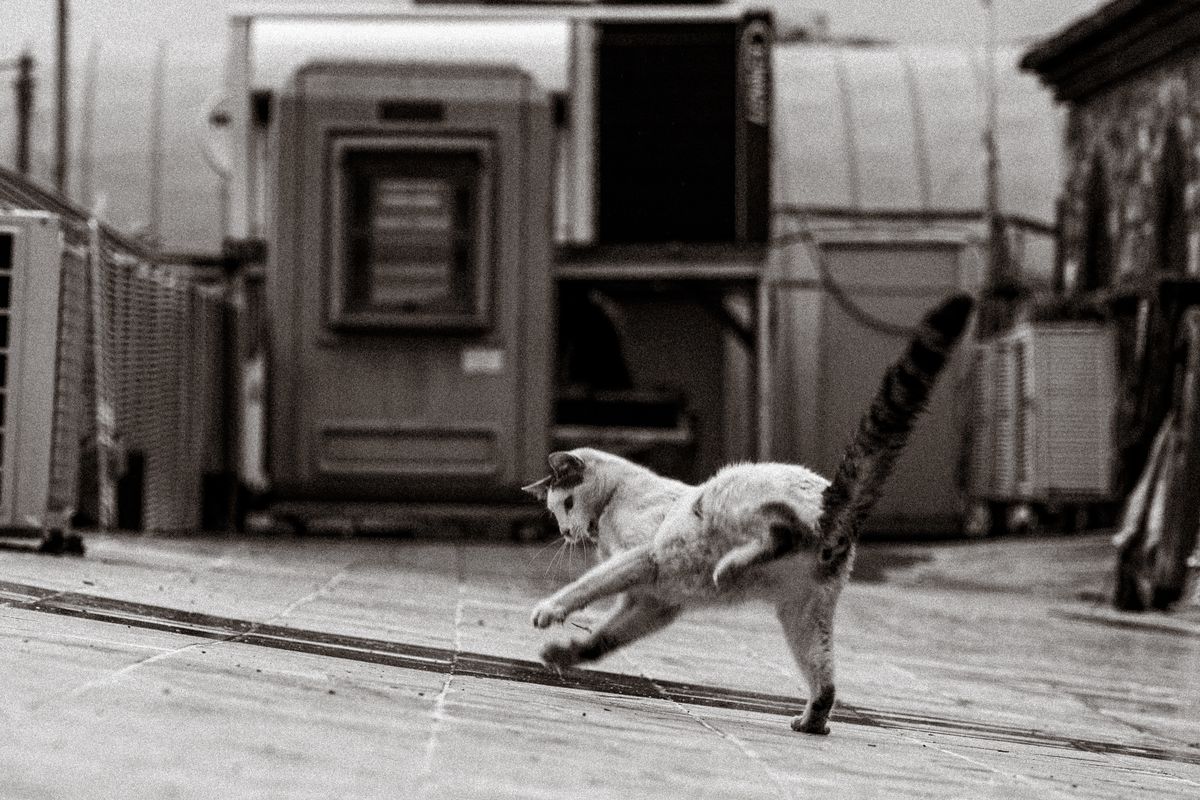
Cats always land on their feet no matter how they start falling, and for a long time that drove physicists crazy trying to explain why. Drop a cat upside down from about knee height and, before it’s even finished processing what you just did to it, it will have already landed on all four paws with a look that says you’ll be paying for this later. It’s a trick every cat owner has witnessed at some point (by accident, we hope), and for over a century it left physicists genuinely stumped. Not because they didn’t understand cats, but because the trick seemed to break one of the most sacred laws in physics: conservation of angular momentum.
The problem of how cats land on their feet
When something is in free fall, gravity is the only force acting on it, and gravity pulls straight down, it can’t make anything spin. Classical physics says a body that starts falling without rotating should keep not rotating for the whole fall, simply because there’s no external force twisting it. And yet a cat dropped belly-up, with zero spin to begin with, manages to flip itself over mid-air and land on its feet. This bit of everyday magic bothered scientists enough that back in 1894, French physiologist Étienne-Jules Marey pulled out one of the world’s first high-speed cameras, capable of a blazing 12 frames per second, for the sole purpose of figuring out how on earth cats were pulling it off.
The trick: a cat isn’t a rigid tube
The catch was in how the problem was framed. Conservation of angular momentum is non-negotiable, sure, but it only applies to rigid bodies, and a cat is about as far from rigid as a mammal gets. Its spine has somewhere between 52 and 53 vertebrae (humans get by with 32 to 34), giving it enough flexibility to fold in half as if it had a hinge at the waist. That lets the cat twist the front half of its body one way while twisting the back half the other way, like wringing out a towel in two directions at once. The two rotations cancel out on paper, so the conservation law stays perfectly intact, but the net effect is that the whole body has turned over.
The second ingredient is an old friend of anyone who’s watched figure skating: moment of inertia. When the cat wants one half of its body to spin faster, it tucks that half’s legs in close to the torso (the same trick a skater uses pulling their arms in to spin quicker), and when it wants the other half to barely rotate at all, it stretches those legs out wide to slow that spin down. Tuck the front, stretch the back, spin the front 180 degrees while the back barely twists, then reverse the move to finish rotating the rear half into place. In a fraction of a second the whole animal has flipped over without ever technically cheating Newton’s laws.
From feline party trick to NASA research problem
This isn’t just a fun bit of trivia. The so-called cat righting reflex develops in kittens between three and seven weeks of age and relies heavily on the vestibular system in the inner ear, which constantly tells the animal which way is “up.” Moreover, the puzzle interested aerospace engineers enough that NASA studied the mechanism back in the 1970s to understand how astronauts might reorient themselves in space with nothing to push off from, since microgravity poses the exact same riddle: how do you rotate a body with no external force acting on it? As a recent deep dive from BBC Science Focus lays out, the puzzle has kept generating serious physics papers right up to recent years, including full mathematical models of the feline flip published in specialist journals.
One important caveat, though: a cat’s mid-air gymnastics don’t mean it can survive any fall unscathed. The righting reflex needs a split second and a minimum height to fully play out, so very short falls, off a low table, say, can actually be more dangerous, since the cat simply doesn’t have time to orient itself before hitting the ground. If cats have you hooked, you might also like finding out why a cat’s purr isn’t run by the brain either. So next time your cat tumbles off the sofa, lands on its feet, and strolls away like nothing happened, remember that behind that poker face is over a century of physics solved with a bendy spine and perfectly timed tucked-in paws.