
There’s a place in northern Chile where not a single drop of rain falls for years on end. It happens across many of its spots. The Atacama Desert is the driest non-polar place on Earth. That’s exactly why what happened in mid-August 2026 was so bizarre: it snowed. And it wasn’t a token dusting. The snow came with winds gusting up to 90 km/h (56 mph). That was enough to shut down one of the most expensive, most sensitive telescopes on the planet. Weeks later, though, that same ground began setting the stage for the Atacama flowering desert, one of South America’s most anticipated natural spectacles.
The culprit was a detached low-pressure system, known as a “cutoff low” in weather jargon, and an unusually large one. It stretched from the southern tip of South America up into subtropical latitudes and teamed up with moisture blowing in off the Pacific. The result: snow on the high plateau and, by local standards, torrential rain along the coast. The city of Taltal normally sees barely 4 millimeters (0.16 inches) of rain a year. This time it collected close to 40 mm in just three days, ten times its annual average in one go.
A telescope in “survival mode”
Up on the Chajnantor Plateau, more than 5,000 meters (16,400 feet) above sea level, the snow and wind were enough to shut everything down. That’s where the Atacama Large Millimeter/submillimeter Array (ALMA) operates, the world’s most powerful radio telescope network for studying the cold universe. So it had to suspend observations and put its antennas into protective mode, as Live Science reported. Nothing broke. But for days, astronomers were locked out of listening to the cosmos. It was a weather event that, by rights, almost shouldn’t happen there.
Because that’s the whole point of the Atacama: its dryness isn’t an accident. It’s boxed in by the Andes, which block moisture rolling in from the Amazon. It’s also boxed in by the cold Humboldt Current offshore, which chills Pacific air and stops it from forming rain clouds. That one-two punch has spent millions of years turning the region into a textbook desert. For both barriers to fail at once, as they did in August, is the exception that proves the rule.
The payoff: the Atacama flowering desert
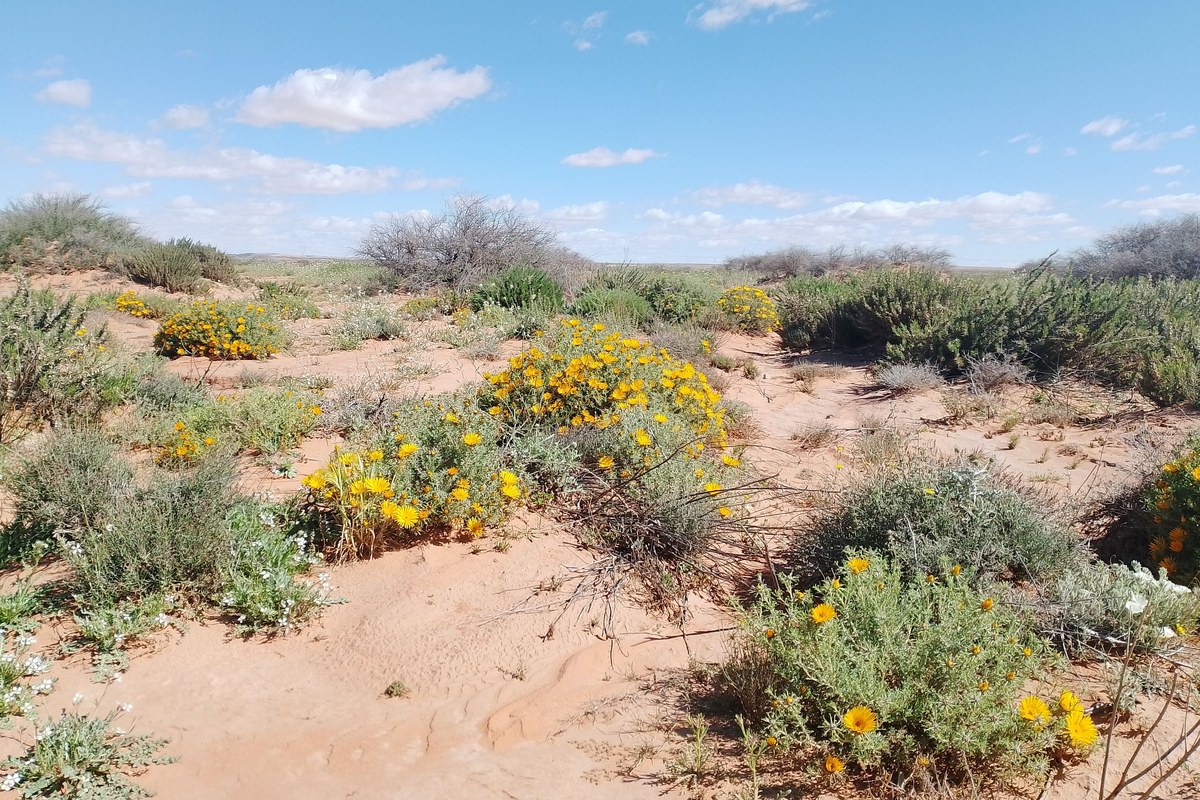
And here’s the good part. All that water didn’t just evaporate. It soaked into the ground, right where seeds and bulbs had been sitting dormant for years, sometimes decades. Given enough moisture, those seeds germinate almost in unison. So a desert that spends most of its life without a single green blade suddenly gets carpeted in color.
It’s called the Atacama flowering desert, known in Spanish as “desierto florido.” According to Chile’s National Forestry Corporation (CONAF), the 2026 bloom could spread across more than 15,000 square kilometers (roughly 5,800 square miles). That would make it one of the most intense since the legendary 1997 bloom, according to Infobae. More than 200 different species are expected: purple añañucas, “guanaco’s paws,” suspiros and terciopelos among them. In fact, they’re already starting to poke through in early September. The bloom should peak in the second half of October, though the show could stretch into November.
The strange part is that these plants aren’t germinating on a whim. They’ve evolved to bet almost everything on a single move. They carpet as much ground as possible with flowers during the few weeks that water is around. Then they crank out seeds as fast as they can and go dormant again, waiting for the next rain, which might not show up for another decade. It’s essentially a desert playing all-or-nothing poker with its own plants’ genetics.
So next time someone tells you nothing ever happens in the driest place on the planet, here’s your comeback. In 2026, it snowed hard enough to shut down a state-of-the-art radio telescope. A few weeks later, that same ground got ready to become, however briefly, the Atacama flowering desert: a wildflower field stretching for miles.
It’s not the only sky mystery that has surprised astronomers lately, either. Just a few weeks earlier, another instrument captured Saturn’s decagon, a shape nobody saw coming.