
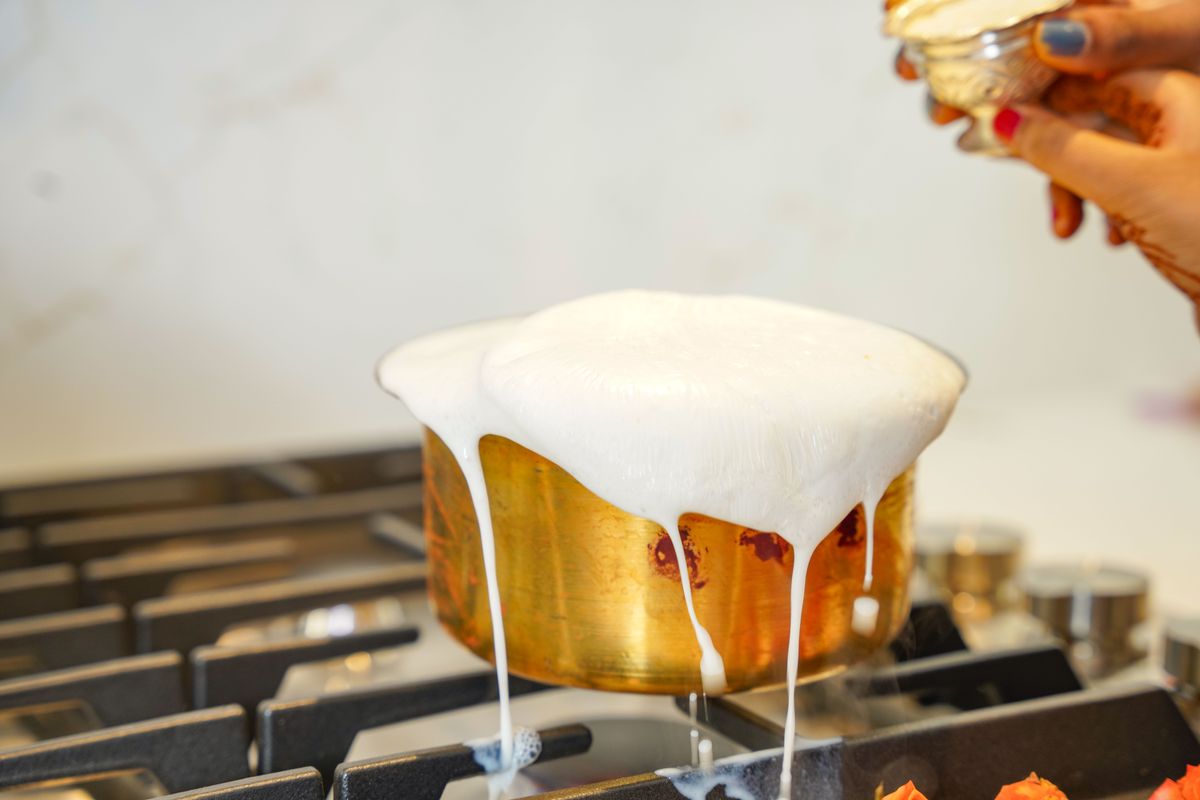
Here’s the wooden spoon trick: lay a wooden spoon across the top of the pot while your pasta water, rice, or milk is boiling. It’ll take a lot longer to spill over. This isn’t just a hand-me-down kitchen myth: in 2025, physicists actually filmed the phenomenon with high-speed cameras to figure out what’s really happening up there. In fact, the explanation turns out to be more interesting than you’d expect.
How to do the wooden spoon trick
- Once the water is boiling hard and foam starts creeping up toward the rim, lay a long wooden spoon across the mouth of the pot. Rest it on the edges.
- Make sure the middle of the spoon sits right over the spot where the foam rises the most (usually the center).
- Leave it there and don’t touch it. No need to stir constantly or hover over the stove — the spoon does the work on its own.
- If you’re boiling something for a long stretch, say a thick sauce, dry the spoon off now and then or swap it for another one. It loses effectiveness the longer it’s used.
It works with pretty much any liquid that foams up as it boils: starchy pasta or rice water, milk, broths with legumes in them… The bubblier it gets, the more the difference shows.
Why it works
The wooden spoon trick comes down to two properties of wood that metal and plastic simply don’t have. First, wood is a poor conductor of heat. That’s why the part of the spoon sticking up out of the pot stays noticeably cooler than the steam and bubbles rising off the boiling water. When a foam bubble hits that cold surface, it loses heat instantly. Its thin water film destabilizes, and the bubble pops, releasing the steam trapped inside instead of letting it pile up as foam.
The second property is that wood is porous and hydrophilic — it “likes” water and has a rough, irregular surface at the microscopic level. That texture acts like a trap for bubbles. It breaks the surface tension of their outer film far more effectively than a smooth surface like stainless steel or plastic would. In practice, the spoon acts as a barrier that bursts the foam right before it manages to climb over the rim of the pot.
Here’s the catch with the wooden spoon trick, though: it isn’t a permanent fix. As the spoon heats up and soaks up moisture, its pores fill with water. It gradually loses some of its ability to pull heat away and pop bubbles. That’s why it works best at the start, while the spoon is still dry and cool. It loses steam over time, especially if the burner is cranked up high or the pot is very full. Still, it’s not magic, and it doesn’t replace keeping an eye on the stove, but it does buy you those extra few seconds that keep you from mopping up a white puddle off the cooktop.
As explained in an analysis published by The Conversation covering the high-speed camera experiments, that’s exactly the mechanism at play. The combination of a cooler, more porous surface is what pops the foam before it overflows. A metal spoon can’t replicate this, since it heats up almost as fast as the pot itself.
So next time you’re boiling pasta and don’t want to babysit the timer, now you know the wooden spoon trick: lay a spoon across the pot and go do something else. If you like this kind of kitchen fix, you might also want the metal spoon trick to stop a glass from cracking when you pour hot liquids. And if your kitchen doesn’t have a single wooden spoon within reach, no worries. Turning the heat down slightly the moment the foam starts climbing is still the classic fallback.