
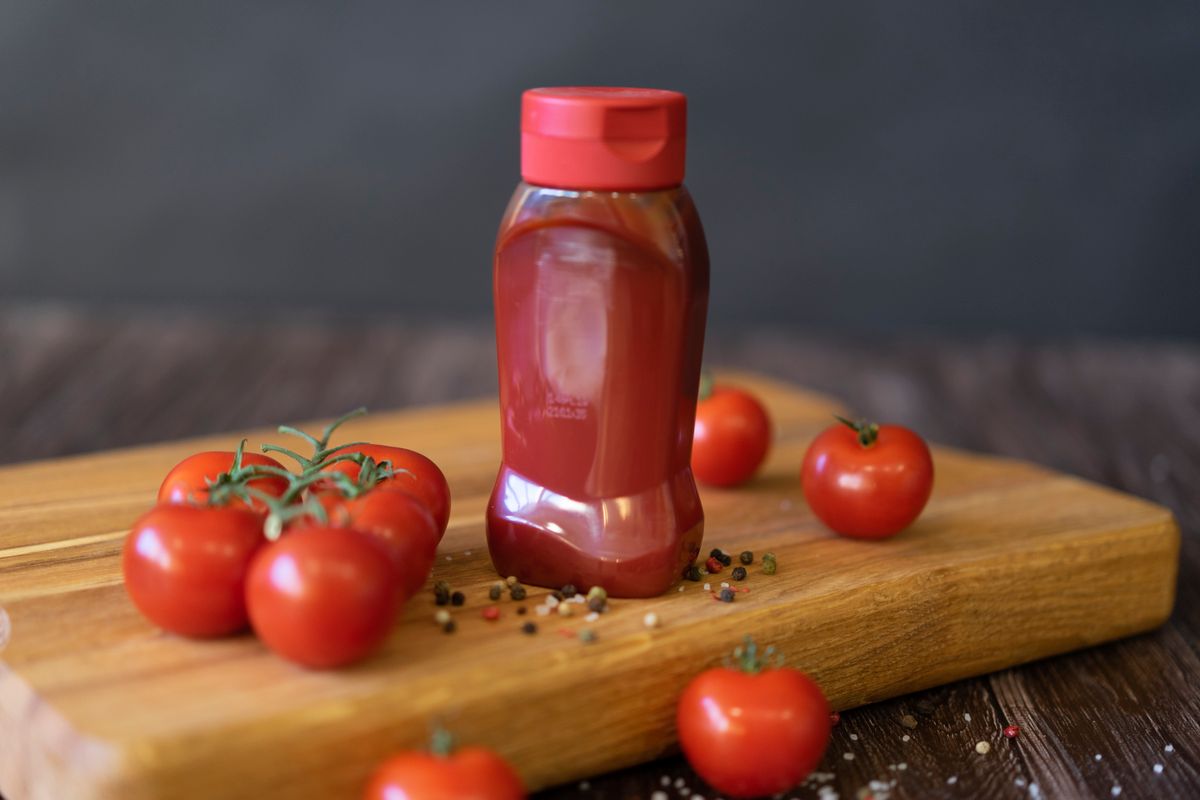
You’ve done it a thousand times: flip the ketchup bottle upside down and shake it like a cocktail shaker. The result is always the same disaster. Either nothing comes out, or it all comes out at once, right on top of your plate (and sometimes the table, your shirt, and your dignity). Turns out there’s a far more civilized method, known as the 57 trick. It’s literally stamped into the glass of the classic Heinz bottle. Hold it at about a 45-degree angle and tap firmly right on the “57” embossed on the neck. The ketchup flows out with suspiciously orderly ease.
How to do the 57 trick step by step
- Grip the bottle by the neck with one hand, keeping the “57” visible.
- Tilt it about 45 degrees, pointing toward the plate, without turning it fully upside down.
- With your other hand, give firm, sharp taps right above the “57” — never on the base.
- If it’s slow to come out, gradually increase the force of the taps. Still, avoid violently shaking the bottle: ketchup can “remember” the motion and let go all at once.
- If the bottle has been sealed for a long time, loosening the cap slightly before you start helps break the internal vacuum.
Why the 57 trick works: the physics of ketchup
Ketchup doesn’t behave like water or honey. It’s what physicists call a shear-thinning non-Newtonian fluid, or pseudoplastic, if you want to sound fancy at dinner. At rest, tomato particles, fiber, and pectin form a kind of microscopic network that keeps it thick. That network is what stops it from flowing under gravity alone.
However, the moment you apply force — shaking, squeezing, tapping — that network temporarily breaks apart. The viscosity plummets and the liquid flows freely. It’s the exact opposite of cornstarch dissolved in water, which hardens the harder you hit it. Ketchup does the reverse: it turns more liquid the more force you apply. High-speed microscopy studies confirm it, as covered by Chemistry World, the Royal Society of Chemistry’s magazine, showing exactly how those particles rearrange under pressure to let the liquid through.
The origin of the 57: marketing legend, not science
Now for the less romantic part: no fluid dynamics engineer designed the “57.” The number dates back to 1896, when founder H. J. Heinz spotted a New York shoe shop sign boasting “21 styles” of footwear. He decided his own company needed a catchy number too, even though it already sold more than 60 different products. According to company legend, he landed on 57 by combining his own lucky number with his wife’s. It was pure marketing, as Food Republic reports. Still, Heinz eventually turned that number into the “official tapping spot” on its glass bottles. The trick became something of a self-fulfilling prophecy: since that’s where people have been tapping for decades, that’s where everyone expects — and gets — the ketchup to respond.
Where to actually tap (and why it works without the number)
The funny thing is that the real effectiveness has less to do with the exact number stamped on the glass. It’s more about where and how you tap: hitting the neck, close to the opening, concentrates the force right where the particle network needs to break down. Pounding the base, meanwhile, spreads that energy through the whole mass of ketchup and loses efficiency along the way. That’s why the 57 trick also works on bottles with no number embossed at all. You just need to tap near the cap rather than the bottom. So next time someone brags about knowing “the scientific 57,” you’ll know what to say. The fluid physics is real and well documented. The number itself, meanwhile, is nineteenth-century marketing folklore.
Incidentally, the same principle explains why flexible plastic squeeze bottles work better for most people than glass ones. Squeezing the bottle wall directly produces that same breakdown of the internal network. It also happens in a more controlled way, without having to tap anything. Glass, though, still wins on retro-diner aesthetics. Curious about other kitchen tricks with real physics behind them? The wooden spoon trick that stops pasta water from boiling over works on a similar surface-tension principle.