On October 6th, the Nobel Committee placed a phone call to Italy. On the other end, an 82-year-old Belgian physicist was stunned. He was being told he’d just won the 2026 Nobel Prize in Physics. His “telescope” doesn’t point at the sky with lenses or mirrors. It’s a cubic kilometer of Antarctic ice buried at the South Pole. And what it hunts for isn’t light. It’s ghosts.
The winner is Francis Halzen. The official citation reads: “for decisive contributions to the IceCube Neutrino Observatory and the discovery of high-energy neutrinos of astrophysical origin.” Said like that, it sounds like lab jargon. But the story behind it is exactly the kind that makes the case for basic science, even when it takes decades to pay off.
Ghost particles that pass through planets
Neutrinos are subatomic, barely have any mass, and almost never interact with anything. Every second, trillions of them pass through you, your house, and the entire planet without you noticing. It’s as if matter were practically empty air to them. That shyness is what makes them fascinating to physicists. It’s also a nightmare to detect: how do you catch something that almost never bumps into anything?
Halzen’s solution was to think big. Literally. If a neutrino rarely interacts, you need an enormous amount of monitored matter to catch the rare collisions that do happen. And Antarctic ice, transparent and available in industrial quantities, turned out to be the perfect detector.
The Antarctic Ice That Became a Telescope
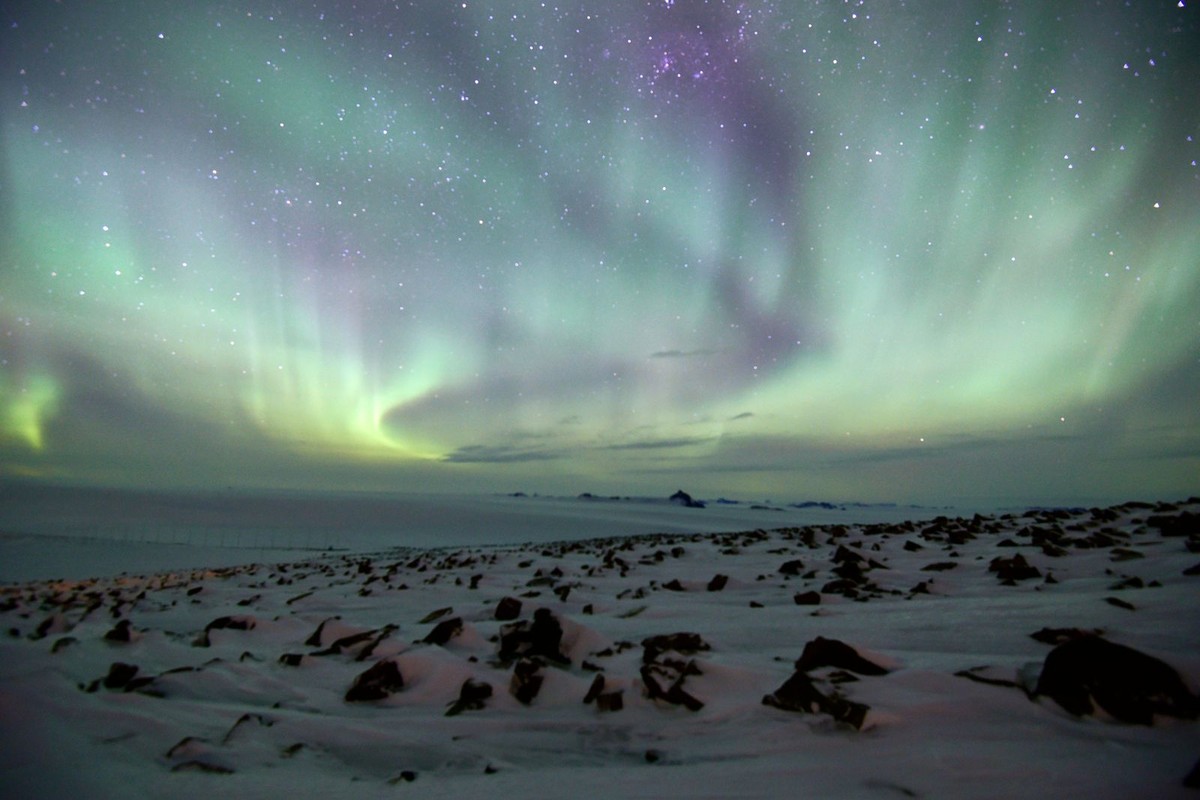
That’s how IceCube was born, built beneath the Amundsen-Scott South Pole Station. The project drilled more than 80 holes, each about a mile and a half deep, to lower over 5,000 light sensors into the ice. That effort turned an entire cubic kilometer of Antarctic ice into the largest neutrino detector on Earth. Every once in a great while, a high-energy neutrino collides with an atom inside that ice. That collision produces a flash of bluish light known as Cherenkov radiation, which the sensors record and use to trace the particle back to where it came from.
Halzen has been at this since 1987, when he started with AMANDA, the precursor experiment that proved the whole idea was viable. IceCube, the full-scale version, has been running since 2010. In 2013 it delivered the first evidence of neutrinos arriving from beyond our own galaxy. That was proof that Antarctic ice really could double as a cosmic telescope.
Why it matters: the universe can also be “heard”
Traditional astronomy relies on light: visible, infrared, X-rays. But some of the most violent events in the cosmos, like eruptions near supermassive black holes, produce different kinds of messengers: cosmic rays and neutrinos of brutal energies. Because neutrinos barely interact with anything, they travel to Earth in a straight line, without bending or losing information along the way. That’s something neither light nor charged cosmic rays can guarantee.
Thanks to IceCube, physicists have been able to point to actual sources of these high-energy neutrinos. In 2022, the observatory detected neutrino emission from NGC 1068, an active galaxy with a supermassive black hole at its core. Meanwhile, in 2023 it found evidence of high-energy neutrinos coming from the plane of our own Milky Way. In practice, this is the birth of a way of observing the cosmos that doesn’t depend on light at all. It’s called neutrino astronomy, one more piece of what’s now known as multi-messenger astronomy. If you enjoy this kind of discovery, we’ve also covered the 19-kilometer whirlpools found inside solar flares. It’s another cosmic phenomenon astrophysicists have only recently begun to understand.
A Nobel with a sense of humor
Committee chair Mark Pearce summed up Halzen’s achievement in a line that sounds pulled from a movie script: “he has given us a fantastic instrument. His tenacity and scientific vision have paved the way for a new kind of astronomy.” Halzen himself, 82 years old with a lifetime of work behind him, reacted with good humor on the phone. He said he was caught completely off guard. He also joked that he’s already drafting a proposal for an upgrade, IceCube-Gen2, with eight times more instrumented ice. “I hope winning this will help get it approved,” he added.
The award ceremony will be held in Stockholm on December 10th. In the meantime, beneath the ice at the South Pole, thousands of sensors keep waiting in silence. They’re waiting for the next blue flash that might tell them something about a black hole billions of light-years away.
Source: GPB News.