
Here’s the shaving cream trick: before you shower, rub a dab of shaving cream onto the bathroom mirror and wipe it off with a cloth. That’s it — the mirror won’t fog up no matter how hot you crank the water.
It sounds like a barbershop myth. However, it’s backed by none other than the Museum of Science in Boston, which features it in a series of hacks explained through real science. There’s also a very specific reason it works. That reason explains why so many other anti-fog home remedies are distant cousins of the same basic move. They include soapy water, a sliced potato, toothpaste, and the soap trick that stops glasses from fogging up.
How to do the shaving cream trick
- Clean the mirror or glass thoroughly first, so there’s no dust or grease left on it.
- Apply a small amount of classic canned shaving cream, not gel. Spread it into a thin, even layer with your fingers or a cloth.
- Let it sit for a minute or two.
- Wipe it off completely with a clean, dry cloth until the glass is fully clear, with no white residue or streaks left behind.
- Shower as usual. The effect typically lasts several weeks before you need to repeat it.
One key detail: you have to wipe off almost all the foam, not leave it sitting there. What’s left behind after cleaning is an invisible film, so thin you’d never notice it. Still, that film is exactly what’s doing the work.
Why it works
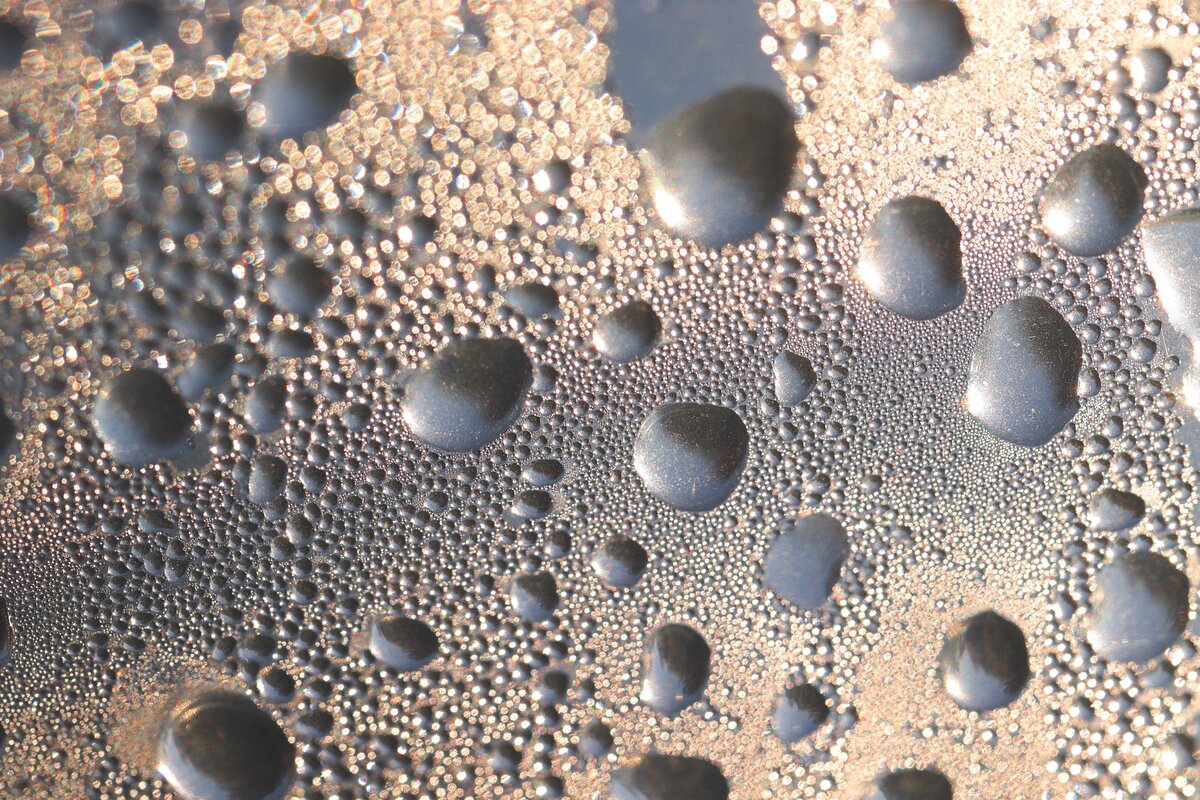
Fog is nothing more than water vapor condensing into tiny droplets on a cold surface. Each droplet acts like a miniature lens, scattering light in every direction. Millions of them together are what you see as the white haze that blocks your reflection. The glass underneath is still perfectly smooth; the problem is how the water decides to arrange itself on top of it.
Shaving cream contains surfactant molecules, the same compounds that make soap foam up. Their job is to break water’s surface tension. Without them, water tends to clump into round beads. This happens because its molecules pull toward each other more strongly than toward the glass. With the thin surfactant film left behind after wiping off the cream, water can no longer form those beads. Instead, it’s forced to spread out into a continuous, transparent sheet. There’s still moisture sitting on the mirror. Still, instead of a thousand tiny light-scattering droplets, there’s now a flat layer that lets light pass through almost undisturbed. It’s the same principle behind anti-fog sprays for diving masks or ski goggles. In fact, they don’t stop condensation: they change its shape.
One catch that rarely gets mentioned
The trick has a catch. Home-humidity specialists quoted by outlets like Ideal Home warn about something important. If steam isn’t condensing on the mirror anymore, it has to condense somewhere else. That could be the walls, the ceiling, or the paint around the bathroom. That doesn’t mean the trick is a lie: the surfactant chemistry is real and does exactly what it claims. You’re just redirecting the moisture, not getting rid of it. Therefore, if your bathroom already has poor ventilation, it’s worth running an extractor fan alongside it. That way you avoid trading a foggy mirror for a mold patch in the corner.
Either way, it’s hard to beat a cheap can of shaving cream moonlighting as a portable lab every morning. That’s everyday chemistry turned into a pocket-sized trick.