
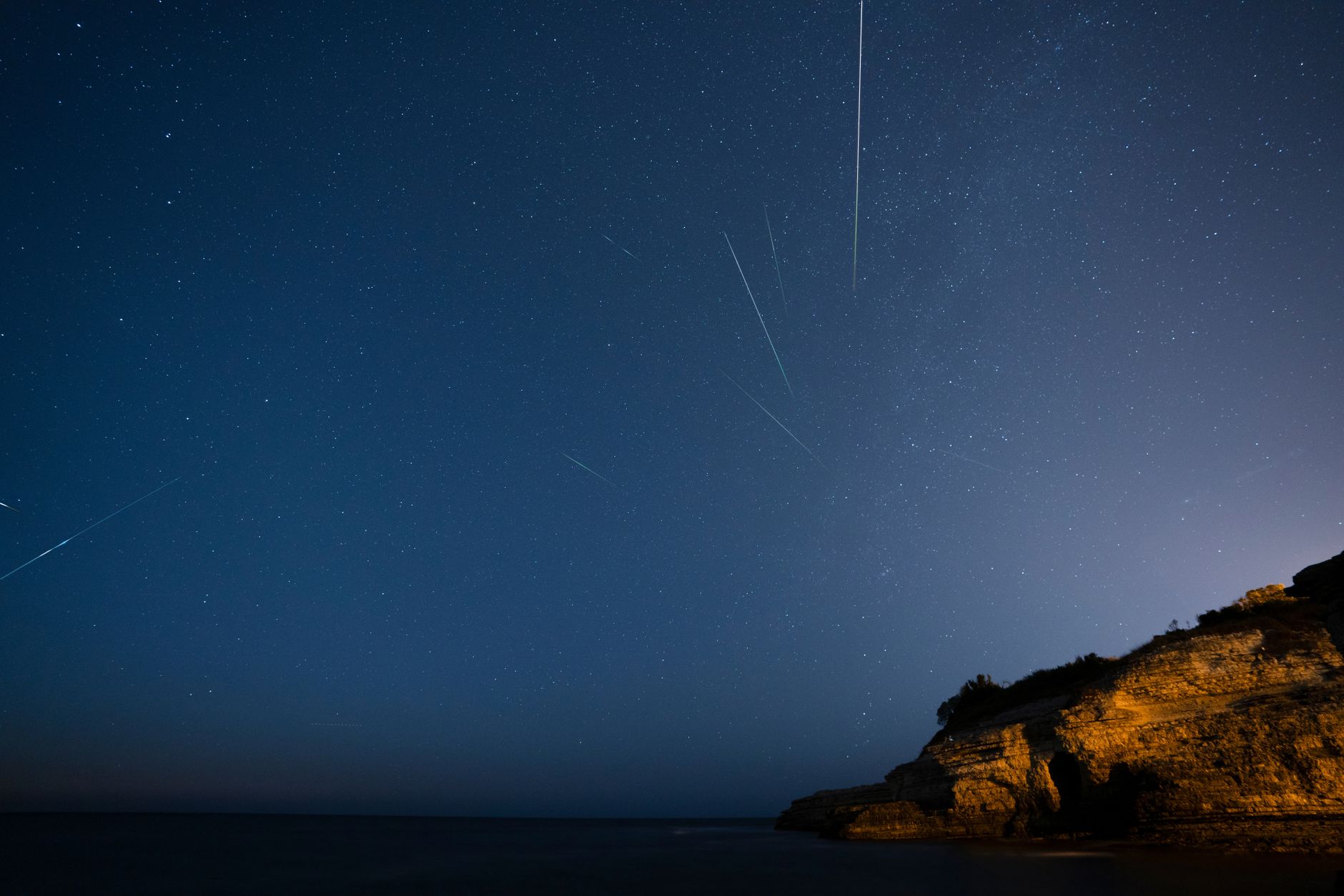
Step outside tonight between midnight and dawn and you might catch something that’s been heading your way since 1986: a speck of dust from Halley’s Comet, burning up at 66 kilometers per second as it slams into our atmosphere. These are the 2026 Orionids, one of the fastest meteor showers of the year, and their peak lands right on October 21-22, according to NASA.
How can a comet we haven’t seen since 1986 still be “raining” on us?
Halley’s Comet only swings by roughly every 76 years, but every time it gets close to the Sun it sheds a trail of dust and tiny rock fragments — like crumbs falling out of a torn grocery bag as you cross the kitchen. That trail stays parked in a fixed orbit, and Earth plows through it twice a year: once in May (giving us the Eta Aquariids) and again in October, which is when the Orionids show up. We don’t need to spot the comet itself to enjoy the show — our planet just has to cross paths with its leftovers.
The name “Orionids” comes from the fact that, if you trace these meteors’ paths backward, they all seem to radiate from a point near the constellation Orion. No need to actually find Orion first, though — the meteors themselves can streak across any part of the sky.
Why it’s worth losing a bit of sleep
The 2026 Orionids have a reputation for being fast and bright. NASA puts their atmospheric entry speed at about 66 kilometers per second (roughly 148,000 mph), making them one of the quickest showers on the calendar, second only to November’s Leonids. That extreme speed, moreover, often leaves glowing trains behind: streaks of light that linger in the sky for a few seconds after the meteor itself is long gone.
Under ideal conditions — clear sky, no light pollution, no moon — you could spot up to 20 to 23 meteors an hour. The catch this year is that the Moon will be about 80% full, which means its glare is going to wash out a good chunk of the fainter meteors. That’s not a reason to stay on the couch, but it is a reason to lower your expectations: think “a handful of pretty streaks” rather than “meteor storm.”
How to watch the 2026 Orionids without overthinking it
- No telescope or binoculars needed — meteors are actually best seen with the naked eye, since they cross huge stretches of sky in a split second.
- Find a spot away from city lights; the darker the sky, the more faint meteors become visible.
- Give your eyes time: 20 to 30 minutes in the dark to properly adjust.
- The best window is usually after midnight through dawn, when Orion sits higher in the sky.
- Lie back and scan the whole sky rather than staring at one spot — the radiant point helps you get oriented, but meteors can pop up anywhere.
The shower doesn’t shut off overnight: activity runs roughly from October 2 through November 7, so if clouds or moonlight ruin the peak night, you’ll still get more chances — just with fewer meteors per hour than at the peak.
If space debris is your thing, it’s worth also reading about the meteorite crater someone stumbled on while scouting a campsite: proof that not all space rocks stay up there.
And next time someone tells you nothing lasts forever, mention that the 2026 Orionids are proof that a comet last seen when people were still recording movies on VHS is still sending us free fireworks every autumn. Not many things in the sky are that reliable.